Re: last blog post. Two species, indeed. Pressed for time, and it will take awhile to develop the pictures and write a post. Look for it tomorrow or the day after. It’ll be interesting, if you’re into this sort of thing.
Bluets Update
Reply
Re: last blog post. Two species, indeed. Pressed for time, and it will take awhile to develop the pictures and write a post. Look for it tomorrow or the day after. It’ll be interesting, if you’re into this sort of thing.
Houstonia species
Rubiaceae
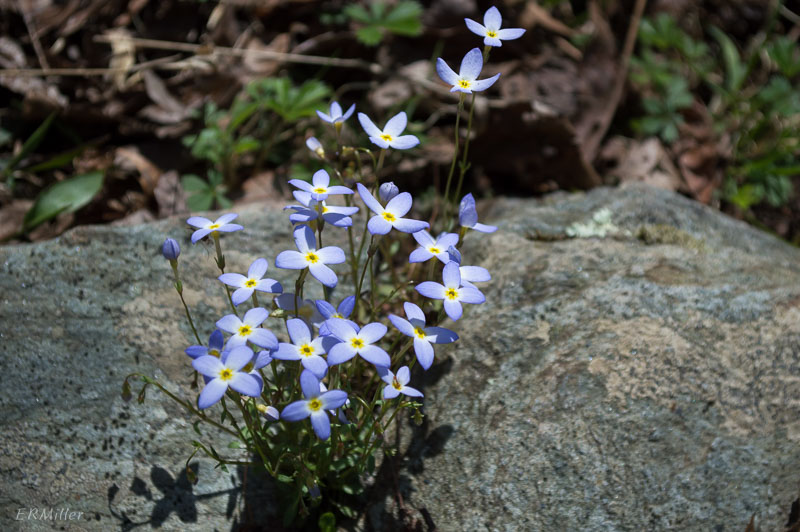 From mid-April to mid-May, the dryer, rocky soils around Carderock will be carpeted in rattlesnake weed and this adorable plant [left]. Standing only a few inches high, each stem bearing a single, terminal flower and few or no leaves, it’s very easy to identify as Houstonia caerulea (azure bluets).

Half a mile or so west on the C&O Canal towpath, come early June, you might see just a dozen or so of these plants [right] on a certain dry hillside. Standing about a foot to a foot and a half tall, with a small terminal cluster of flowers and three-nerved, oval leaves, it’s pretty easy to tell that this one is Houstonia purpurea, variously known as large bluets, woodland bluets, and Venus’ pride.

Here’s when I get into trouble. Satisfied with the identification, I fail to examine every single plant and start concentrating on taking lovely photos, until I get one that I really like.
<—– Like this one.
Yesterday, I posted that photo to an internet discussion group and was quickly challenged: isn’t this Houstonia longifolia (long-leaf bluets)? Let’s consider it, with descriptions from my three favorite ID books.*
H. purpurea: stem leaves egg-shaped or broadly lance-shaped, with 3-5 veins (Newcomb); plants erect, 6-20″, leaves rounded or notched at the base, stalked or stalkless (C&G); leaves oval, paired, sessile, entire, 3-veined (Peterson).
H. longifolia: stem leaves lance-shaped or oblong, 1-veined (Newcomb); plants erect, 4-10″, leaves narrowly oval or narrowly oblong, 1-nerved, tapering to base, stalkless (C&G); a small plant, slender paired leaves (Peterson).
Note that I didn’t describe the flowers; in all three sources the descriptions pretty much match, but more importantly, there can be a lot of morphological variation in flowers. Color is probably the worst clue, because it can vary so much. And look at the previous picture again: can you see that the topmost flower has 5 petals, while the others have 4? These things happen. To distinguish these two species, you need to examine the leaves.
Back to the question: which species is pictured? There isn’t enough information to say for sure. Only the uppermost stem leaves are shown clearly, and while they appear to be narrow and 1-veined, the same can be said of the uppermost stem leaves on the plants ID’d as H. purpurea (in other pictures; I’ll spare you). Is it possible there are two different species in a single stand of plants? Sure. Is it likely? I don’t know enough to say.
These things bother me. As I finish my third cup of coffee, I’m going to hit “publish immediately”, get my camera out, and go to the canal. If I’m lucky these plants will still be blooming and I’ll get a good look. If they aren’t, I probably won’t be able to pick them out from all the other foliage in the area.
I’ll post an update later today.
———–
*Newcomb’s Wildflower Guide; Wildflowers in the Field and Forest (Clemants and Gracie); Peterson’s Field Guide Wildflowers Northeastern/North-central North America

Monotropa uniflora
Monotropaceae or Ericaceae
(depending which authority you consult)
Last year I posted that Indian pipe is a saprophyte. Turns out that’s wrong. Not only is it wrong, but it’s been known to be wrong for ten years or so. But you still see a lot of references to “saprophytic plants” out there. Once established, a “known fact” tends to stick around. Like the tongue map myth, dispelled by Virginia Collings in 1974 – 41 years ago!
I’m usually skeptical of Wikipedia as a source of technical information, but this article on myco-heterotrophy is well-referenced. In short, rather than obtaining nutrition through photosynthesis (as chlorophyll-containing plants do), and rather than obtaining nutrition through direct breakdown of organic matter (that’s the definition of “saprophyte”), plants like Indian pipe get nutrients by parasitizing certain fungi.

Back to the plant. Monotropa means “once turned”, and uniflora means “one flowered” – a pretty good description of Indian pipe. A single flowering stem containing a few scale-like leaves emerges from the ground and forms a single pendant flower at the apex; as the plant grows, the flower will start re-orienting itself until it’s pointing upwards. And that’s pretty much it. One other species of Monotropa can be found in the US; that one (pinesap, or M. hypopithys, meaning “under pine”) has multiple flowers on the stem. Indian pipe stands only a few inches tall, and grows in clumps in deep, moist woods throughout much of the US (except the desert southwest and parts of the Rocky Mountains). Despite being wide-ranging, it’s an unusual find, perhaps because of the very specific growing conditions.

Trivia: Indian pipe was a favorite of poet Emily Dickinson.
Scutellaria elliptica
Lamiaceae
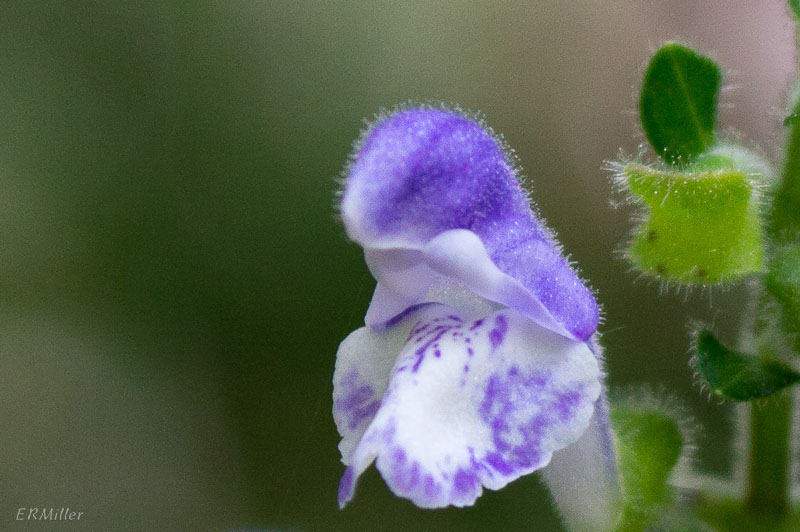
Don’t you just love common names sometimes?
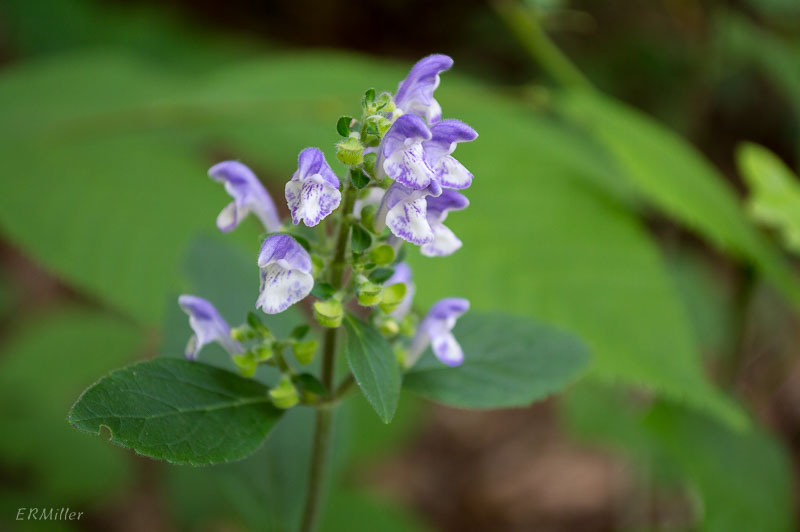
This woodland forb is one of only a few plants blooming now in the Gorge. It ranges from New York and Michigan south to Florida and Texas. There are more than 40 other native species of Scutellaria scattered throughout the US, ten of which can be found in Maryland. With the exception of veiny skullcap last year (but not this year), I’ve never seen any of the others. In the Gorge you’ll find hairy skullcap in the drier soils and rocky areas well above river level, especially in the vicinity of Carderock and the Marsden Tract.

I’ve never come across it in the nursery trade and wonder why. Although somewhat short at 2 1/2 feet tall, it would make a lovely addition to a partly shady perennial border, for the inflorescence is quite showy and lasts several weeks. It is an inconspicuous plant without the flowers, though. Maybe that’s why.

Sambucus canadensis, aka
Sambucus nigra ssp. canadensis
Caprifoliaceae
Elderberry is a small, many-stemmed shrub, found in the woodland understory in riparian areas all over the US, except for a few states in the West and Northwest.
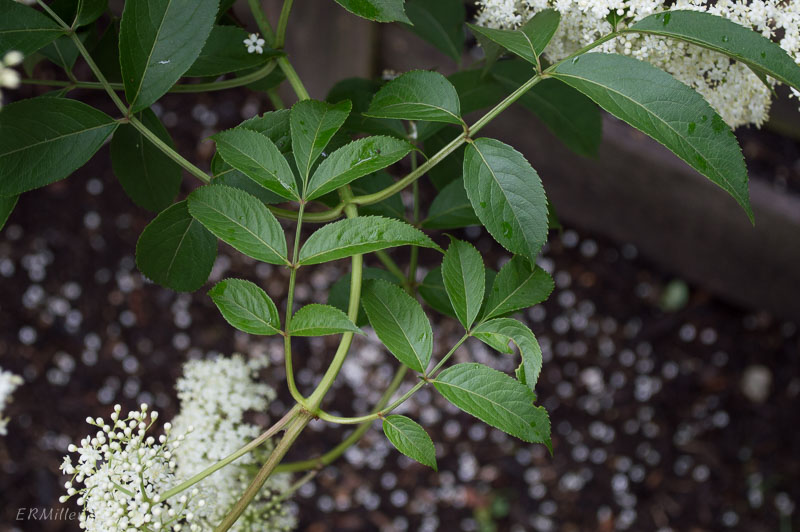
The foliage is lush, with odd-pinnate compound leaves,

and in good growing conditions masses of tiny flowers in large, umbel-like panicles.

You won’t see it growing like this in the wild, though. This is an established specimen in my garden.
Elderberry is useful, providing good food and cover to wildlife and useful wood to humans. (And fruit, of course, though not commercially.) All the ecology, horticulture, and ethnobotany you’d care to know can be found on this USDA page.
Maybe I should re-name this site “Elizabeth’s Flowering Tree Blog”. Between rain and commitments to other projects, I haven’t been getting out to the Gorge much. And when I do, tree flowers are what I’m seeing.
 Elizabeth's Wildflower Blog