Three Blue Violets

20160507-_DSC0014

Violets are notoriously tricky to identify, especially the blue ones. First, some of the characteristics are rather subjective (eg “leaves somewhat rounder than other species”). Second, they are known to hybridize freely. And third, taxonomists frequently re-name them.

Nonetheless, I am reasonably confident that I have these three correct. As always, please leave a comment if you feel differently.

20150417-20150417-_DSC0035

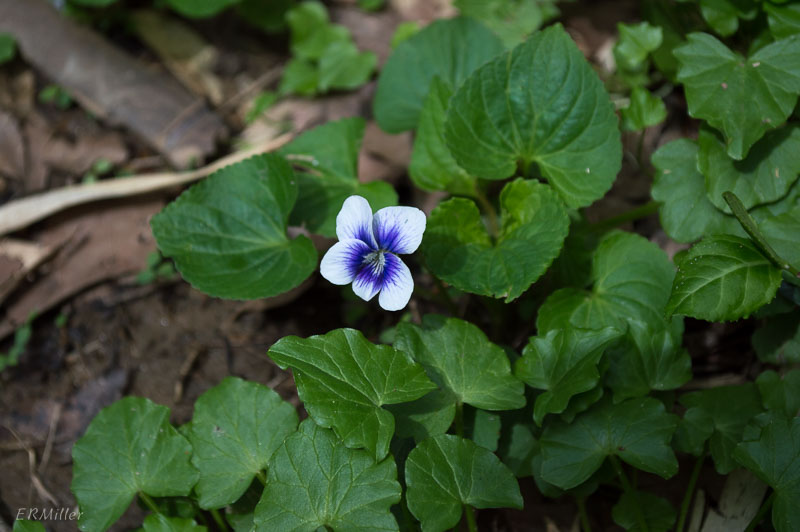
common blue violet
Viola sororia
(formerly V. papillonacea)

This violet is found from Quebec to Florida and east into the Great Plains, in many different habitats, including peoples’ lawns, where it’s considered a weed. I’m more likely to think of turfgrass as weeds.

20160505-_DSC0041

marsh blue violet
Viola cucullata

The primary way to distinguish marsh blue from common blue is to consider the habitat. This group of plants was growing on a mossy mound in the middle of a stream. I’ve seen others growing right in the water. Note also that the flowers rise well above the leaves (mostly), while in common blue flowers and leaves are about the same height (mostly). Marsh blue has a range similar to common blue, though it isn’t found quite as far west or south.

20160505-_DSC0127

ovate-leaved violet
Viola sagittata var. ovata
(formerly V. fimbriatula)

You can see that this one has a somewhat longer leaf from the previous two. Also, the habitat was drier: it was growing on a slope in an area dominated by mountain laurel, with other ericaceous species (namely Vacciniums) and two different pine species nearby. This species doesn’t range as far south as the other two, and goes west only into some of the Midwest states.

One characteristic you should not rely on for identification of blue violets: color. It can vary wildly. Have a look at this:

20150420-20150420-_DSC0016

This is common blue violet… white form.

Sugarloaf, May 5

20160505-_DSC0042

pinxter azalea in all its glory


Went back to Sugarloaf Mountain on May 5 and spent all morning hunting for lady slipper orchids. I didn’t find any, but I did find some other things that I haven’t seen before (more about those in the next few days). The list of plants in bloom:

  • sweet cicely
  • dwarf cinquefoil
  • Indian cucumber root
  • flowering dogwood
  • common fleabane
  • mountain laurel (just two buds open)
  • pinxter azalea
  • Rubus species (unknown which, probably a dewberry or blackberry)
  • rue anemone
  • Gray’s sedge
  • wild sarsaparilla
  • false Solomon’s seal (buds not quite open)
  • marsh blue violet
  • ovate-leaved violet
  • spotted wintergreen (buds)

Also I saw great stands of royal fern and cinnamon fern, and some nice specimens of scrub pine (Pinus virginiana) and white pine (Pinus strobus).

Most trees seem to be fully leafed out but the leaves are still small and pale; on that gloomy, misty morning the pinxters stood out like beacons in the forest. Mountain laurel buds are swollen, and by the time this post is published they should be opening. Since mountain laurel is one of the dominant understory plants at Sugarloaf, it will be a fabulous show.

20160505-_DSC0099

mountain laurel about to pop

Two Wood-Sorrels

20150507-20150507-_DSC0067

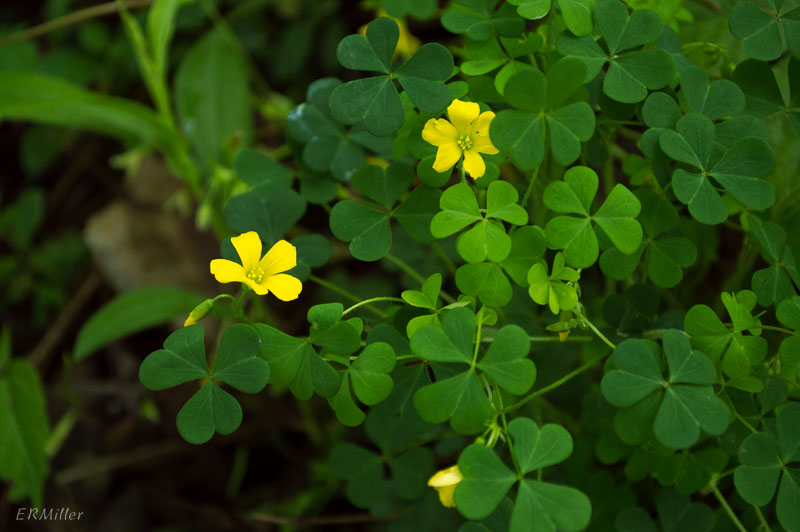
common or yellow wood sorrel
Oxalis stricta
Oxalidaceae

20160425-_DSC0179


violet wood sorrel
Oxalis violacea
Oxalidaceae


The yellow-flowering species is derided by some [hi, Linda!] as a real nuisance plant. It is pretty, though. Is it a weed? Not when I find it in a natural setting like the Potomac gorge, where it doesn’t seem to grow in large swaths like it does in the garden. Yellow wood-sorrel is found all over the US except Oregon, California, Nevada, and Utah, and is listed as a weed by some authorities. It seems to have a long bloom period in the wild.

Violet wood-sorrel is found in all US states except Montana, Idaho, Washington, California, Nevada, and Utah. The plants hug the ground, but the flowers stand a few inches taller than the yellow species, and it doesn’t bloom as long. I’ve seen it in the gorge forming carpets as large as half a square meter. Before blooming, the leaves often have a violet tinge, especially on the edges, but it always seems to be gone by bloom time. A large patch never seems to produce more than a few flowers, but then this is only the third year I’ve observed it.

Scan

I feel it’s time to re-post this.
<————


Two Geraniums

20160425-_DSC0192

wild, wood, or spotted
geranium; cranesbill—>
Geranium maculatum
Geraniaceae

20160425-_DSC0136

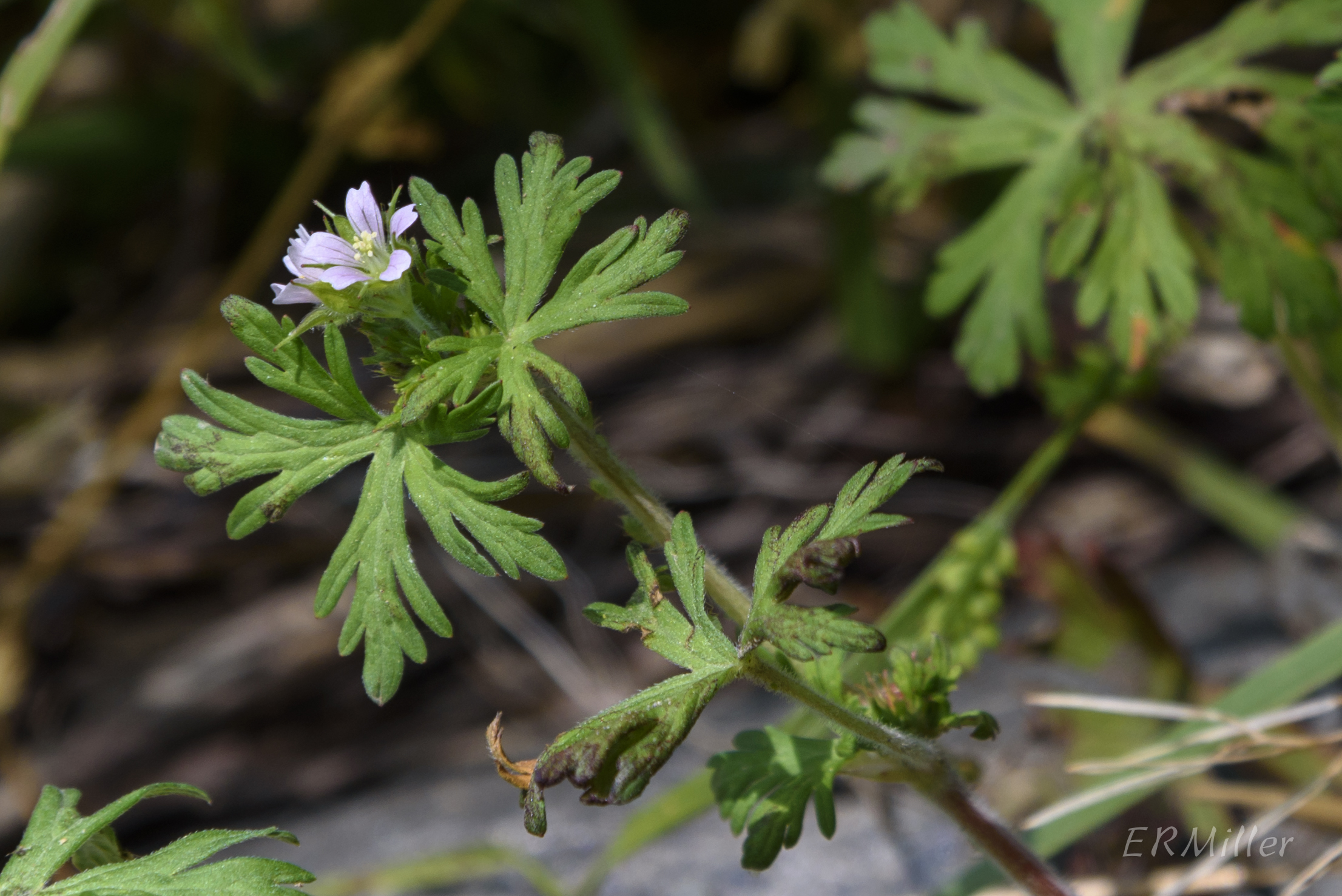
Carolina cranesbill
Geranium carolinianum var. carolinianum
Geraniaceae [below]

These are the only two native geraniums easily found in the Maryland piedmont. There’s a third species (G. bicknellii) that might be present, and a fourth (G. robertianum) that is listed S1, so spotting it is unlikely. There are also half a dozen or so alien geraniums present in the state.

DSC_0021

Carolina cranesbill is found in all US states except Colorado, and most of Canada except the far north and the maritime provinces. It is listed as weedy by some authorities. It grows best in poor soils, which may explain why I first found it growing from cracks in the concrete curb in the Carderock parking lot.  [right] The other place I’ve spotted it is on the rocky promontories that jut into the Potomac downstream of Carderock.

20160426-_DSC0074

Wild geranium is found in the the eastern US, most of the south and midwest, and somewhat into the great plains states. It prefers moister, richer soils than Carolina cranesbill; watch for it in open woodlands in the piedmont. Wild geranium is lovely in the home garden, and so far in my garden it’s been rabbit-resistant. There are native plant sellers around who carry it. The one I planted last spring has about tripled in size and is blooming profusely.

Buttercups, Native and Alien

To answer a question left in the comments of my previous post, all three of those species of buttercups are natives. As luck would have it, today is cold and rainy and I’m in the mood to do a little research, so for anyone interested, here’s a rundown of buttercups in Maryland.

The Biota of North America Program’s North American Plant Atlas lists twelve native and five alien Ranunculus species present in the state of Maryland. The Maryland Biodiversity Project adds one each native and alien to the list.

Natives:

Ranunculus abortivus  little leaved buttercup; common, found in most of Maryland

R. allegheniensis  Allegheny Mountain buttercup; supposedly found in Maryland, but no county data in BONAP and no records in MBP; state rank is S3

R. ambigens  water-plantain spearwort; state rank is historical, state status is endangered extirpated

R. caricetorum  swamp buttercup; not in BONAP; in MBP with no records; per the Integrated Taxonomic Information Service the species is now R. hispidus var. caricetorum

R. fascicularis  early buttercup; state rank is S1, state status is endangered; MBP has records in Howard, Prince Georges, and Washington counties

R. flabellaris  yellow water-buttercup; state rank is S1, state status is endangered; MBP has records in Montgomery and Prince Georges counties

R. hederaceus  ivy buttercup; state rank is S1, state status is endangered; MBP has records in Prince Georges and Charles counties

R. hispidus  bristly or hispid buttercup; very common, found throughout the piedmont

R. laxicaulis  Mississippi buttercup; state rank is S1, state status is endangered; MBP has records in Worchester county

R. micranthus  rock buttercup; found in southern piedmont (Howard and Montgomery counties)

R. pensylvanicus  Pennsylvania buttercup; state rank is historical, state status is endangered extirpated

R. pusillus  low spearwort; found in southern piedmont but status is uncertain

R. recurvatus  hooked buttercup, blisterwort; common, found throughout the piedmont

R. sceleratus  cursed buttercup; found in most of the piedmont

R. trichophyllus  thread-leaved buttercup or white water-crowfoot; no records in MBP; state rank is S1, state status is endangered; per ITIS it’s now R. aquatilis var. diffusus

The Maryland Department of Natural Resources’ Rare, Threatened, and Endangered Plants of Maryland (April 2010) list adds the species R. carolinianus, with state rank uncertain and state status endangered extirpated.

In the Maryland Piedmont, there are only five native buttercups you’re likely to encounter; they’re the ones in bold above. And, there are three alien species that you’re very likely to encounter (in bold below).

Aliens:

R. acris  tall buttercup; common, found in the southern piedmont

R. arvensis   corn buttercup; not in BONAP, no records in MBP

R. bulbosus  bulbous buttercup; common, found in all of the piedmont

R. parviflorus  small flowered buttercup; not found in the piedmont

R. repens  creeping buttercup; common, found in most of the piedmont

R. sardous  hairy buttercup;  not found in the piedmont

All eight of these commonly encountered species are described in the New England Wild Flower Society’s excellent website Go Botany. Please, before you go pulling any plants on your property, do some research and make sure you’re pulling the aliens!

Regrets that I’m unable to photo-illustrate any of these species (except the three I posted about this morning).

I can’t write about alien buttercups without mentioning the notorious fig buttercup, aka lesser celandine, Ranunculus ficaria. Many sources (like BONAP and MBP) will list this plant as Ficaria verna, but by any other name it’s a buttercup and one of the worst invasives we have. See my post from March 31.