 Ah, violets. How can something so small, delicate, and beautiful be so vexing?
Last year I wrote about Viola blanda (sweet white violet), then updated my post to say that the plant pictured might be Viola primulifolia (primrose-leaved violet). When I went back to Rachel Carson Conservation Park last week, my third goal was to find these plants and get a definitive ID.
I’m so naive.
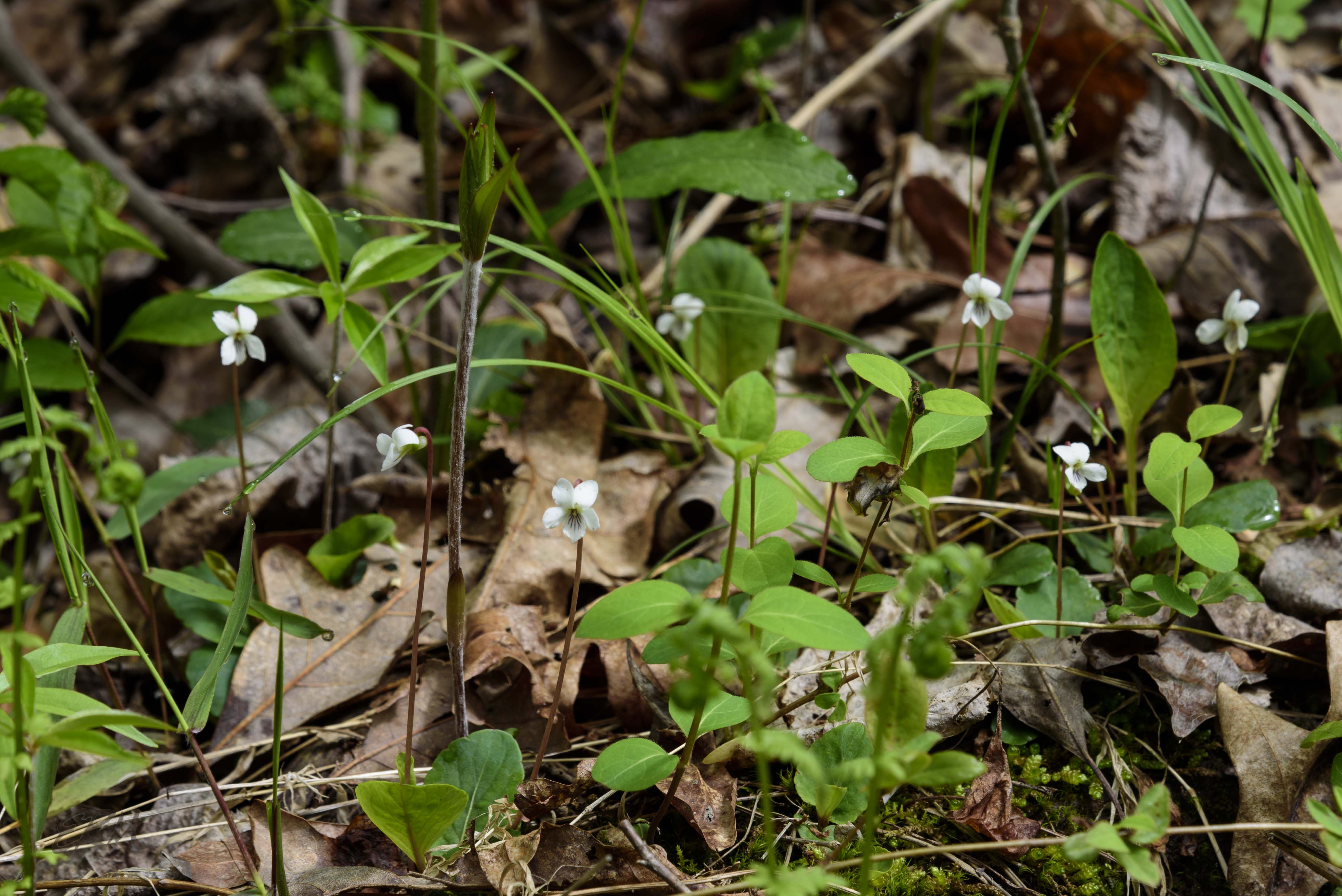
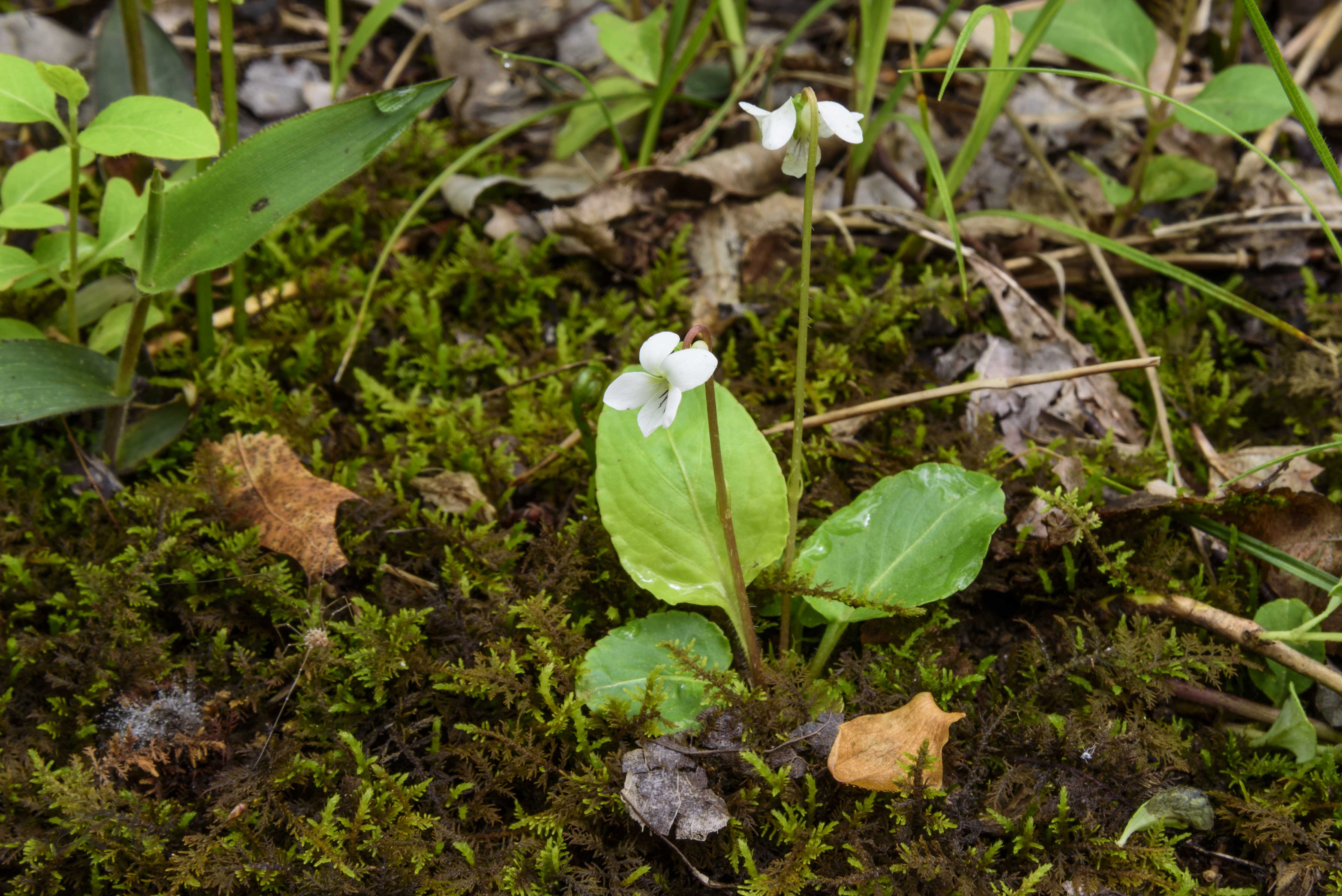
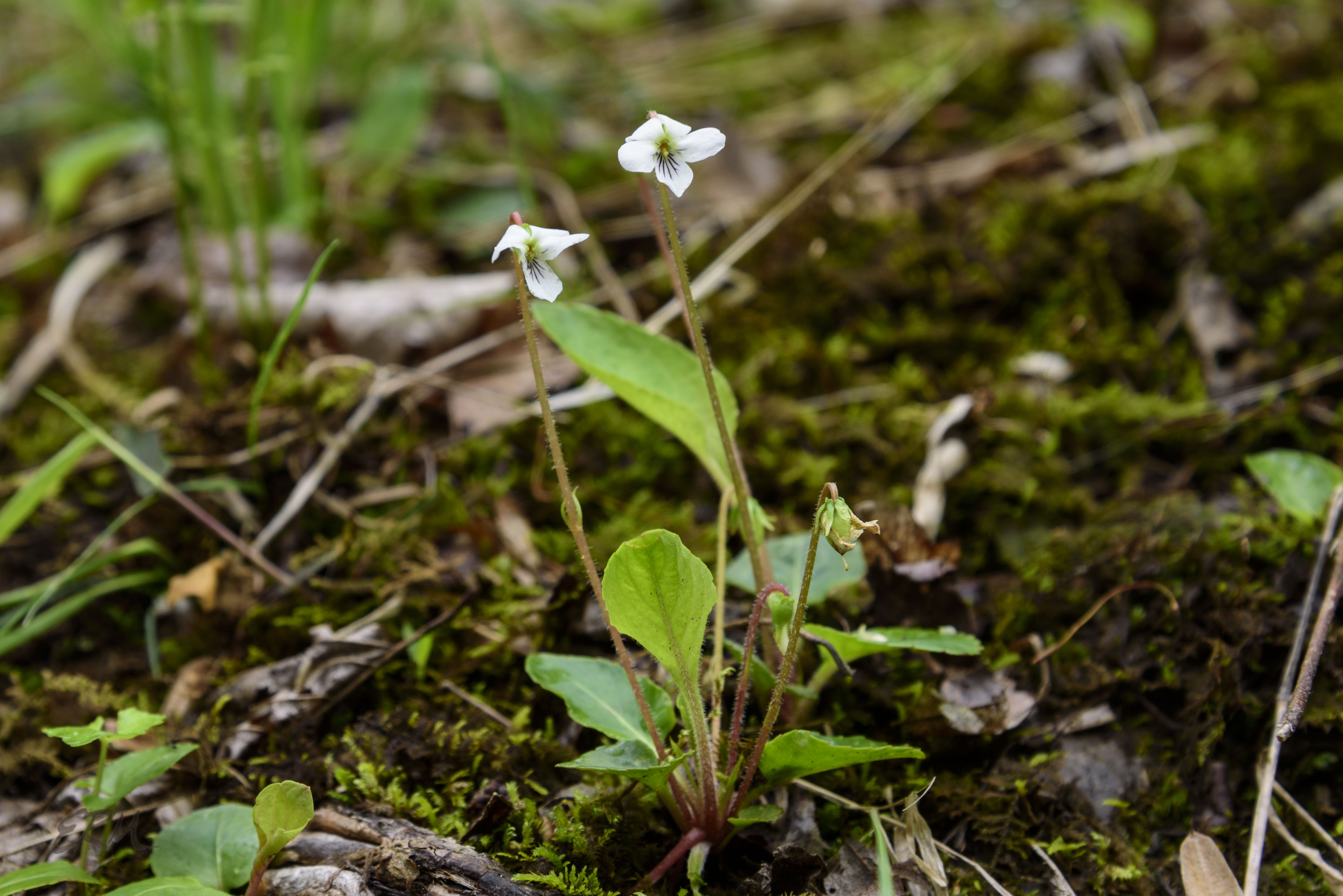
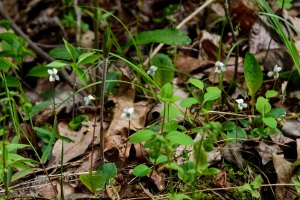 I did find a nice stand of them, in the same place where I saw a single plant last year. With Weakley’s Flora* downloaded to iBooks on my iPhone, I perched on a rock near the trail, took out my hand lens and measuring tape, and got to work.
First step: read about the genus.
Identification notes: Viola has presented numerous problems in taxonomy, distribution, and identification…
Oh, yay. But, I knew this.
Particularly troublesome are the so- called “acaulescent blue violets”, including V. sororia, V. sagittata, V. palmata, V. septemloba, etc. They may be difficult to identify due to morphological overlap, or trying to key plants without mature leaves; in some instances hybridization may be suspect. Leaf maturity is an important feature to recognize–the earliest 1-2 leaves produced in most of these taxa are generally ovate-cordate in outline and may not display characteristic lobing, toothing, or pubescence until more mature leaves are produced, 1-2 weeks later. Specimens thus collected early in the flowering period can present the botanist with a perplexing series of plants that do not key cleanly. [emphasis mine]
 Interesting, and worth keeping in mind about leaf morphology and maturity, but I was looking at white violets, not blue. So continuing…
A second troublesome group contains the small white violets, including V. blanda, V. incognita, and V. macloskeyi. These taxa have been dealt with in various ways, but resist a wholly satisfactory treatment, due to apparent hybridization…
So now what? Soldier on, use the keys. There are four of them. Four keys for a single genus.
Key C – Acaulescent Violets with stolons and white (or rarely blue) flowers
That’s the one. “Acaulescent” means “without stem”. This amuses me, because violets have stems. A major distinguishing feature among violets is that some have only basal leaves, while others have caulescent leaves (leaves on the flowering stems). I’m not sure why basal-only is termed “acaulescent”, but whatever. These plants had white flowers and no stem leaves, so Key C it was.
First couplet:
1. Flowers generally blue…
1. Flowers white…
Hey, this is easy! Second couplet:
2. Leaf blades > 1.5× as long as broad.
2. Leaf blades < 1.5× as long as broad.
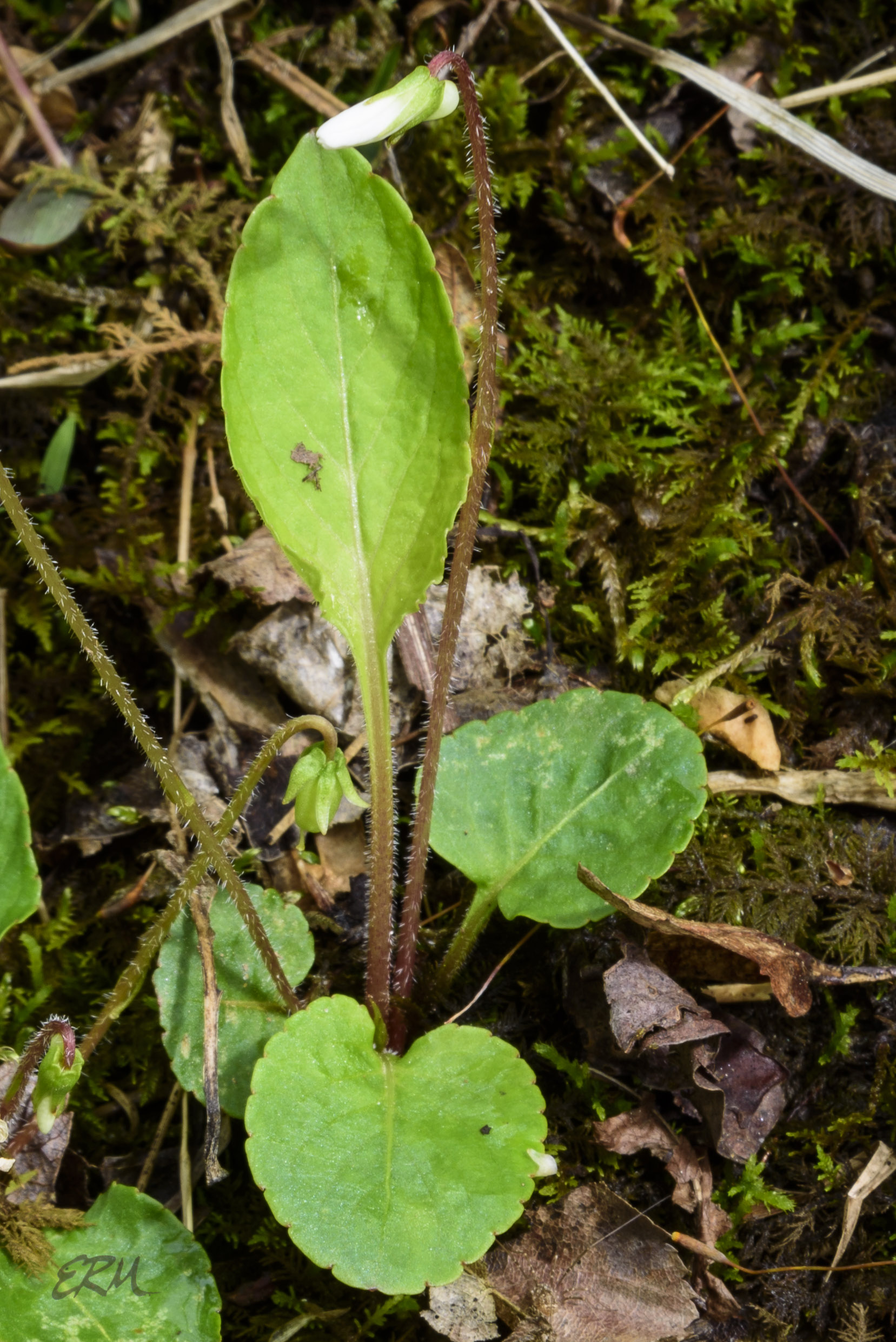
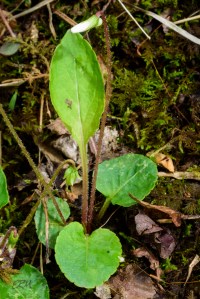 Got the measuring tape, checked a few leaves… uh oh. Which leaves to measure? Each plant had several low leaves and a single larger, more upright leaf. Is that the mature leaf I should be measuring? “Leaf maturity is an important feature to recognize…” Oh, right. So I measured a few mature leaves and found that on average, they are exactly one and a half times as long as they are broad. (A few are very slightly more, and a few are very slightly less.)
The thing about nature is that it refuses to be put into neat categories. Keys are great, but they can never account for every variation. When using keys the rule is: examine multiple specimens and go with the best fit, even if it isn’t a precise fit. But I really didn’t know where to go here, so I decided to follow both leads to see what happens.
The first line of the couplet above leads to
3. Leaf blades ovate-lanceolate to ovate-triangular, 1.5-2× as long as broad, the base broadly rounded to subtruncate… V. primulifolia
3. Leaf blades lanceolate to linear-lanceolate, 3-15× as long as broad, base narrowly cuneate and somewhat decurrent onto petiole.
This had me scratching my head. For the most part the leaves were more ovate-triangular (first line), but the bases were more often cuneate and decurrent (second line). Since neither of these descriptions quite fit, but the first one was closer, I kept it in mind as a possibility and went back to the second line of couplet two (leaf blades less than one and a half times long as broad):
5. Leaf blades completely glabrous (petioles may be villous); [of wet, acidic seepage or swampy woods, often with Sphagnum]… V. pallens
5. Leaf blades pubescent, at least on the upper surface of the basal lobes; [of wet to more mesic situations]
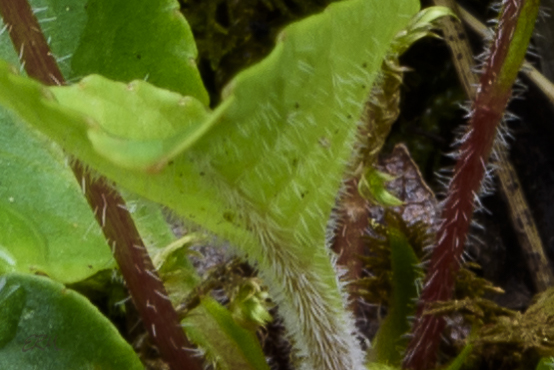
 Most of the leaves were slightly to very pubescent. Also, these plants were found in a wet area, so the habitat description works, too. I chose the second line, which led to:
6. Lateral petals glabrous within; petioles and peduncles usually reddish-tinged; leaf apex acute; basal lobes of the leaf often overlapping; pubescence of the upper leaf surface often restricted to the basal lobes; [of mesic, often nutrient-rich forests]… V. blanda
6. Lateral petals bearded within; petioles and reduncles [sic] green; leaf apex obtuse to rounded; basal lobes of the leaf not overlapping; pubescence of the upper leaf surface usually widespread; [of mesic to wet situations]… V. incognita
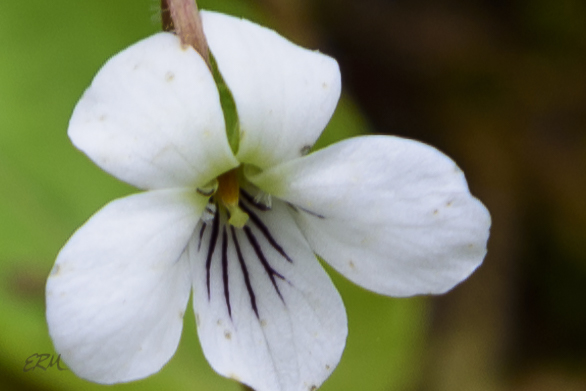
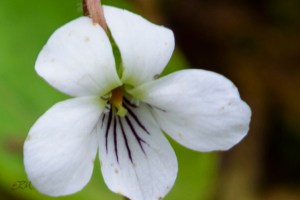 The lateral petals were very slightly bearded, not glabrous, but the petioles and peduncles were reddish-tinged; the leaf tips were acute, but the basal lobes of the leaves were not overlapping. The pubescence was more widespread on some plants than others.
At this point I didn’t know what to think, so I turned to the internet and a few books to get descriptions of V. primulifolia and V. blanda. I’ll spare you the details, other than to say that according to Illinois Wildflowers, V. primulifolia sometimes has slightly bearded petals.
In the end it came down to looking at pictures. From all that I saw, the mature leaves of these plants look a lot more like V. primulifolia. The final check was location: are the two species found in Montgomery County? V. primulifolia is, V. blanda is not.
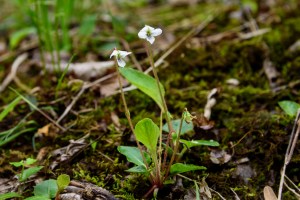
So with the information available and my understanding of the terminology, I’ve reached the conclusion that these are primrose-leaved violet.
Going through an exercise like this is tedious, but I do it in part to teach myself botany. How else can we learn but to question everything? I welcome discussion in the comments section, especially if you think I got something wrong.
*Weakley’s Flora can be downloaded from the University of North Carolina Herbarium website









 Elizabeth's Wildflower Blog