Beautiful Leaves

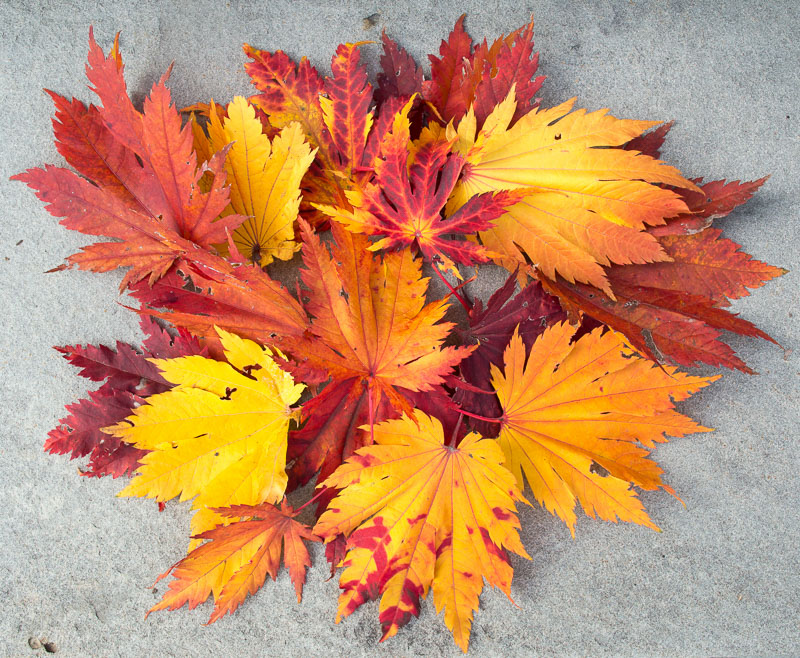
20141108-_DSC0023

It’s hard to keep up a wildflower blog in December in the mid-Atlantic, so I’m taking a break.  Expect only a few posts over the next few months.  If we have a typical (whatever that means) winter, by mid or late March the spring beauties and harbinger-of-spring will be coming back, and so will I.

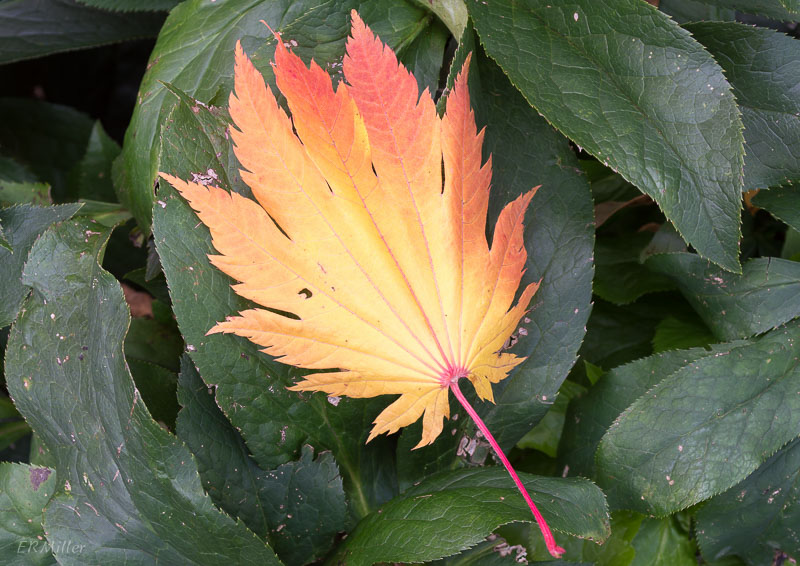
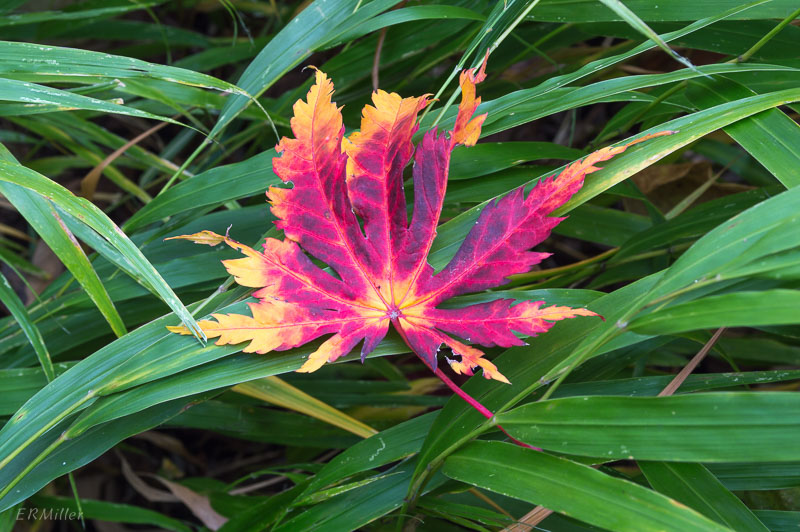
In the meantime, here are a few pictures from a full-moon maple (Acer japonicum) in my front yard.  This is an extraordinary tree of graceful form and bright autumn color, and rather unusual to find in the nursery trade.  Much more common is Japanese maple (Acer palmatum).

And one more rant about common names vs. botanical names.  I didn’t mix it up. You’d expect Japanese maple to be A. japonicum, but nope!  Japanese maple = A. palmatum; full-moon maple = A. japonicum.

These pictures are corrected for exposure but otherwise untouched.  The colors really are this vivid.

20141108-_DSC0029

maple leaf on hellebores (Helleborus hybrids)


20141108-_DSC0007


maple leaf on Japanese forest grass (Hakonechloa macra)


20141108-_DSC0012


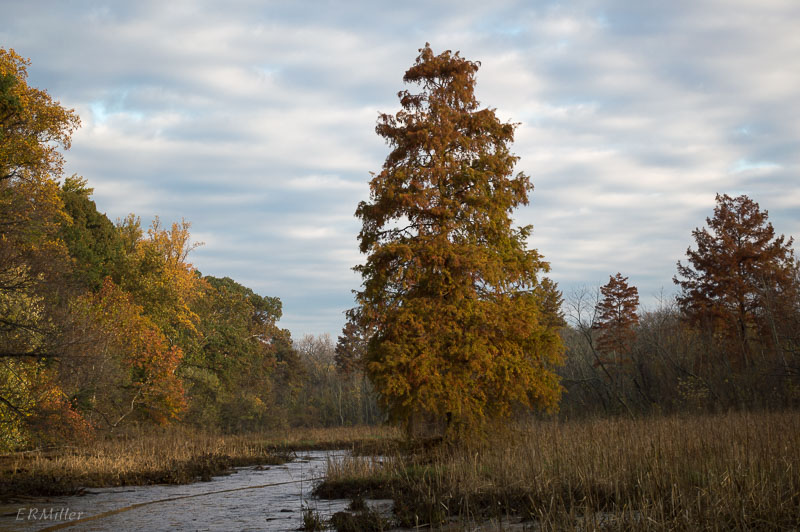
Tree of the Day: Bald Cypress

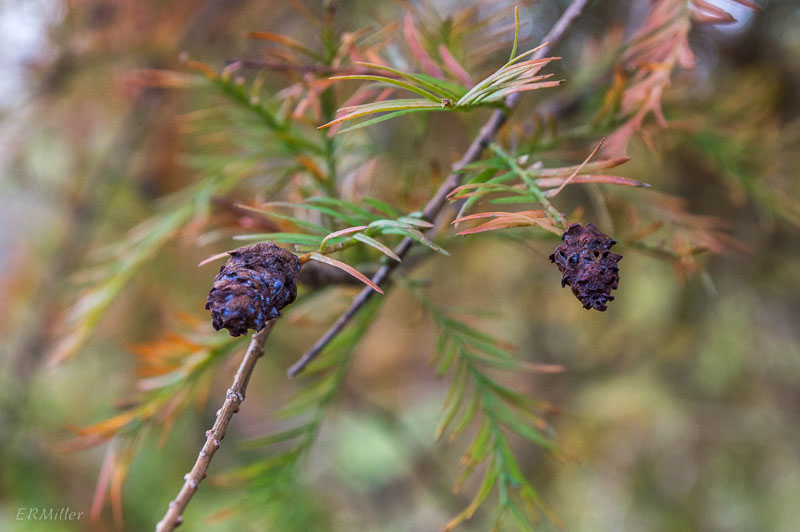
Taxodium distichum; Cupressaceae (cypress family; some authorities place it in the redwood family)

_DSC0224

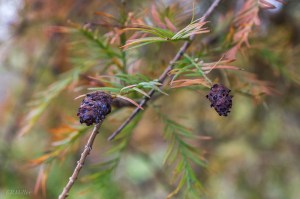
This time I’m not cheating!  The bald cypress is actually found in the Potomac gorge, though just barely: there are a few stands on Theodore Roosevelt Island, which is at the southern (downstream) end of the gorge, well within the Coastal Plain region.

The USDA lists bald cypress occurring from Texas to New York (threatened in Indiana), but according to the US Forest Service, it’s a tree of the Atlantic and Gulf coastal plains (and inland in the Mississippi river valley), growing no further north than Delaware.

Either way I was tickled to find a few specimens so close to home.

The bald cypress is a large, long-lived tree.  The tallest known is 145 feet tall and almost 18 feet in diameter.  The oldest known specimen (located in North Carolina) is believed to be more than 1,620 years old.

There are two other species of Taxodium (or not, depending on which taxonomist you’re consulting).  All three are native to the southereastern US and found nowhere else in the world.
_DSC0265

An unusual thing about bald cypress: it’s a deciduous conifer.

In conversation people often misuse the terms “conifer” and “evergreen”, possibly because most conifers are evergreen.  But not all evergreens are conifers – not even close.  Let me explain….

Conifers are cone-bearing trees: pines, spruces, firs, junipers, and so on.  They have characteristically scale-like or narrow leaves called needles.

The words “evergreen” and “deciduous” describe the way trees hang on to their leaves.  Deciduous trees shed all their leaves at about the same time – usually during the autumn, sometimes (as with American beech and some species of oak) during the winter.  But regardless, each leaf lasts for only one year.

Evergreen trees shed some leaves every year, but each leaf stays on the tree for several years before falling off.  Most needle-leaved species are evergreen, but there are a large number of broadleaf evergreen plants, like southern magnolia (Magnolia grandiflora), some viburnums, cherrylaurel, rhododendrons, live oak (Quercus virginiana).  And some plants might be either deciduous or evergreen, depending on where they’re growing.  Sweetbay magnolia is one example.

As for deciduous conifers, there are only a few: the dozen or so in the genus Larix (the larches), the three in Taxodium, and Metasequoia, Pseudolarix, and Glyptostrobus (each of these genera contain a single species).  So that’s only 14-21 species of trees worldwide.


Slope Fen, Cape Breton Highlands

20140915-DSC_0195

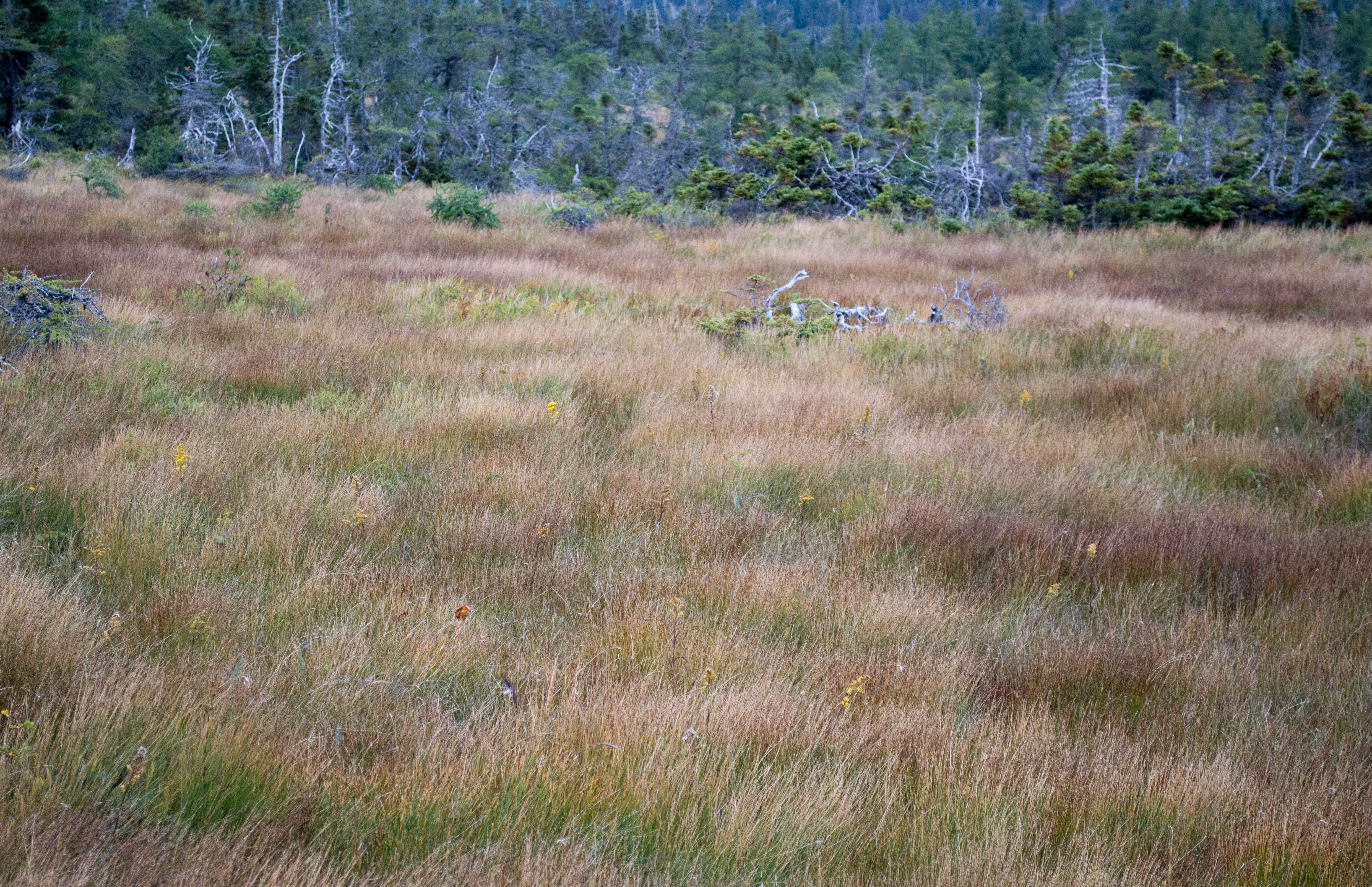
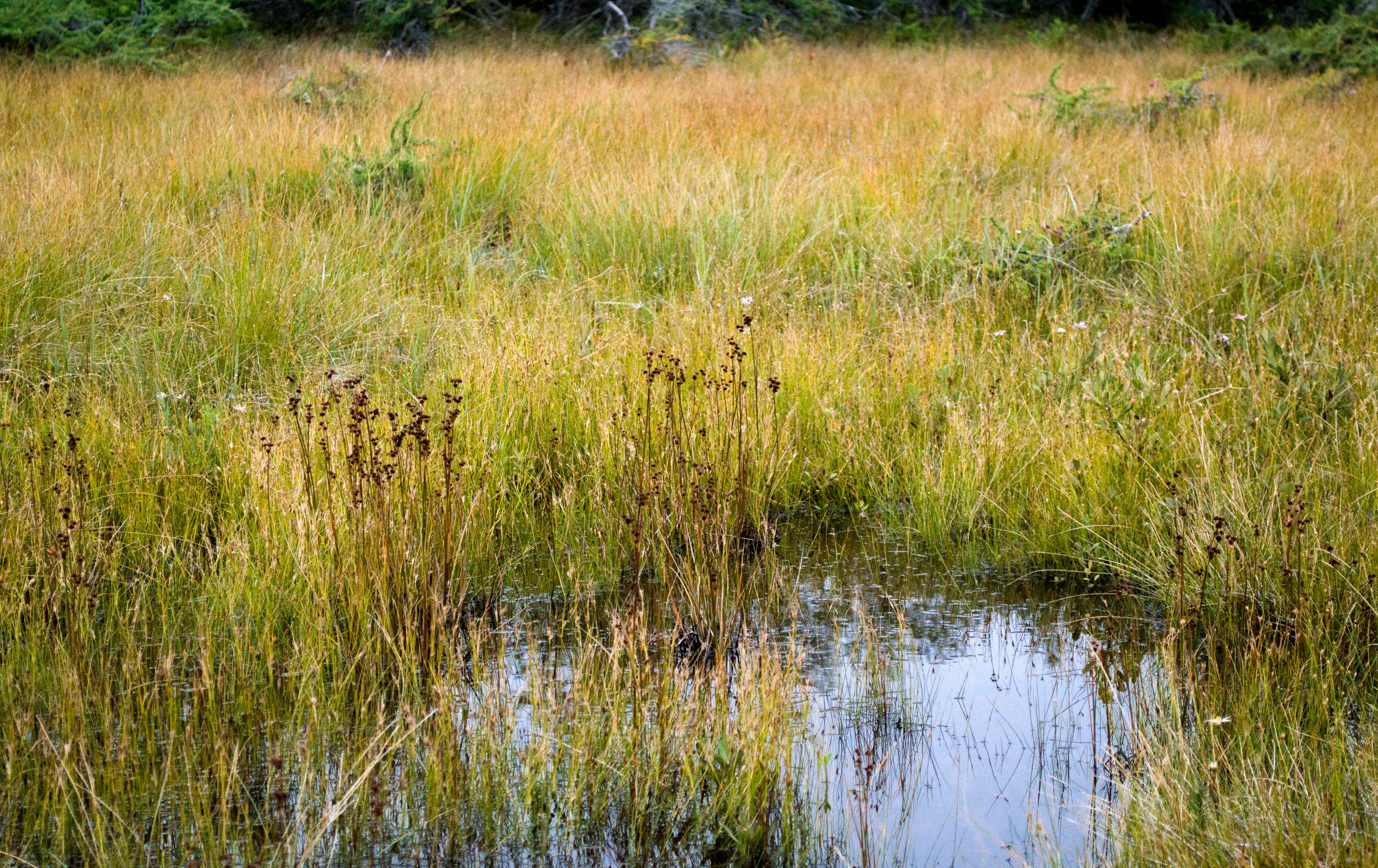
Looks like a grassland at the edge of the boreal forest, doesn’t it?  Actually, it’s a slope fen; there’s water flowing very, very slowly under there.  You can’t walk across it, but there is a boardwalk around it.  There are a few open pools of water within.

20140915-DSC_0203

So you might be wondering, as I did, what distinguishes a fen from a bog, or from any other type of wetland?  And what exactly is a wetland?

According to Lewis Cowardin of the US Fish and Wildlife Service, “wetlands are lands where saturation with water is the dominant factor determining the nature of soil development and the types of plant and animal communities living in the soil and on its surface (December 1979).”

There are four main types of wetlands: marshes, swamps, bogs, and fens.

Marshes are wetlands dominated by herbaceous vegetation.  Most of the water in marshes comes from the surface, but in many cases groundwater is also a source.

Swamps are wetlands dominated by woody vegetation.  There are a few swamps on the Maryland side of the Potomac gorge.  Long-tube valerian, winged monkey flower, and lizard’s tail are some of the wildflowers I’ve found there.

Bogs are wetlands formed by the growth of sphagnum moss either over a pond, filling it in, or over land, preventing water from evaporating.  Either process results in a wetland characterized by very acidic water and a low amount of nutrients.  Not many plants are well adapted to these conditions.  Regardless, the bottom of a bog is generally impermeable, so most of a bog’s water comes from precipitation.

A fen is basically a bog that receives some groundwater; as a result, fens have more nutrients and less acidic water.  They support a broader range of plants than bogs do.

Bogs and fens are found mostly in the higher latitudes of the northern hemisphere, and in some alpine areas in the middle latitudes.  There are no bogs or fens in the Potomac gorge.

20140915-DSC_0197-2

A slope fen is exactly what you’d think it is: a fen situated on  gently sloping land. Sadly I did not learn the names of most of the plants I found here, though I believe the area is dominated by rushes, not grasses.  (Hmm, now I have an idea for another blog post.) 20140915-DSC_0200

If you click on the first picture and zoom in, you’ll see some goldenrods and a northern pitcher plant.

In case you were wondering, the sevenangle pipewort featured on November 26 was found in the shallows of a very large pond, not in this slope fen.


The Potomac Gorge

20141024-_DSC0042

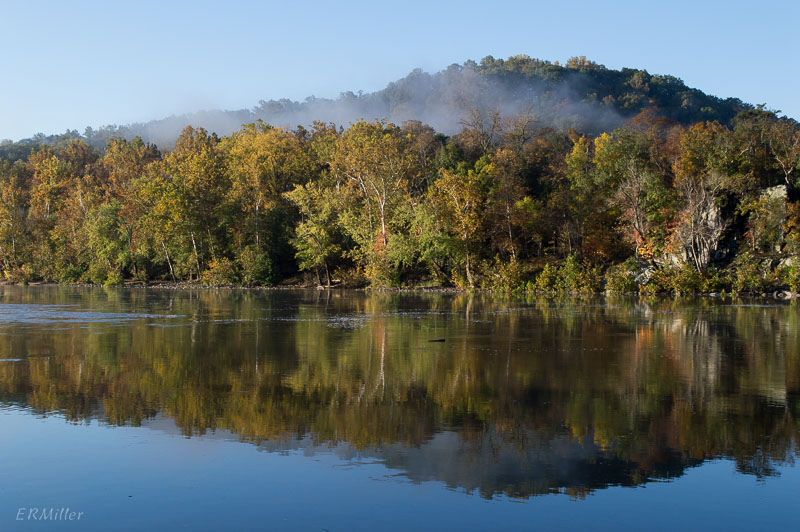
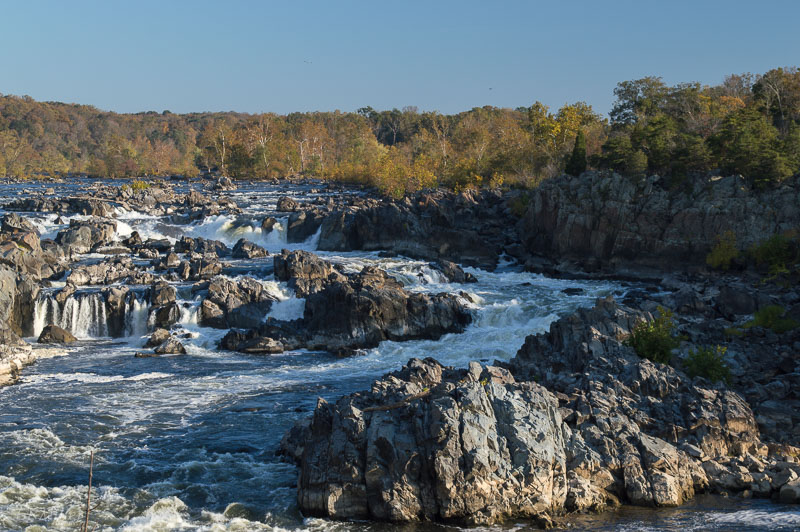
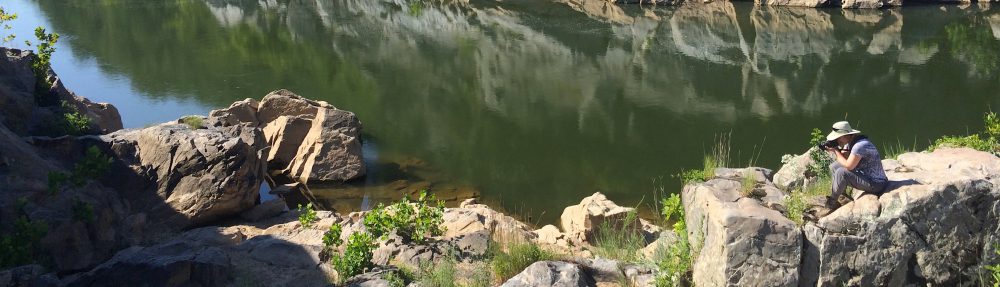
You might be wondering, since I keep mentioning it, what the Potomac gorge is.  It’s an interesting geological/hydrological feature of the Potomac River: a 15 mile stretch from Great Falls to Theodore Roosevelt Island in Washington, DC, in which the river drops about 130 feet.  Great Falls itself is a plunge of 76 feet over about two thirds of a mile.  This is one of the longest and most dramatic fall zones of any watercourse on the Atlantic seaboard.  It’s the area where the hard metamorphic rock of the piedmont meets the sediments of the coastal plain, and as a transitional area supports a large diversity of life, including over 200 rare communities and species.

20140729-DSC_0089

One of the interesting geological features of the gorge is the bedrock terraces. These very hard rock formations are quite erosion resistant, and are swept by frequent floods, resulting in micro-habitats where you can find unusual species of plants.  Sometimes you can find plants growing next to each other that wouldn’t co-exist anywhere else in the world.  And there are species found in the gorge that are otherwise rare east of the Appalachians, like racemose goldenrod and Coville’s phacelia.

20140728-DSC_0161

More rare plants can be found in the Potomac gorge than in any other part of Maryland.

_DSC0092

There’s more.  A lot more.  When I started researching for this post I discovered some really nice articles, and spent hours reading, and decided I couldn’t do the topic justice on my little blog.  Most of what’s written here I found in the following sources:

“The Wildest Urban River: Potomac River Gorge”  –Jeffrey P. Cohn, Oxford Journals

Potomac Gorge Field Guide  –National Park Service

Potomac Gorge Site Conservation Plan  –Nature Conservancy

Potomac Gorge –Michael Kircher, Burn Magazine

Geologic Map of the Potomac River Gorge  –USGS

20141024-_DSC0102

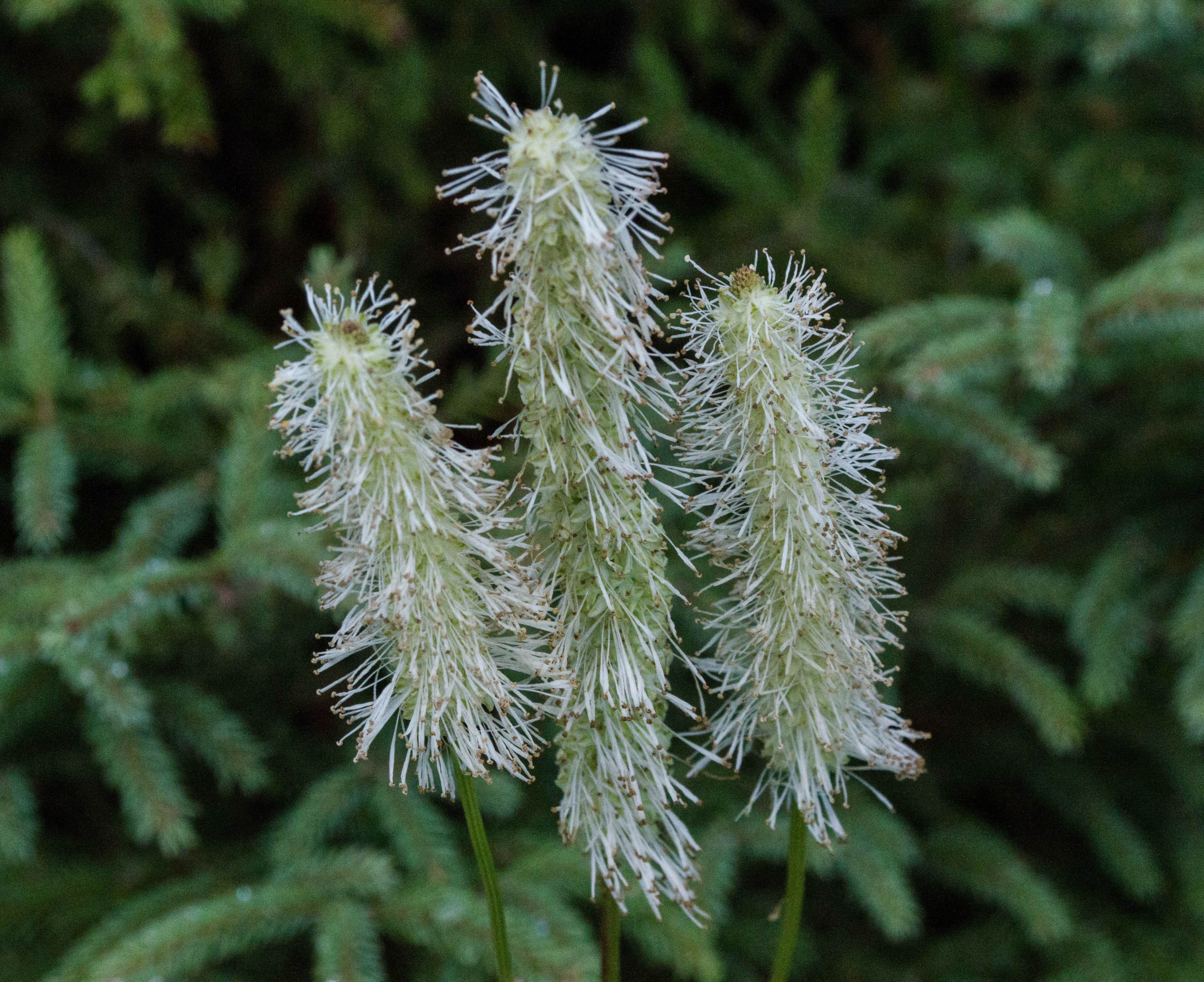
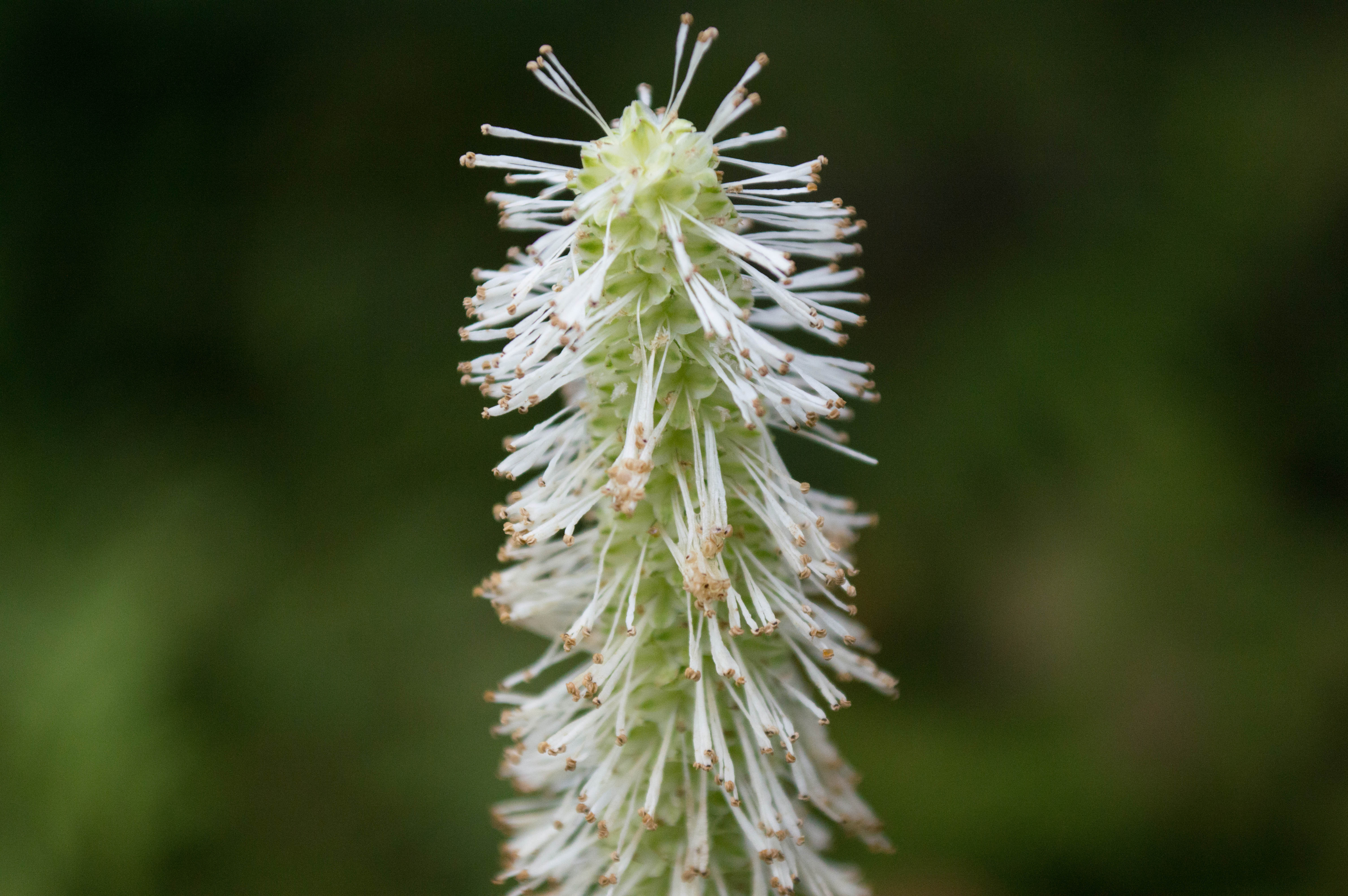
Flower of the Day: Canadian Burnet

Sanguisorba canadensis; Rosaceae (rose family)

20140915-DSC_0173

First, an apology – the picture above is a little misleading.  The green branches behind the inflorescences are balsam fir, which makes for a poor photo illustration.  Sometimes I don’t have much of a choice, though.

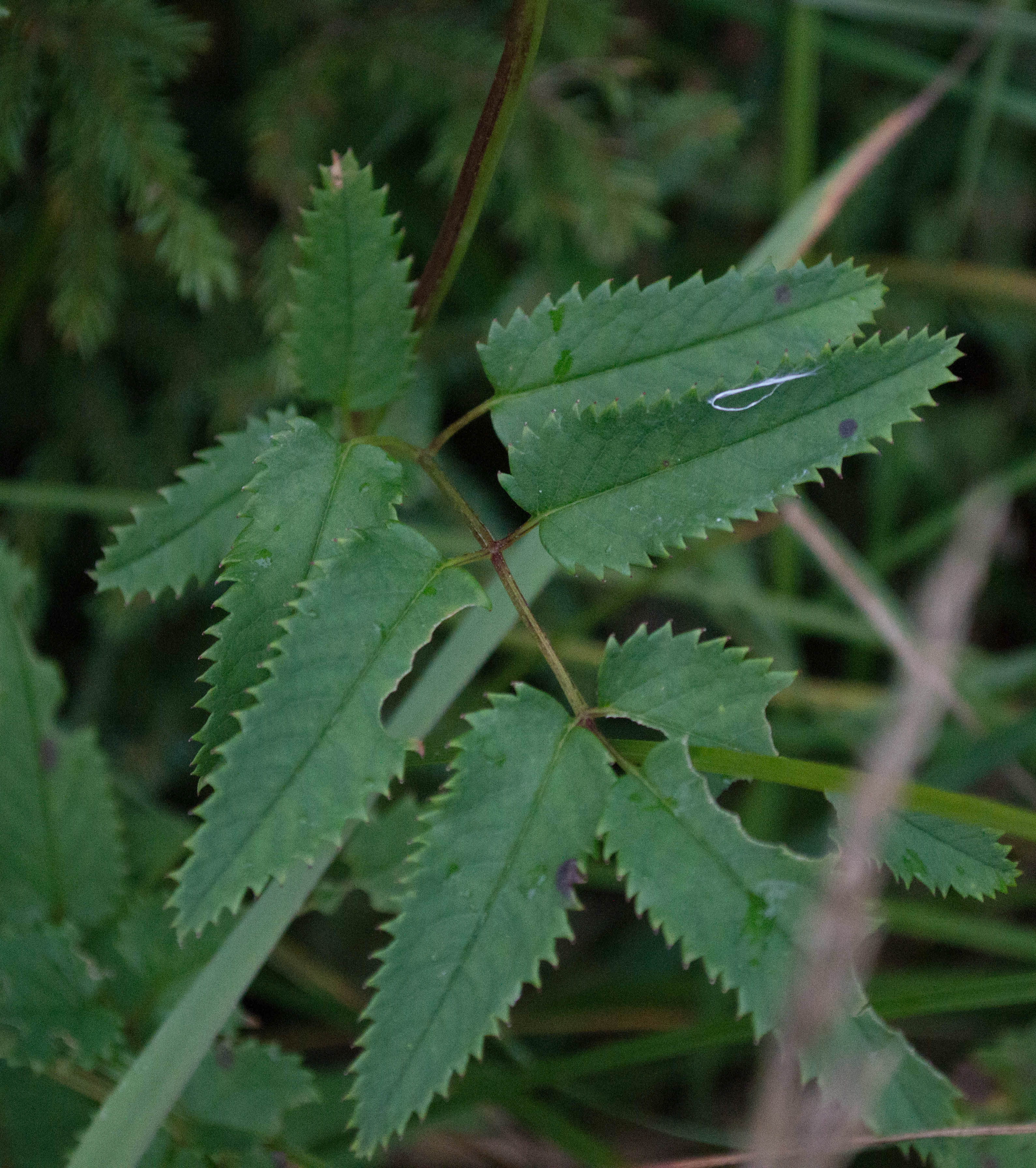
The presence of balsam fir should be a clue that once again, I’m cheating.  I found this plant in Nova Scotia, and didn’t pause long enough for a proper photo shoot.  Here’s a look at the leaves:

20140915-DSC_0175

Canadian Burnet is native to the eastern US and Canada and the Pacific Northwest.  Though it does occur in Maryland, it is probably not a plant of the Potomac gorge; I’ve found references to it growing in Baltimore County and in the Blue Ridge, and west of there.  Sadly it is either threatened or endangered in nine states, including Maryland.

Burnet is a perennial that likes a wet habitat, though it is fairly drought resistant.  It will grow up to five feet tall.  Four other species (three native, one alien) of Sanguisorba are found in North America.

20140915-DSC_0156

In the past burnet sap was used to staunch wounds.  The genus name comes from Latin words meaning “blood” and “to suck in” (presumably that’s also the root of the word “absorb”).