The Euphorbiaceae, part 1

20161115-_dsc0238

The spurge family is one of the largest in the world, though exactly where it ranks is difficult to say for sure. There are almost 2,000 species in 300 genera worldwide (except the arctic and Antarctica). Most are tropical, and many are succulent, resembling cactuses; others are typical annual or perennial forbs, and a few are woody. It’s a family of great morphological diversity.

It’s also a family of great economic importance. Poinsettias are one of the most widely grown ornamentals. Natural rubber is made from the sap of Hevea brasiliensis. Cassava isn’t much known in the US, except in the form of tapioca, but it’s a staple food in many tropical regions; it comes from Manihot esculenta. The roots are eaten as a vegetable or dried and made into a flour.

Castor bean, Ricinus communis, is a particularly interesting plant, appearing on (or topping) lists of most poisonous plants in the world. It’s grown as an ornamental for its foliage, but is considered invasive in many places, and is highly allergenic, rating 10 out of 10 on the Ogren Plant Allergy Scale. The oil extracted from the seeds has industrial and medicinal uses, but the raw seeds contain a potent poison (ricin). Castor oil is even used in the manufacture of a food additive, polyglycerol polyricinoleate.

20161115-_dsc0184

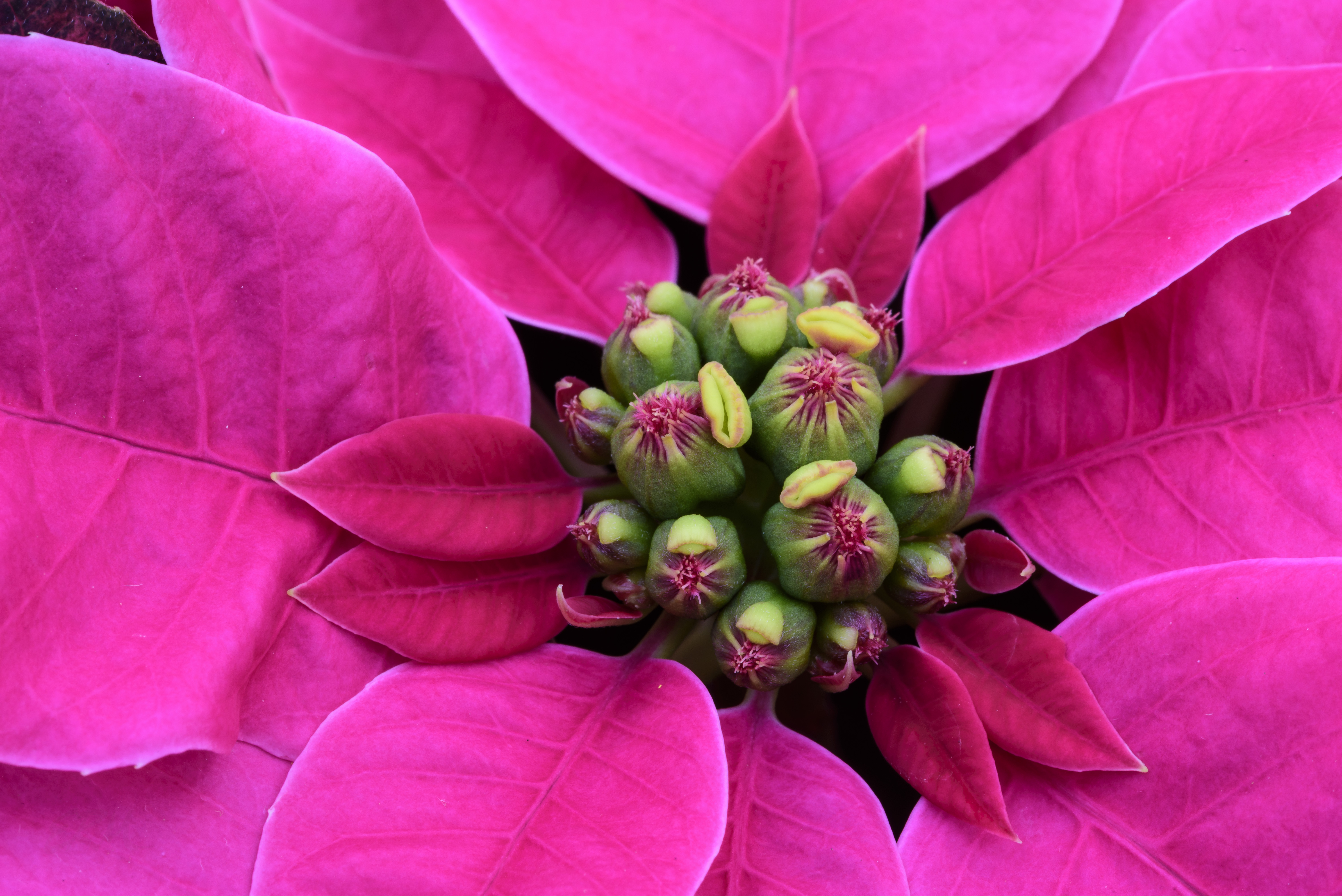
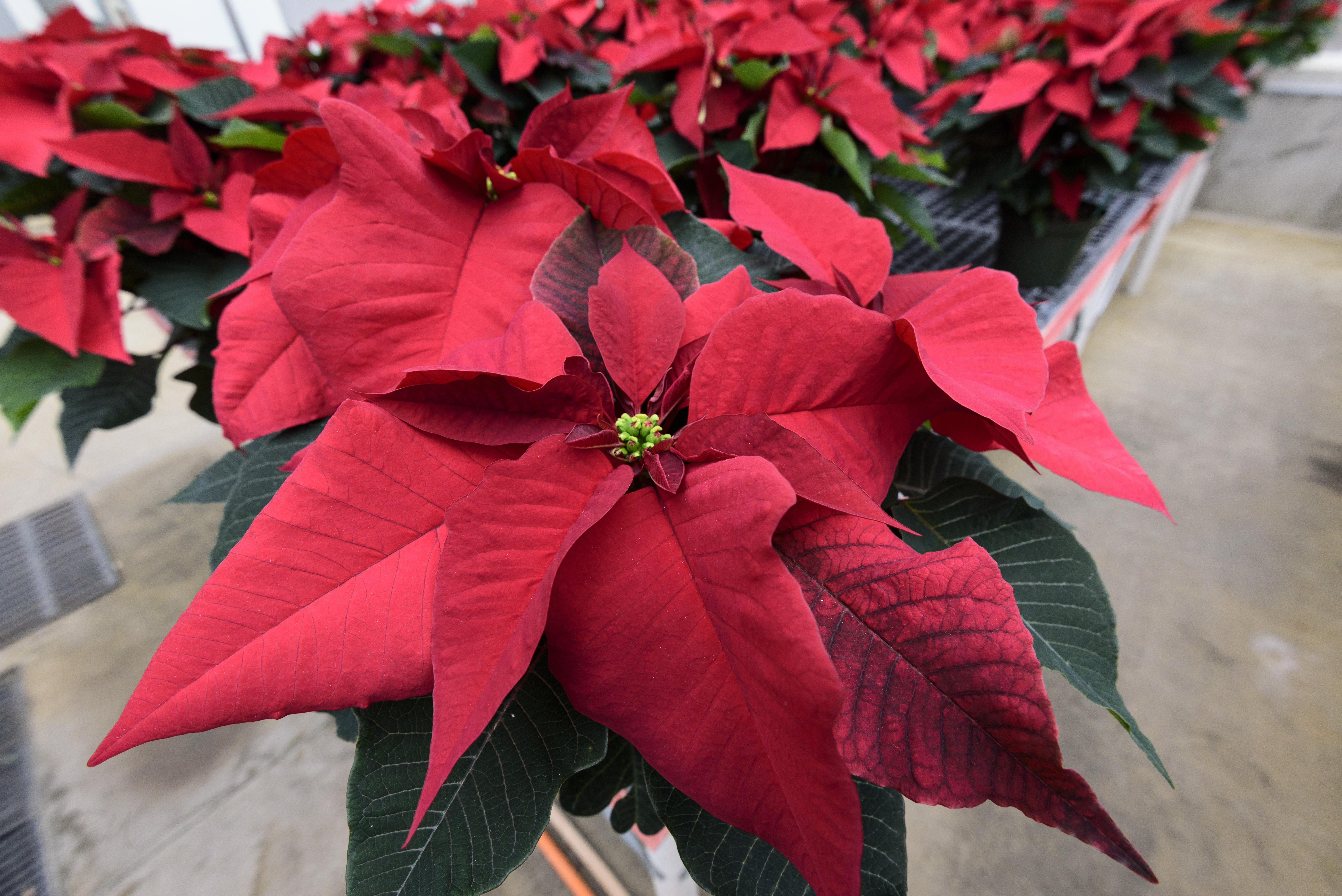
Species in the genus Euphorbia tend to have minute flowers. An involucre contains all the reproductive parts, collectively referred to as the cyathium. The cyathium consists of one carpellate (female) flower and several or many staminate (male) flowers surrounded by bracteoles (miniature bracts, or modified leaves). In many species there will be lipped glands (extrafloral nectaries) on the outside of the cyathium. This closeup of a poinsettia shows more than a dozen unopened cyathia with their nectaries, surrounded by the highly colored bracts.

Another characteristic common to many (but not all) euphorbs is the presence of a milky sap (latex) in the stems. Generally it’s caustic, more or less so depending on the species. It’s one field test to use when trying to identify plants, but not definitive, as ten percent of flowering plants contain latex*. At any rate, don’t get it on your skin.

Of course there are euphorbs in the Maryland piedmont, otherwise I wouldn’t be writing about them. More on those next time.

*Latex: A Model for Understanding Mechanisms, Ecology, and Evolution of Plant Defense Against Herbivory

Native Umbellifers (Apiaceae, part 4)

Now that you know a little about umbellifers, have a look at these native wildflowers. Some of them are not as obviously umbelliferous as others; you would almost have to look at them with a hand lens to tell. (The bloom times mentioned below are for the Maryland Piedmont, based on recent years.)

20160316-_DSC0037

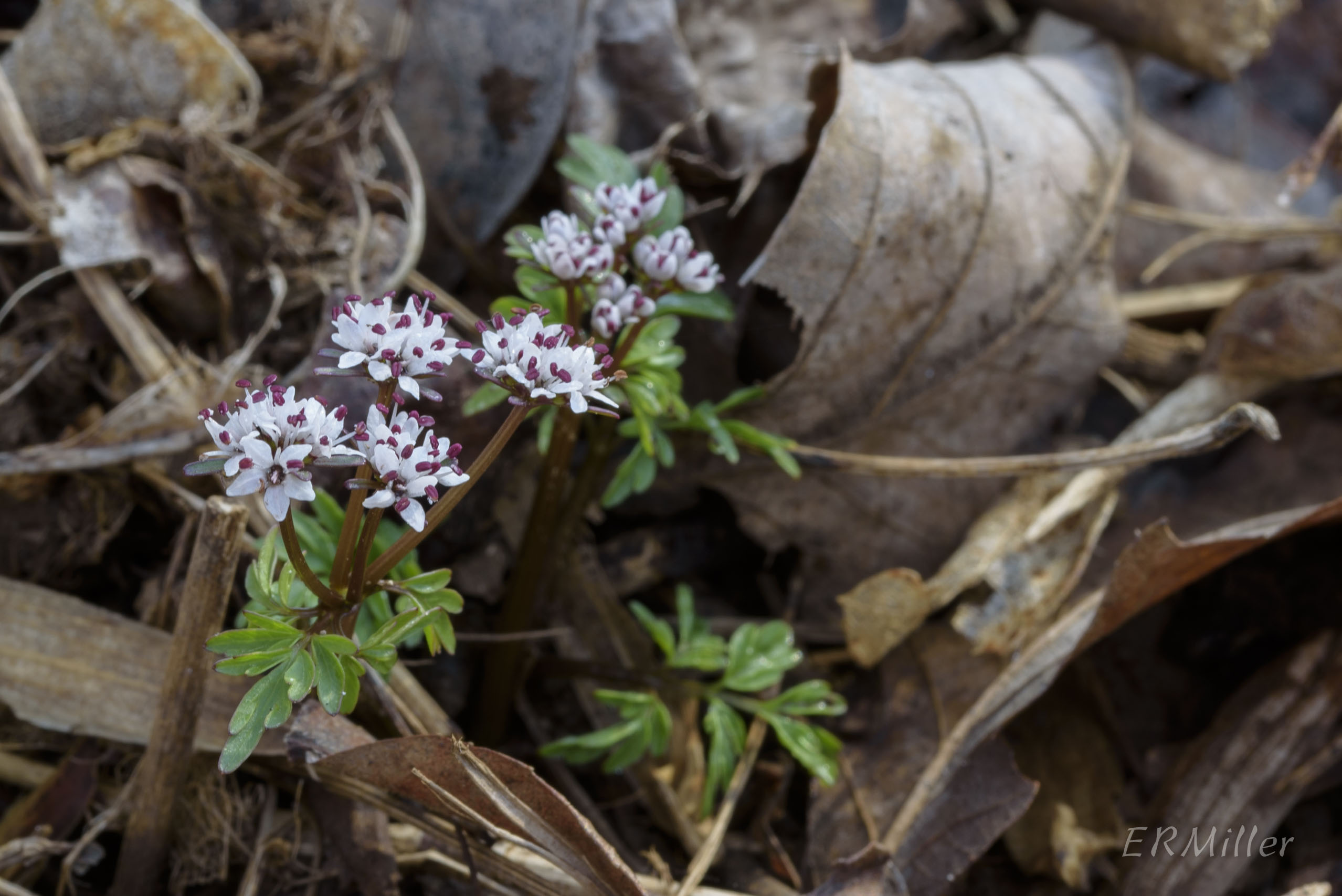
Erigenia bulbosa
Harbinger of spring, aka salt-and-pepper, blooms as early as mid March, and maybe as late as mid April. It’s listed S3 (watchlist) in Maryland, is endangered in New York and Wisconsin, and threatened in Pennsylvania. It’s a perennial of rich woodlands, with flowers in compound umbels; there are 1-6 flowers per umbellet and 1-4 umbellets per umbel*. The near umbel in this picture, with four umbellets, is about the width of a nickel.

20150429-20150429-_DSC0020

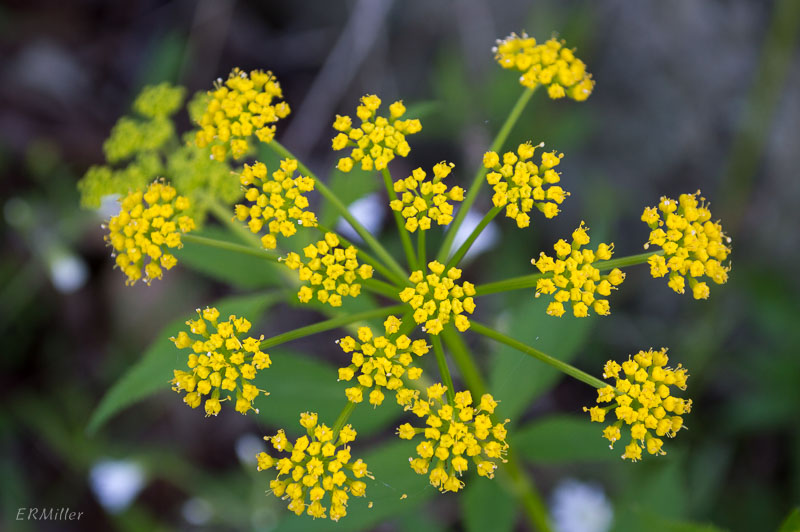
Zizia aurea
Golden alexanders can bloom as early as late March and if they start later, might last ’til late May. This species is also S3/watchlist in Maryland, and is listed as special concern in Rhode Island. The compound umbels typically have around 12 umbellets, each with about 21 flowers*.

20140505-DSC_0018

Osmorhiza claytonii
I’ve seen sweet cicely blooming as early as early April and as late as mid May. The plants tend to be in flower rather longer than the previoius two species. There are no conservation issues. This species also has compound umbels, with each umbellet sporting 4-7 flowers**.

20160409-_DSC0001

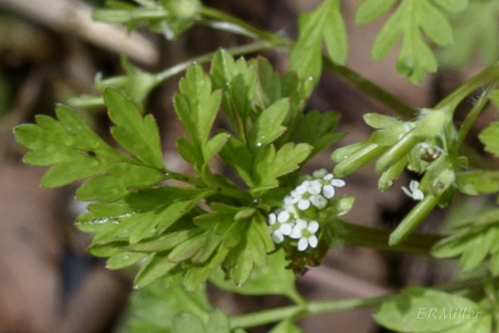
Chaerophyllum tainturieri
Hairy-fruit chervil generally blooms from about mid April to about mid May. Each flower measures around 3/32″ wide. This is another species whose flowers are in compound umbels. There are no conservation issues.

clustered snakeroot closeup


Sanicula odorata
Clustered snakeroot blooms for a long period, starting as early as late April and lasting maybe ’til mid June. It’s threatened in Massachusetts and New Hampshire but abundant in the Maryland Piedmont. In late May it seems to be a dominant understory forb, growing in great swaths in the woods along the Billy Goat B and C trails and the Cabin John trail. There are 20-60 flowers in each umbellet, and 1-5 umbellets per one-half inch wide umbel*.


20140604-DSC_0220

Cryptotaenia canadensis
Honewort also blooms for a long period of time, typically from late May to late June. Once again the flowers are in compound umbels, with 3-10 flowers per umbellet and 3-10 umbellets per umbel*. Like clustered snakeroot it grows profusely in Maryland piedmont woodlands.


*from Dr. John Hilty’s wonderful Illinois Wildflowers site.
**Minnesota Wildflowers

Poisonous Umbellifers (Apiaceae, part 3)

img_2936

Isn’t that pretty?

It’s also deadly.

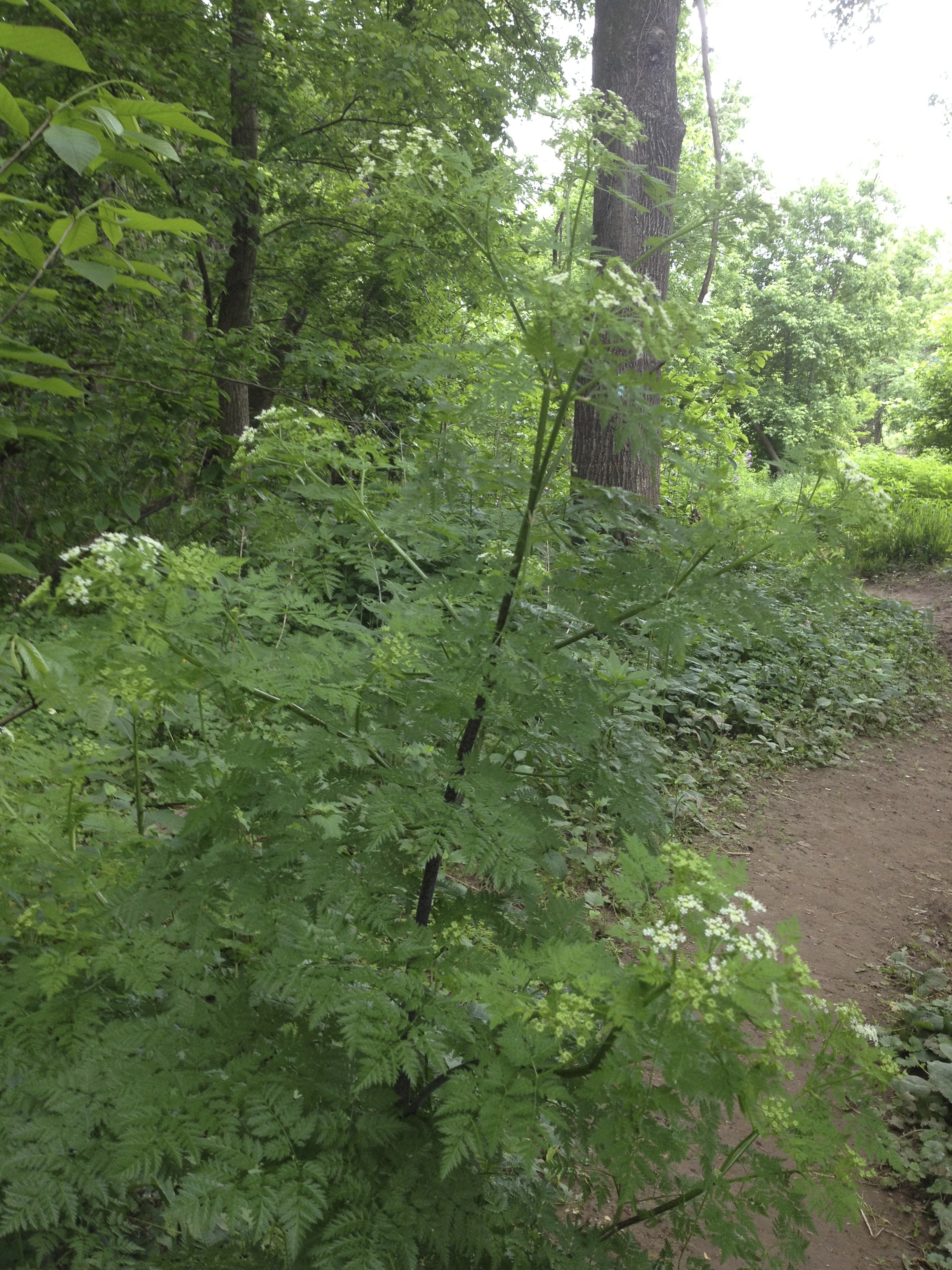
Umbellifers can be tasty, and they can be poisonous. And they can be both. The deadliest plant in North America is a native umbellifer, and the notorious European native pictured here is widespread in the Maryland piedmont. This specimen was right on the Billy Goat C trail.

img_2937

This is Conium maculatum, aka poison hemlock. It’s found throughout the US (except Mississippi and Florida) and most of southern Canada, and is on the noxious weed list in eight states. It likes moist soils in disturbed areas and can grow to eight feet tall in its second year (it’s a biennial). In young plants all you’ll see is a basal rosette of leaves.

_dsc0078

Most of the brown material in the above photo is poison hemlock plants that are dead or dying after setting seed (there’s a still-flowering plant on the left side, but you have to zoom way in to see it).

There are five related alkaloids present in poison hemlock, but the one that occurs in greatest concentration is coniine, a peripheral nervous system disrupter. It doesn’t take much coniine to kill an adult human (The LD50  (mice) is in the range of 10 milligrams per kilogram of body weight). Remember that umbellifers often have hollow stems? There are documented instances of children dying after blowing across the tops of cut poison hemlock stems.

North America’s deadliest plant is Cicuta maculata, the spotted water-hemlock. It grows in wet areas all over the US and Canada, including the Maryland piedmont. The plant looks similar to Conium maculatum but usually the foliage is not as finely cut, and it doesn’t get quite as tall. Despite being a native it’s on the noxious weed list in Nevada. There are three other species of Cicuta native to North America; of these C. bulbifera, bulblet-bearing water hemlock, has been recorded in Montgomery and Cecil counties, but it is listed as Endangered/S1 (highly state rare). The poisonous compound in Cicuta species is called cicutoxin. It’s a central nervous system disrupter that usually causes death by respiratory failure. The LD50 (mice) is 2.8 mg/kg.

(By the way, the specific epithet “maculata” or “maculatum” means spotted.)

There are a few other species of umbellifers found in parts of the US that have similar toxicity, but none of those are found in Maryland.

For the most part the poisonous compounds found in umbellifers fall into two broad categories: systemic poisons and phototoxins. When a phototoxin – say the sap from an umbellifer – gets on the skin, nothing happens. Until the skin is exposed to sunlight. Then there is a reaction that renders the skin highly photosensitive, so that sun exposure causes burns. Second degree burns, even. And the resulting skin discoloration and scarring can last for months or be permanent.

Wondering which plants have phototoxic compounds? It’s an interesting list, and includes species in a number of families, including the citrus family. Depending on which authority you consult, most of the vegetable and spice umbellifers at least have the potential to cause such a reaction. This includes anise, carrots, celery, chervil, coriander, dill, fennel, lovage, parsley, and parsnip. Usually the reaction isn’t bad, but it’s a good idea to wear gloves and long sleeves when handling them in the garden.

Interestingly, the celery reaction only happens when the celery has been infected with a particular species of fungus.

Among the phototoxic umbellifers, none looms as large as the giant hogweed,  Heracleum mantegazzianum. I mean that both literally and figuratively. Literally, because this Caucasian native can grow to 18 feet tall. It’s a biennial, so that means it grows to 18 feet in a single season. And figuratively, because the sap is exceptionally dangerous. Crews in New York and British Columbia tasked with removing it suit up head to toe to prevent the sap from touching them. This video has a rather silly intro but basically good information. There’s a lot of good information on the New York State Department of Environmental Conservation website.

Giant hogweed is on the federal noxious weed list and on 13 state lists. It’s found in a handful of states in the Pacific northwest, upper Midwest, New England and mid-Atlantic, and North Carolina. The Maryland Biodiversity Project has records for it in Garret, Baltimore, and Harford counties.

Giant hogweed has two cousins present in the US, H. maximum (native) and H. sphondylium (alien), both of which are commonly called cow parsnip. The former is present in the Maryland piedmont, but there are no records of the latter in Maryland. Both species contain phototoxins, but are not nearly as dangerous as H. mantegazzianum.

next time: more flower pix

Tasty Umbellifers (Apiaceae, part 2)

Many umbelliferous plants are used as vegetables, herbs, and spices. Here’s a list.

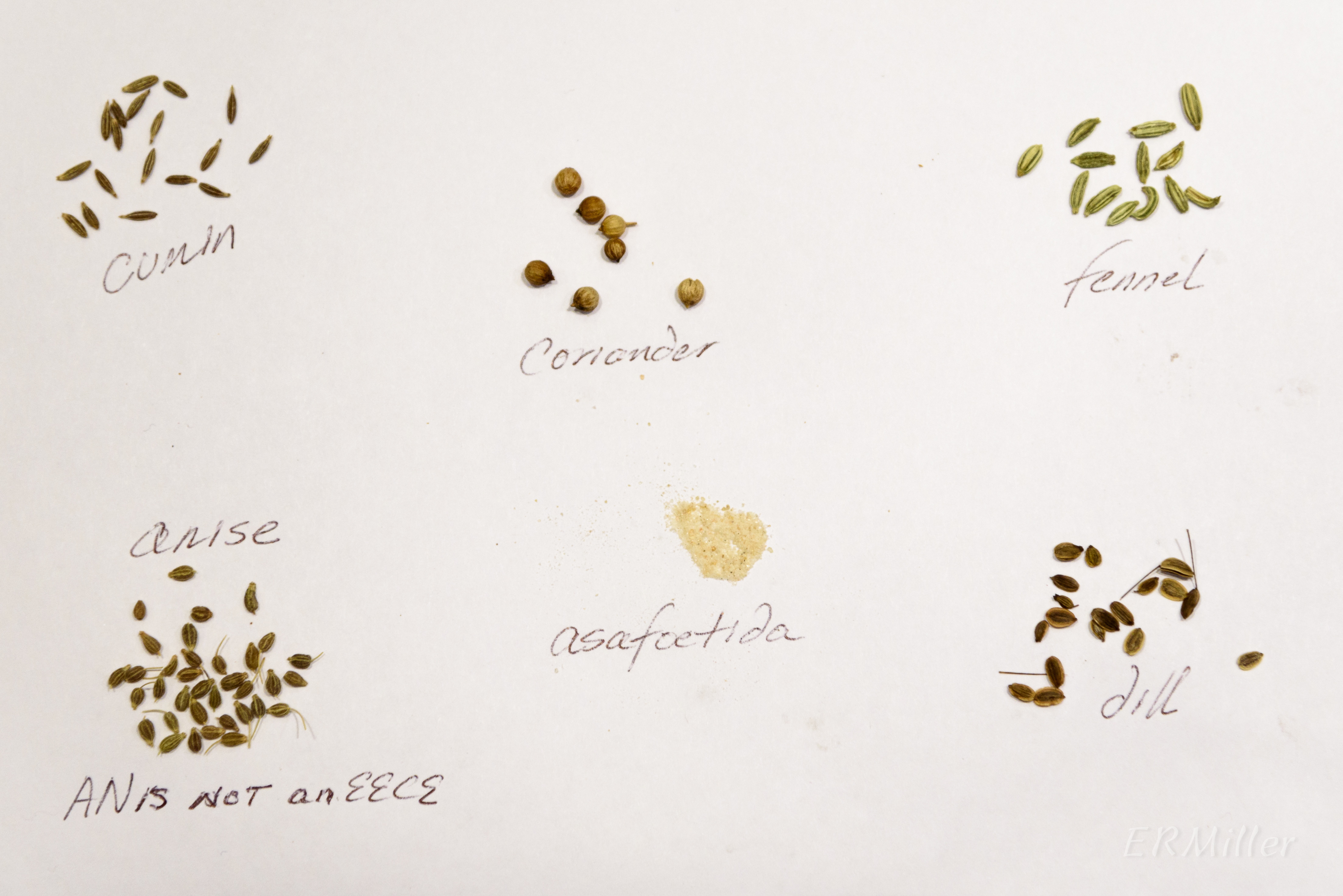
But first, a note on terminology: although everyone refers to the spices as “seeds”, they’re actually fruit, specifically a type called schizocarp, a dry fruit that will split into segments, each of which contains one seed; plants in the Apiaceae always have schizocarps that split in two parts. In the text below I’m sticking with common usage and referring to them as seeds. But really they’re fruit.
20150716-20150716-_DSC0008

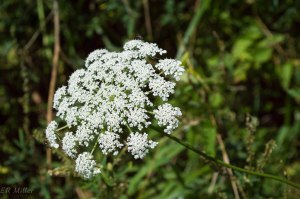
Daucus carota   Although the carrot is a biennial plant, the roots are harvested during the first year of growth. The plant is native to Eurasia, but found in the wild in all the lower 48 states and much of Canada; as wildflowers, they’re called Queen Anne’s lace, and on noxious weed lists in Iowa, Michigan, Ohio, and Washington. Older sources sometimes refer to two subspecies, D. carota ssp. sativus and D. carota ssp. carota; these names are now considered obsolete by ITIS.
20150610-20150610-_dsc0115

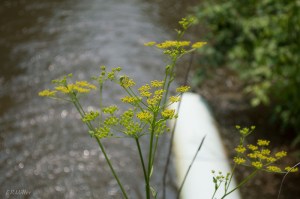
Pastinaca sativa   Like the carrot, the parsnip is a biennial plant whose roots are harvested during the first year. Also native to Eurasia and now established in North America except in the Deep South. Parsnip is a prohibited noxious weed in Ohio.


Apium graveolens  The stalks, leaves, and seeds of celery are used. The plant is a biennial native to central and southern Europe, southwestern Asia and North Africa. Probably. Celery has been cultivated for so long there’s a lot of confusion about its origins. It’s become established in parts of the US, in an arc running from New York south, west, and then north into Washington. The variety A. graveolens var. rapaceum is grown for the root, called celeriac.

Perideridia  There are 13 species in this genus, all with the common name yampah. It’s a perennial plant native to western North America. The roots were an important food source for Native Americans.

Arracacia xanthorrhiza   Arracacha is a perennial native to the Andes, grown for the edible root.

Foeniculum vulgare   Sometimes incorrectly labeled anise, fennel is a perennial grown for the swollen stalks at the base of the plant (the “bulb”). It’s native to the Mediterranean but has naturalized in much of Europe and in the warmer parts of the US. Fennel is on the California Invasive Plant Council’s Invasive Plant Inventory for moderate invasiveness and severe impact (2006 version).

Levisticum officinale  The native range of lovage is uncertain; probably Europe or Asia. It’s a perennial and once established can be hard to get rid of. Both the stalks and leaves can be eaten. The flavor is intense, like some sort of super-celery. A little goes a long, long way.

Anthriscus cerefolium (sometimes spelled cereifolium) This southern European native is an annual plant that deserves more respect. Chervil is used mostly in French cuisine, in delicate dishes because the flavor is mild. Although the leaves are sold in dried form, don’t bother buying them; the volatile oils are lost during drying and the result is flavorless. Chervil is trivially easy to grow from seed.

Petroselinum crispum   Parsley is a biennial generally used as an annual, since the leaves can get harsh or bitter in their second season. There are scattered populations established in parts of the US, but it’s not listed anywhere as a weed. It’s native range is uncertain, possibly the Levant or nearby areas.

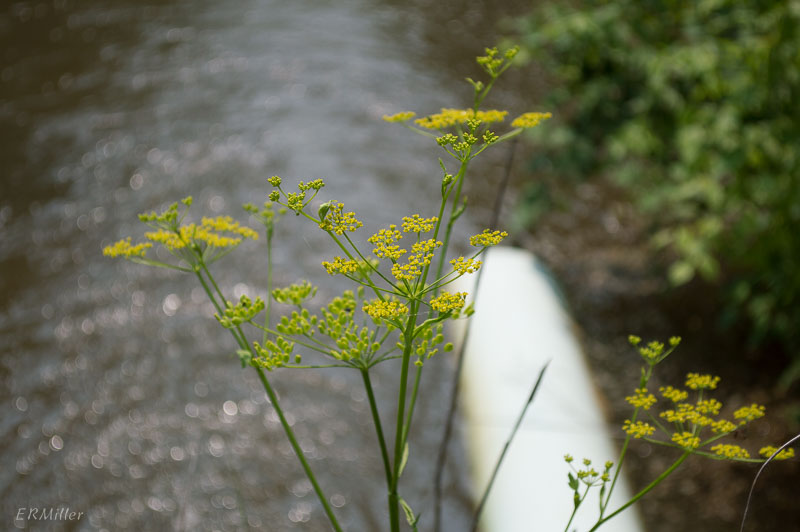
Anethum graveolens   Dill is annual, naturalized in much of the US and Canada but native to Asia minor and the Mediterranean. Both leaves and seeds are used. The common name “dill weed” is a clue that this plant is really easy to grow.

Carum carvi   Caraway is an established alien in Canada and the northern half of the US (more or less), and a B-list noxious weed in Colorado. It’s a biennial native to Eurasia and north Africa. Caraway seed is familiar as the dominant flavor in rye bread and aquavit.

Pimpinella anisum   I blame Alton Brown (of Good Eats fame) for the increasingly widespread mispronunciation of the word “anise”. It’s pronounced ANis, not anEECE (google it). The plant is an annual native to southeastern Europe and southwestern Asia. My Italian forebears would roll in their graves if I used anything other than anise seed to flavor pizzelles.

Myrrhis odorata   Both the leaves and seeds of cicely are used as a flavoring, though the use is not widespread. The plant is a perennial native to south-central Europe, with scattered naturalized populations in the US and Canada.

Coriandrum sativum   Called cilantro for the leaves, shoots, and roots, and coriander for the seed, this annual is native to southeastern Europe, southwestern Asia, and north Africa. It’s present in parts of North America but not listed as a weed by any authorities.

Eryngium foetidum  Grown for the leaves, culantro (often confused with cilantro) is used in Southeast Asia, the Caribbean, and Central America. It also grows in Georgia and Florida. I can’t find any authoritative information about its native range, but it is a tropical annual.

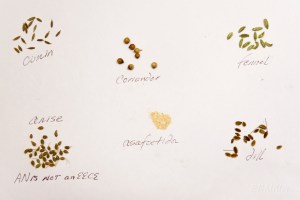
Cuminum cyminum   Cumin is an annual plant native to the eastern Mediterranean and central Asia. The seeds are used in many cuisines around the world.

Bunium bulbocastanum   The seeds of this perennial plant are known as black cumin, black caraway, and kala jeera. It’s native to southeastern Europe and south Asia.

Trachyspermum ammi   Ajwain is an annual native to south Asia, grown for the seeds.

Ferula assa-foetida   The dried and ground sap or resin of the roots of this perennial is called asafoetida. The powder is used sparingly in various Indian cuisines, more as a flavor enhancer than a flavor in itself. The plant is native to western Asia.
20161130-_dsc0003

now my kitchen smells like an Indian restaurant

Many umbelliferous plants contain poisons of various sorts, including some of the plants described above. More on that next time.

Foods, Flavorings, and Poisons: Plants of the Apiaceae (part 1)

The Apiaceae, also known as Umbelliferae, is the 16th largest plant family in the world (1), with almost 3,800 species in over 300 genera (2). Plants in this family are found almost everywhere (except Antarctica), but mainly in northern hemisphere temperate regions and tropical highlands. Within the US, the Apiaceae is the 11th largest family, with 349 (native) species.

Sixty-five species of umbellifers can be found in the state of Maryland, though 28 of these are non-native, and many of those are waifs (plants that are alien and known to be present, but not in established populations). Of the 65, maybe half are present in the piedmont.

Umbellifers are usually herbaceous and can be annual, biennial, or perennial. Although identifying individual species can be difficult, as a family they are easy to recognize. There are always exceptions, but general characteristics to help you identify them include:

  • hollow stems (between the nodes)
  • sheathing at the nodes
  • compound or twice-compound pinnate or palmate leaves, arranged alternately
  • aromatic foliage
  • seeds enclosed in schizocarps (a dry, often woody fruit)
  • tiny flowers arranged in umbels or more often compound umbels

dsc_0013-x-2

This last characteristic is the one from which the older family name is taken. An umbel is an arrangement like an umbrella, with pedicels (individual flower stalks) all growing from the same point. In a compound umbel, multiple secondary peduncles originate from one point and terminate in individual umbels, with pedicels and flowers arising from these.

dsc_0018

Few plant families have such easily identifiable inflorescences, but be careful: getting the details right can mean the difference between life and death. Literally. More in the next few posts.


(1) Wikipedia
(2) Stevens, P. F. (2001 onwards). Angiosperm Phylogeny Website. Version 12, July 2012 [and more or less continuously updated since] (Missouri Botanical Garden)