In Search of Something Green (and Native)

20160112-_DSC0212
American holly (Ilex opaca) on the Cabin John Trail


After two weeks battling a sinus infection, I finally felt well enough to go for a hike. Well, more of a walk. As I’ve written before, the Cabin John Trail is treacherous: an over-used trail with poor footing in many places. But, I almost always find something worthwhile, if I take the time to poke around and really look at things.

And so it was yesterday. I knew I’d find a lot of Christmas fern, but went with the goal of finding something else – and I did, after scrambling about in a dryish seasonal watercourse. Look for a post about that fern in another few days.

After that I went to a section I call Erica Alley. It’s a very rocky slope with a high concentration of mountain laurel (Kalmia latifolia), and big stands of rock polypody. There I found several small stands of spotted wintergreen (Chimaphila maculata, another ericaceous plant), which thrills me because I failed to find it near Carderock this year. And then, poking about, I found something completely new. And something old that required re-inspection.

I don’t carry ID books with me. Whenever I have a book, I end up plopping my butt down and reading for 20 minutes. I’m too easily distracted by “dictionary syndrome”. So I take pictures, but often fail to get the right pictures for a definitive ID. At least I’ve narrowed them down to the correct genus. Perhaps if the weather’s good today I’ll go out again, this time with the ID books, dammit.

If you see a middle-aged woman reading a book on the Cabin John Trail, say hi.
Many Little Feet

20150726-20150726-_DSC0140

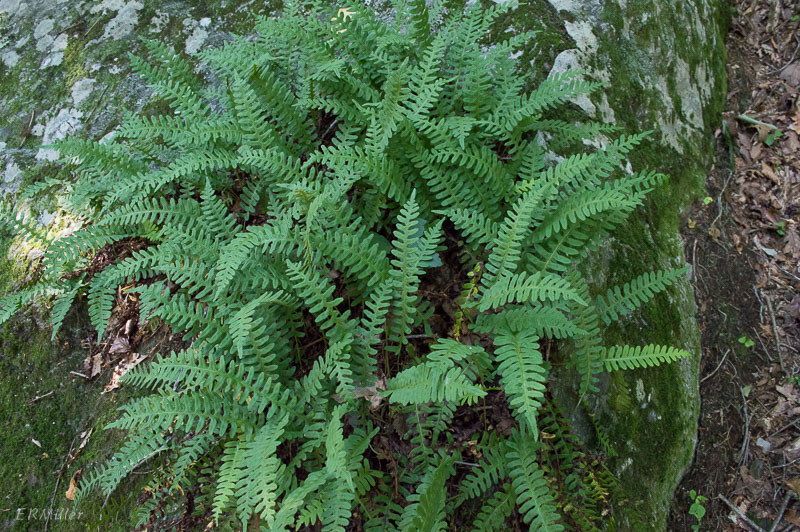
Common or rock polypody, American wall fern, rockcap fern
Polypodium virginianum

a small stand on the Cabin John trail


This little fern is no less charming for being incredibly common.  It’s found throughout most of the eastern US and Canada except for parts of the deep south.  Although short (the fronds are usually about twelve inches long), the rhizomes will form massive colonies in suitable habitat, which consists of all sorts of rock outcroppings and rocky soils in moist shade.

20140725-DSC_0156


an itty-bitty specimen at Carderock; it doesn’t have much soil to grow in!


It’s also an easy fern to identify, especially at this time of year, since it’s evergreen.
20150420-20150420-_DSC0082


new fronds in late April along the Cabin John trail

Ebony Spleenwort

20150429-20150429-_DSC0034


Asplenium platyneuron
new fronds with croziers, May 2015


The day after my last post, I went to Hoyles Mill Conservation Park (in the Little Seneca Creek watershed, near Boyds), hoping to find some evergreen ferns. There was a nice stand of Christmas fern along a bank:

20151226-_DSC0017

Looking closer I saw a second species: ebony spleenwort.  It’s the smaller, lighter-colored fronds on the left in this picture:

20151226-_DSC0010

At twelve to twenty inches tall, ebony spleenwort is one of the larger members of its genus.  It’s wide-ranging, from Quebec south and west as far as Arizona, and can be found in a variety of habitats.  Look for it on embankments, rock outcroppings that have a little soil, even old stone fences.  It’s listed as special concern in Maine and exploitably vulnerable in New York.

20150728-20150728-DSC_0054


a specimen near C&O Canal lock 8, August 2015


The name “asplenium” is from the Latin, meaning “without spleen”.  The specific epithet “platyneuron” can be translated as “flat-nerved”.
20150713-20150713-_DSC0020


underside of a pinna on a fertile frond, showing indusia and sporangia


Several other evergreen ferns can be found in the Maryland Piedmont; I’ll be posting about them in the coming weeks.

Oh, Christmas Fern

20150628-20150628-_DSC0002

Polystichum acrostichoides
Dryopteridaceae (wood fern family)

specimen showing sterile and fertile fronds; pardon the boot!
——>

If you’ve been walking around the woods during this freakishly warm season, you’ve probably seen Christmas fern, a widespread evergreen fern of moist to dry woodlands that’s found all over the eastern part of North America.  It’s a lovely plant for the garden, with glossy dark fronds adding winter interest, and a tidy, clump-forming habit.

20150731-20150731-_DSC0449


young frond in July


Christmas fern stands about two feet tall, and is easily identified (especially in winter). Each pinna has a distinctive upward-pointing lobe near the base, variously described as a thumb, or toe, or ear. (The technical term is auricle, meaning ear-shaped lobe.)

The fertile fronds have a distinctive shape, with the sori-bearing pinna becoming shorter, narrower, and more widely spaced on the upper portion of the fronds:

20150709-20150709-_DSC0058

20150709-20150709-_DSC0062


sori on underside

20150731-20150731-_DSC0448


crozier in July


ps: please refer to my posts about fern terminology and fertile fronds for definitions of some of the jargon

Fertile Fronds (More About Ferns)

20150711-20150711-_DSC0066

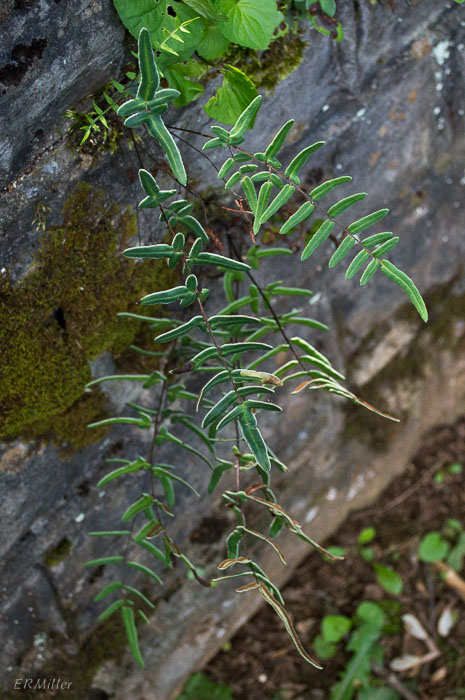
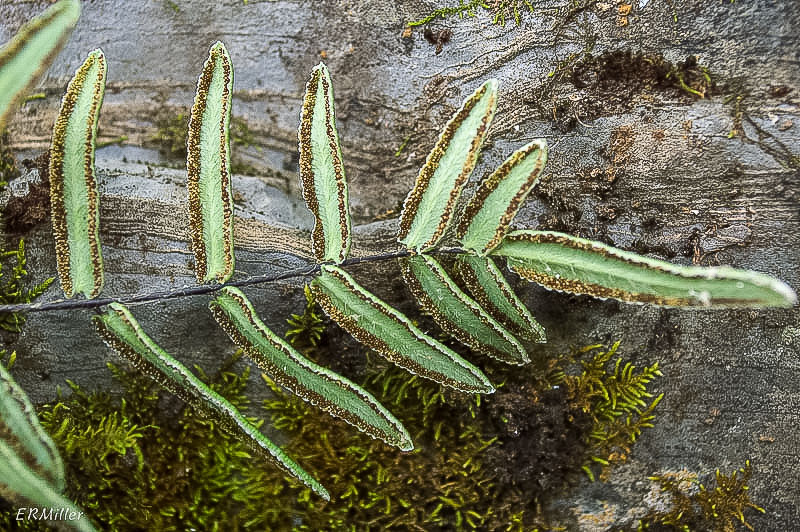
fertile fronds of purple cliffbrake (Pellaea atropurpurea)


So if ferns aren’t flowering plants, how do they reproduce?  The answer is fairly technical, and detailed descriptions are only a search away.  Here’s a good one.  A short answer is: they produce spores rather than seeds.  (Although, as with seed plants, there are vegetative means of reproduction as well.)

Spores generally, but not always, form on the underside of a frond.  Not all fronds are fertile (that is, spore-bearing).  If you look on the back of a fern frond and see lots of little dots, you’re looking at a fertile frond.

The spores are contained within structures called sporangia.  The sporangia, in turn, are often (but not always) clustered together in structures called sori (singluar sorus), which are the small dots that you can see with the naked eye. Sometimes the sorus will be covered by a flap of tissue called an indusium (plural indusia).

Noting the characteristics of the sori – how they’re shaped, how they’re placed on the pinnae – can be an important step in identifying the species of fern.

And now, the meat of this post, which I’ve written in part because this stuff is fascinating, but mostly because I’ve been having fun taking “studio” pictures.

20150805-20150711-20150711-_DSC0071


the reverse side of purple-stem cliffbrake; in the lead-in photo, the white margins on the pinnae are a clue that the fronds are fertile (an unusual characteristic)

20150802-20150802-_DSC0531


linear sori along the midveins of the pinnae on ebony spleenwort (Asplenium platyneuron); some indusia are also visible near the rachis


20150802-20150802-_DSC0529-2


orbicular sori along the margins of the pinnae of common polypody (Polypodium virginianum)


20150802-20150802-_DSC0522


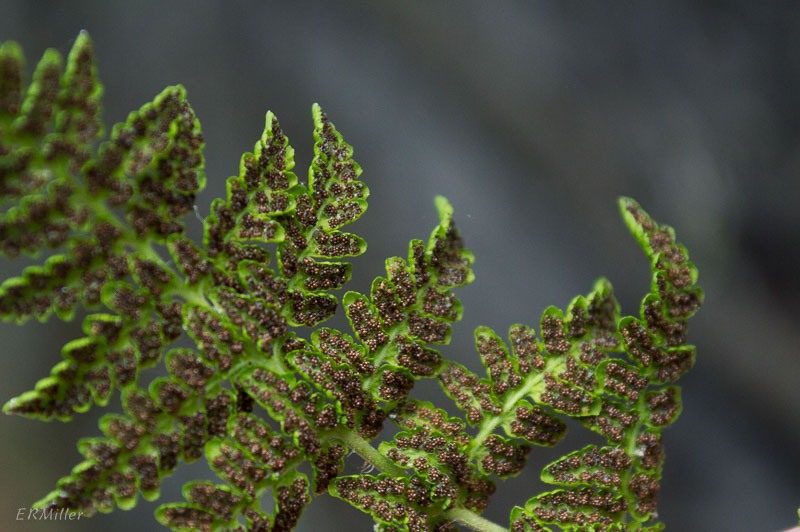
marginal woodfern (Dryopteris marginalis)


20150802-20150802-_DSC0523


closeup of marginal woodfern

20150527-20150527-_DSC0004


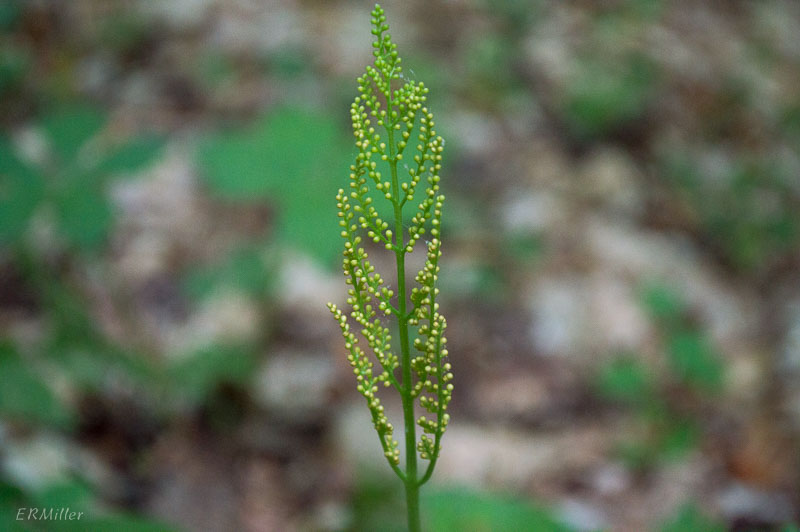
the unusual fertile frond of rattlesnake fern (Botrypus virginianus)


20150730-20150730-_DSC0353


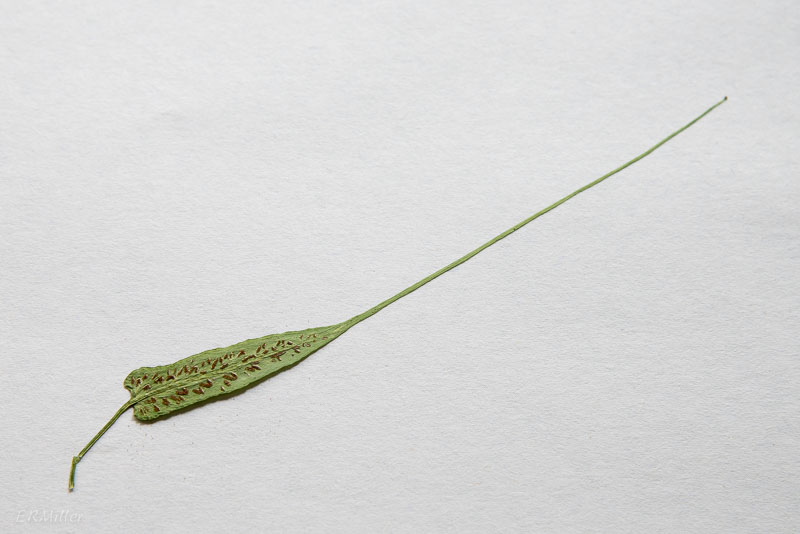
linear sori scattered along the frond of walking fern (Asplenium rhizophyllum)

20150711-20150711-_DSC0079


blunt-lobed cliff fern (Woodsia obtusa)

20150709-20150709-_DSC0062


masses of sori on christmas fern (Polystichum acrostichoides)