
 I was getting into my car at Lock 10 a few weeks ago when I decided to take a quick picture of the weedy lawn area nearby. I was in a hurry, you see. I figured I’d come back a few days later if I saw anything interesting in the picture. And then I didn’t get around to looking at the photo for a few days. And there was something interesting – two things, really: the pansies weren’t the ones I thought they were, and hiding among them were lots of tiny bright blue flowers.
Of course when I did get back there, eight days later, all the pansies were gone: done blooming. But the other blue flowers were still there.
Rule number one: take the time to get the shot. Will I ever learn?
Anyway, this is not a very clear picture, but the two flowering plants in it are Viola bicolor (field pansy, Violaceae), and Myosotis stricta (strict or small flowered forget-me-not, Boraginaceae). The former is a native, but the latter is an alien.
Field pansy is a low-growing annual forb that prefers drier soils in open and disturbed areas, like parking-lot lawns. Viola species can be tricky to key out, as there can be a lot of morphological variation within species, and cross-species hybridizing is common. The plants that we now call Viola bicolor were once considered a European species, and you’ll still find references to them as Viola kitaibeliana and Viola rafinesquii. It’s widespread in North America, though not in a few northern and western states. It’s also widespread in Maryland, missing only from Garret, Harford, and Somerset counties.
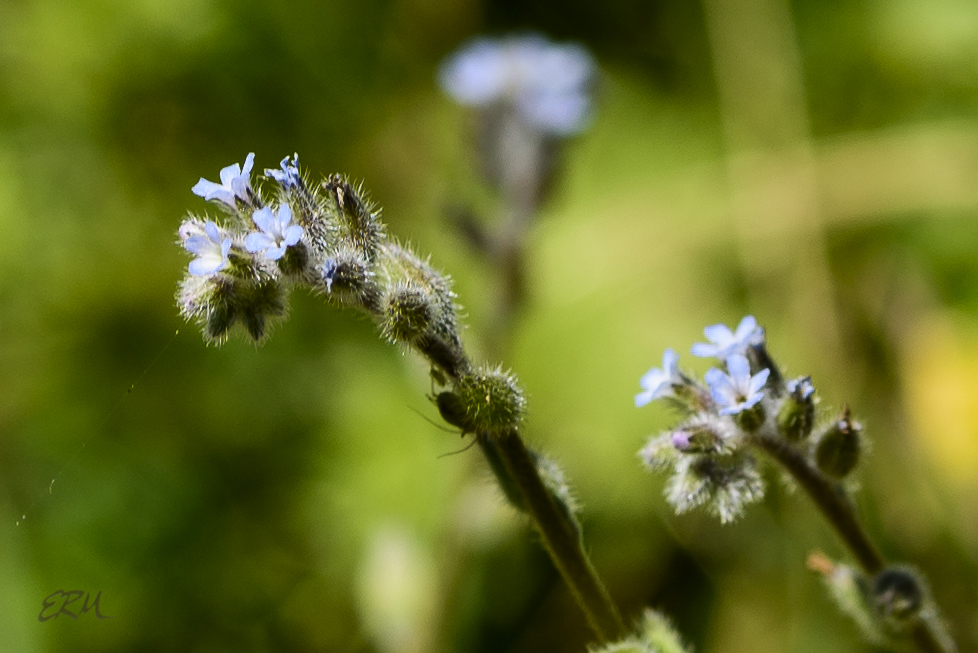 Strict forget-me-not is one of four alien Myosotis species found in Maryland (there are three natives, too). The plants stand only a few inches tall, and the flowers are minute; I didn’t even see them there when I took the picture of the pansies. The species can be found in much of the US, minus a few northern and southern states.
It’s been a boraginaceous year.



 Elizabeth's Wildflower Blog