What’s Green Now? Wild Pink

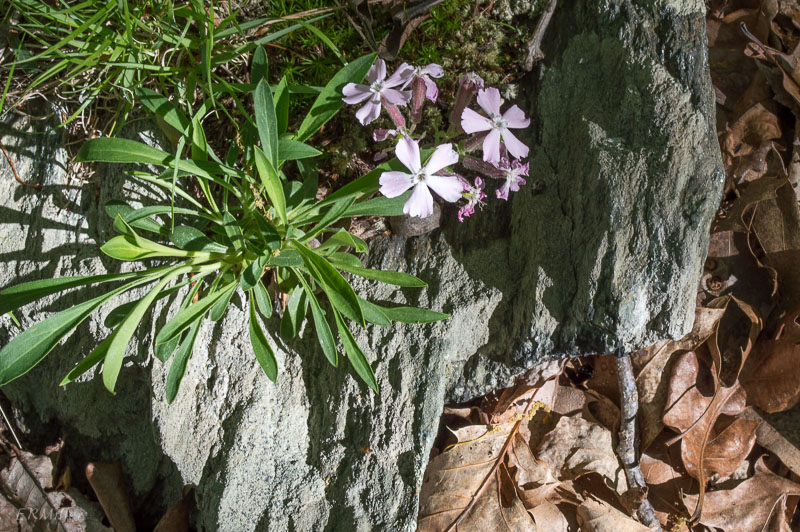
20150131-_DSC0172Silene caroliniana; Caryophyllaceae

This one just took me by surprise.  I went to a favorite area that has some unusual plants, and saw two that I didn’t know were evergreens (I’ll post about the other one next time).  Apparently this one is a semi-evergreen, which usually means the leaves will survive a mild winter.  Wild pink is endangered in Florida and exploitably vulnerable in New York.  Start looking for the flowers in early May.
20140505-DSC_0012

Oh, and about that common name… one internet source says that the word “pink” used to describe color came from the common name of flowers in the genus Dianthus.  For some reason I had it in mind that the word “pink” in describing flowers of the Caryophyllaceae came from an old word meaning “to cut a decorative edge” – like what you use “pinking shears” for.  I can’t find a source to support that claim, though.  If anyone reading this is an expert in English etymology and would care to post a reply, I’d be grateful.
Winter Interest: Tuliptree

20150131-_DSC0037

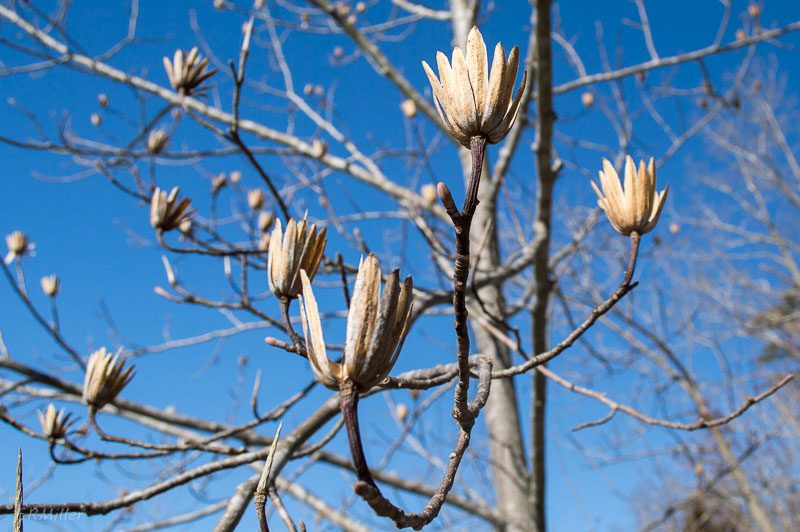
aka tulip poplar, yellow poplar, white poplar, whitewood; Liriodendron tulipifera; Magnoliaceae

Tuliptree blooms in late May; once the flower drops, these nifty seedheads remain, but are hidden from view until the leaves drop.

20140527-DSC_0122

in flower, late May


ps – don’t confuse this with true poplars (genus Populus), which are in the willow family (Salicaceae)

What’s Green Now? American Holly

20150131-_DSC0127

Ilex opaca; Aquifoliaceae

According to the US Forest Service, American holly is “the hardiest known broadleaf evergreen”.  Despite the cold tolerance, it’s a plant of the southeastern US, although it does grow along the Atlantic coast as far north as Massachusetts.  And considering how popular it is in horticulture (over 1,000 known cultivars), it’s a little surprising that it’s listed as threatened in Pennsylvania and exploitably vulnerable in New York.

Sadly I have no pictures of the flowers, which are small, white, and inconsequential, or the berries.

20150131-_DSC0144

More detailed information from the USFS here.

What’s Green Now? Alumroot

20150131-_DSC0110

Heuchera americana; Saxifragaceae

Like rock polypody, alumroot grows right out of rocks, or rocky areas with thin soils.  Cultivars of Heuchera species are common in the nursery trade; look for them under the common name “coral bells”.  They make for nice texture in a shade garden, or as a groundcover near trees (if tree roots don’t out-compete them), though they won’t tolerate foot traffic.

This not-so-good photo is of the exact same plant shown above, taken in early June 2014.  Note the Virginia creeper (Parthenocissus quinquefolia) cascading around it.

20140601-DSC_0028

What’s Green Now? Rock Polypody

20150131-_DSC0151

Polypodium virginianum; Polypodiaceae

There are a few native ferns that are evergreen: ebony spleenwort, some of the woodferns (Dryopteris species), Christmas fern (in milder winters).  I’ve seen a few around but haven’t been able to identify them.  Rock polypody is pretty easy, though.  I love how it grows right out of stone, needing very little soil. Being a fern, of course, it won’t flower, but here’s how it looks in mid July:

20140725-DSC_0156

There are vast stands of it on the rocky bluffs around Carderock.