
Verbesina alternifolia
Asteraceae

I don’t have anything new to write about this plant since last year; just wanted to post these pictures. The light on them was so lovely.
Verbesina alternifolia
Asteraceae
I don’t have anything new to write about this plant since last year; just wanted to post these pictures. The light on them was so lovely.
woodland sunflower
Helianthus divaricatus
and

thin-leaved sunflower
Helianthus decapetalus
Asteraceae
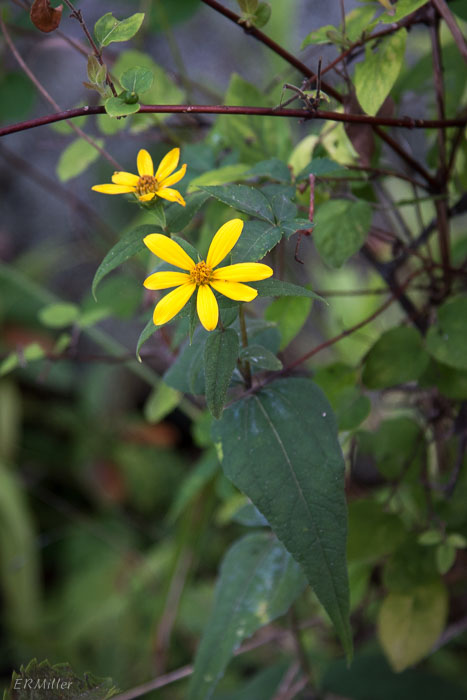
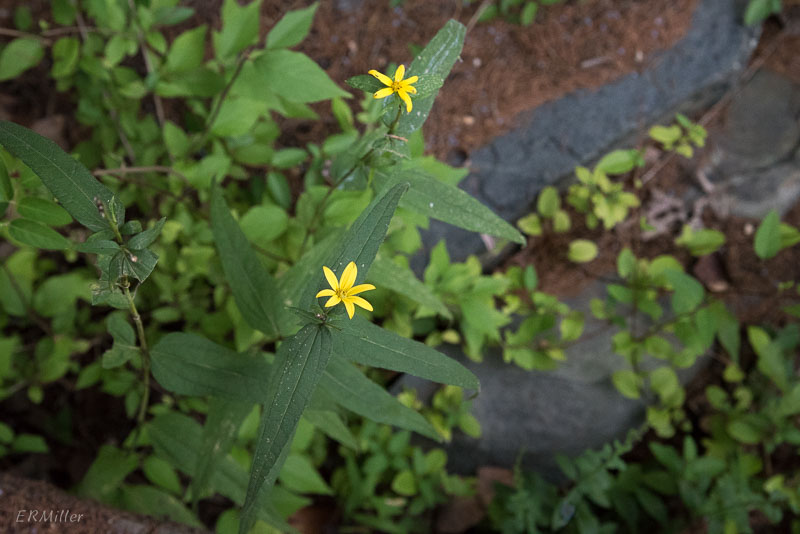
These two species have very similar looking inflorescences, with yellow disks and anywhere from 8 to 20 rays; note that despite the specific epithet “decapetalus” (meaning ten petals), thin-leaved sunflower does not always have ten rays.
Both grow from two to six feet tall. Despite this and the similar flowers, it’s easy to tell them apart if you look at some of the details.
Habitat: woodland sunflower, as the name suggests, tends to be found in the shade of woodlands, often in drier soils than the other species. Thin-leaved sunflower is more often found in open areas between trails and the river, where there’s more sun and moisture.

Woodland sunflower has long-tapering, lance-shaped leaves that are either sessile or with very short petioles. The margins have a few slight teeth. The leaf surface is rough to the touch, like sandpaper.

The leaves of thin-leaved sunflower have long petioles, often winged (especially the larger leaves, which are sharply toothed), and the top leaf surface is smooth.
Woodland sunflower can be found in the eastern US and a few states west of the Mississippi. In the Potomac Gorge, it’s not too common. It’s listed as “special concern” in Rhode Island.
Thin-leaved sunflower has a similar range and is much easier to find in the Gorge, especially along the eastern half of Billy Goat C. There are no conservation issues.
Sixty more native species and naturally occurring hybrids of Helianthus are in the continental US and Canada. Seventeen total can be found in Maryland; of these, three are listed as S1 (“highly state rare”) by the DNR.

It’s been in the back of my mind to break out of my rut and explore different areas – at the very least, the rest of the Potomac Gorge. And I keep thinking “next year; I’ll do it next year.”
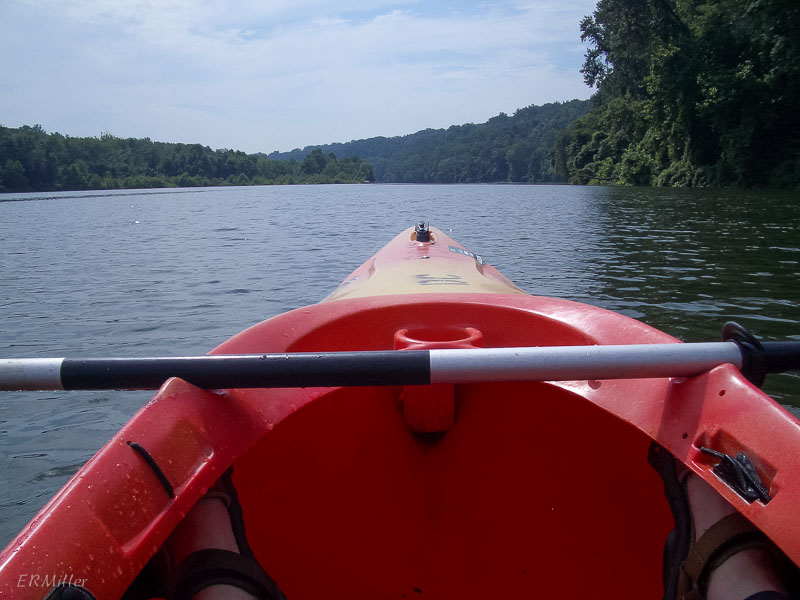
In the meantime, Steve and I might have picked up a new hobby. We rented kayaks from the Boathouse at Fletcher’s Cove and went out on the river last Saturday. And guess what I saw? Wildflowers. Lots and lots of wildflowers, some that I’d never seen before. But I didn’t have a camera with me. Not even the iPhone!
So yesterday morning I went again, and took my time exploring the shoreline. Went from Fletcher’s upstream to Chain Bridge, then back down the Virginia side past Fletcher’s and part way to Key Bridge, then back up the DC side. Along the way I saw:
wild senna (either Senna hebecarpa or Senna marilandica)
water horehound or bugleweed (Lycopus species)
obedient plant (Physostegia virginiana)
boneset (Eupatorium perfoliatum)
cardinal flower (Lobelia cardinalis)
pickerel-weed (Pontedaria cordata)
purple loosestrife (Lythrum species)
sneezeweed (Helenium autumnale)
water star-grass (Heteranthera dubia), in its element this time
tickseed sunflower (Bidens coronata)
and something that might have been extraordinarily tall evening primrose (Oenothera biennis)
And two ospreys, fishing.
So, where are the pictures? I’m still new to kayaking; not trusting my ability to keep myself in the boat and dry, I decided to take an old point-and-shoot camera (Pentax Optio S4), figuring that if I was going to ruin a camera, it may as well be one I haven’t used in more than ten years.
Long story short, the pictures are awful (which is why some of the plants aren’t fully identified).
But now I have a new beat to explore. And a new way of exploring it, too. I’ll be back as soon as I can rig a way to keep the Nikon D3200 safe and dry.

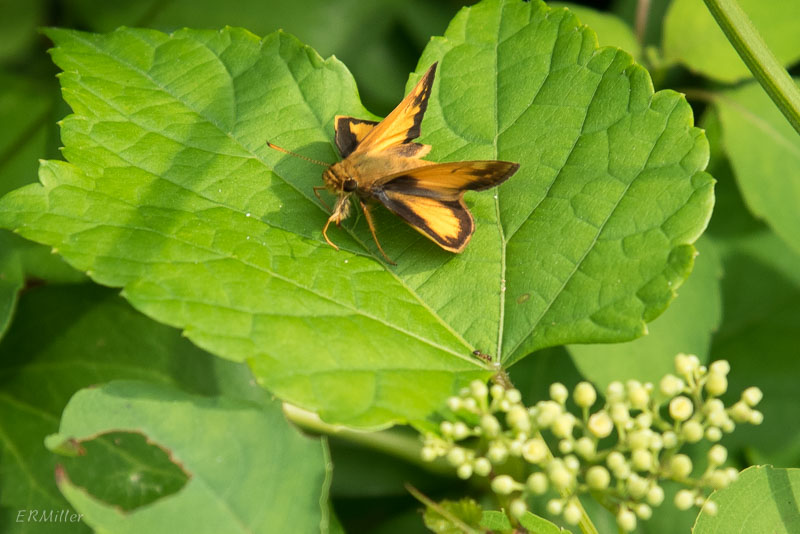
a skipper, possibly a zabulon skipper (Poanes zabulon)
When I took this photo I wondered, is that a moth or a butterfly? Eventually I identified it as a skipper, which I thought was a kind of butterfly until this article came along. So of course I had to dig a little deeper.
Researching these topics usually becomes an exercise in understanding names, which usually leads down the rabbit hole into the wonderland of taxonomy, a place I love but don’t want to be visiting every time I write a blog post.
To my great relief, I found this right away: “From a taxonomic standpoint, the distinction between moths and butterflies is largely artificial”.*
Moths, butterflies, and skippers are in the order Lepidoptera, (from the ancient Greek words meaning “scale” and “wing”). Scaly, pigmented wings that are relatively large compared to body size is one of the distinguishing characteristics of the order. In general – there are always exceptions – the differences come down to this:

Moths are mostly nocturnal, hold their wings flat when at rest, tend to be drab colors, and have threadlike or featherlike antennae.

Butterflies are diurnal, hold their wings over their bodies when at rest, tend to be brightly colored, and have hooked or club-like antennae.
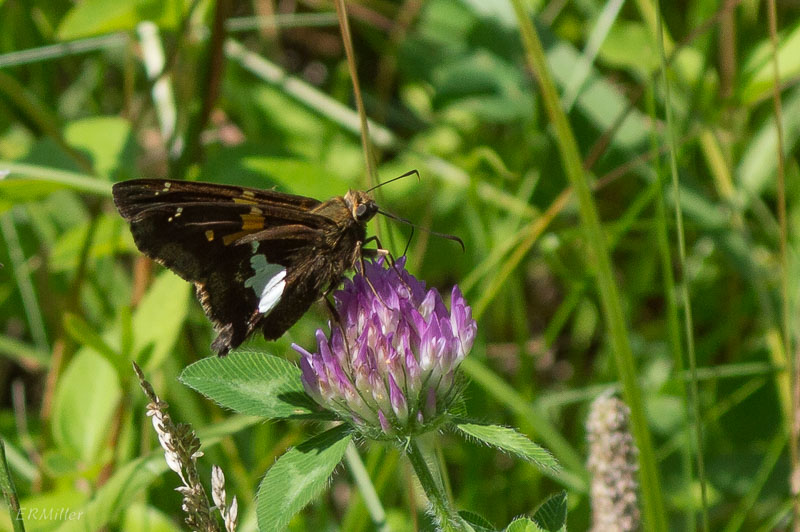
Skippers often hold their forewings over their bodies and their hindwings flat, have moth-like heads and bodies, have knobbed antennae with hooked tips, have smaller wings with respect to body size, and larger eyes than moths and butterflies.
As Shakespeare wrote:
What’s in a name? that which we call a rose
By any other name would smell as sweet…

northern pearly eye (Enodia anthedon)
*North Carolina State University General Entomology website
other sources:
Wikipedia articles about skippers and Lepidoptera
LearnAboutButterflies.com
Encyclopædia Brittanica
marylandbutterflies.com

aka field mint, corn mint
Mentha arvensis
Lamiaceae
Pretty little thing, isn’t it? Not a very remarkable plant. It looks like mint, it smells like mint. It grows to two feet tall in moist soils in the sun; in the shade it can be somewhat sprawling. But it has those wonderful whorls of flowers in the leaf axils.
Wild mint can be found through most of the US and Canada except for parts of the South. There are no conservation issues, but Nebraska considers it weedy/invasive.

 Elizabeth's Wildflower Blog