Three Buttercups

20160425-_DSC0218

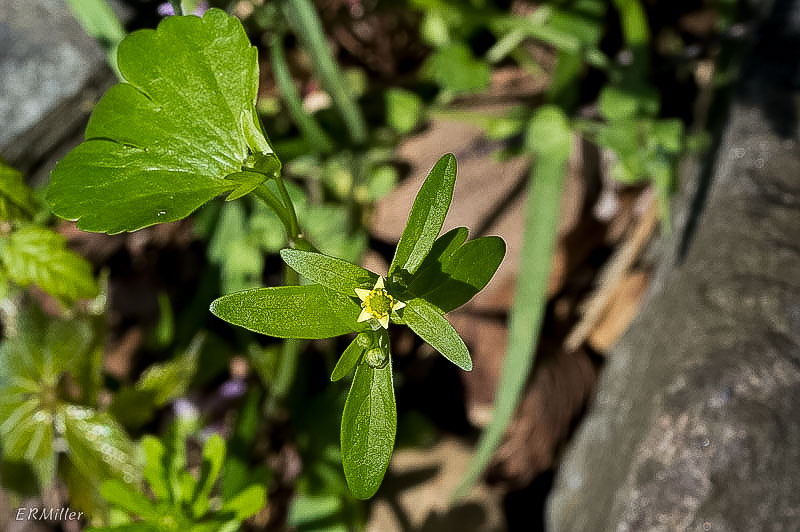
hooked crowfoot or buttercup
aka blisterwort
Ranunculus recurvatus

20150708-20140417-DSC_0155


kidney-leaved, small-flowered, or little-leaved buttercup
Ranunculus abortivus

20160404-_DSC0058


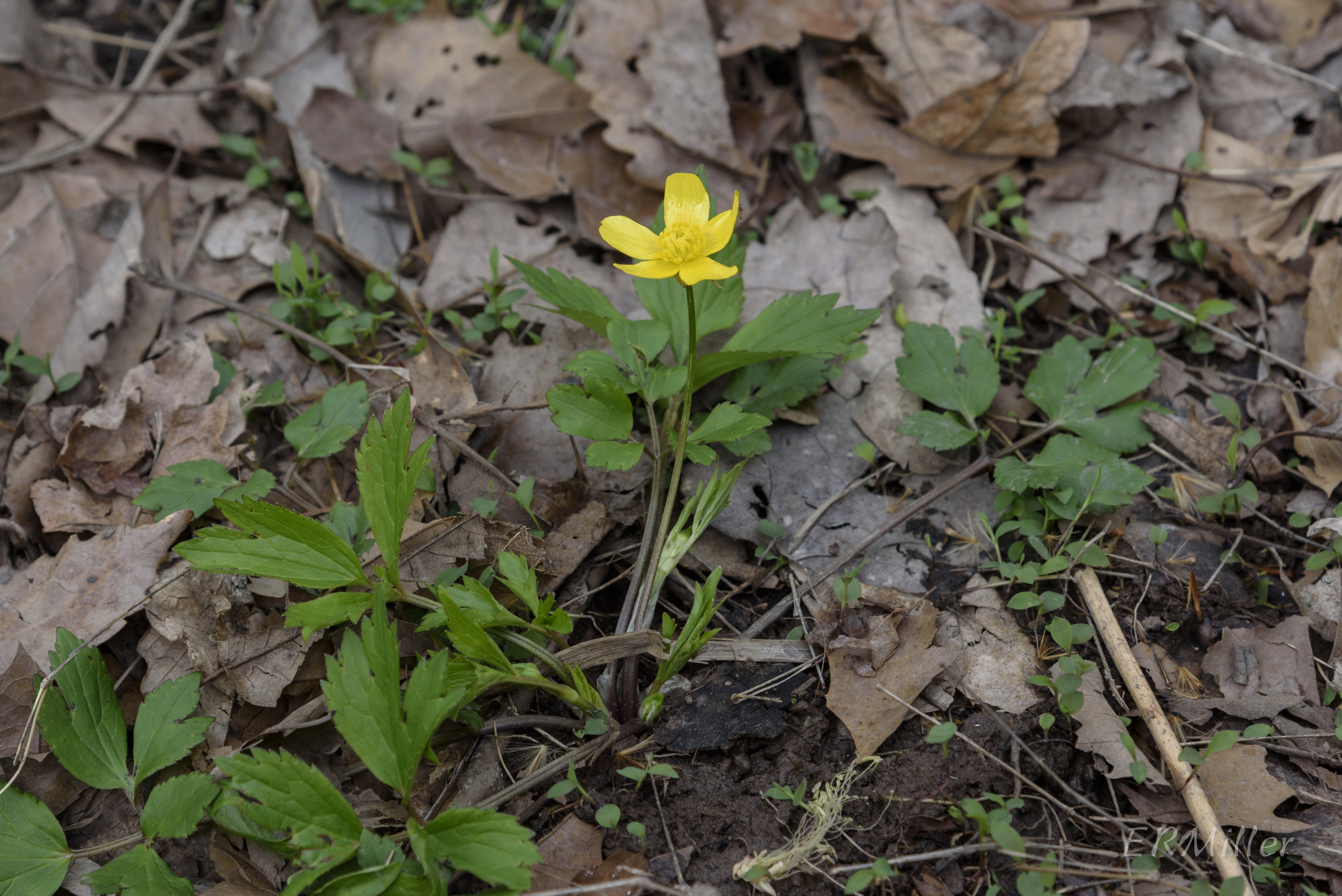
swamp buttercup
Ranunculus hispidus var. nitidus
(formerly R. septentrionalis)


Not every wildflower is as showy as the azaleas and orchids I recently wrote about. To a geek like me, though, they’re all interesting. These three aren’t much to look at but they’re commonly encountered in moist woods all over the Maryland piedmont at this time of year.

There may be as many as eight different native Ranunculus species in the area. I have some difficulty in telling them apart, but am reasonably certain that these three are correctly identified. If you believe differently please leave a comment!

perfoliate

20160426-_DSC0113

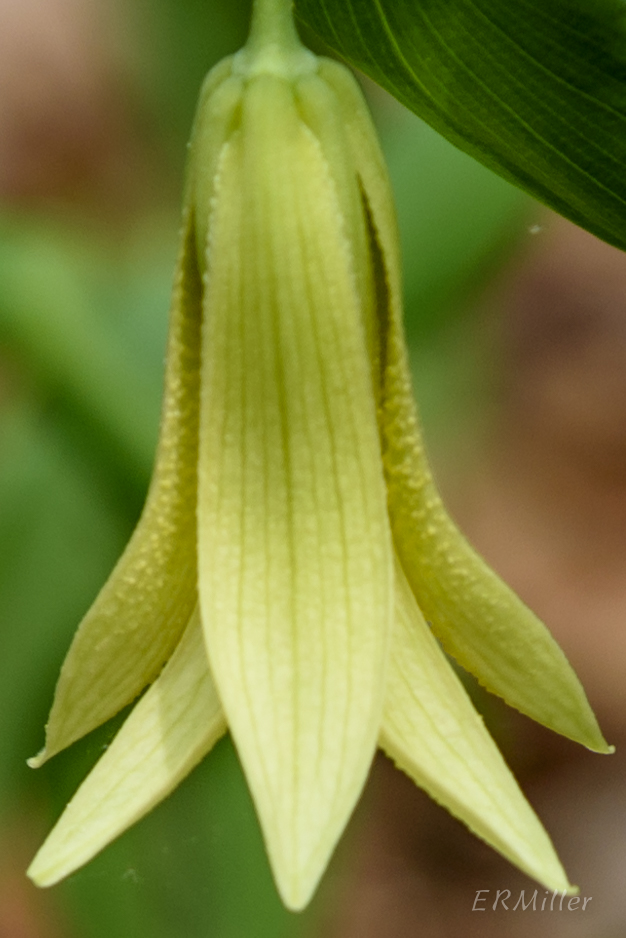
perfoliate bellwort
Uvularia perfoliata
Colchicaceae


Cousin to the tiny dancer I posted about last month, perfoliate bellwort grows in the same conditions and much of the same parts of the country. It’s endangered in Indiana and New Hampshire. There isn’t much more to say about it, other than I found this fantastic stand in Rachel Carson Conservation Park. I’ll let the pictures do the talking.

. 20160426-_DSC0115 20160426-_DSC011820160426-_DSC0114 20160426-_DSC0120

Two White Violets

20160405-_DSC0131

creamy violet
Viola striata
Violaceae

20160421-_DSC0059


sweet white violet
Viola blanda
Violaceae


It is with some trepidation that I venture into violet territory, as there are 117 species across the US, and violets are known to hybridize freely, so that identification often comes down to tiny little details.

According to the blog Mid-Atlantic Nature, nine white violets can be found in this area. A cross check with the Maryland Biodiversity Project shows that only six of these are present in the Maryland piedmont. And, the two shown in this post have some unique characteristics, so I’m fairly confident that they’ve been correctly identified.

As you can see in the pictures (if you zoom in), creamy white violet has two bearded petals, while sweet white violet has a reddish-brown stem .

Creamy violet is all over the place on Billy Goat C downstream of Carderock, with some occurrences upstream along Billy Goat B as well. I’m honestly not sure If I’ve seen sweet white violet in that area; You have to be pretty close to see the details. I saw this one plant (only this one plant) in Rachel Carson Conservation Park.

The two species have similar ranges, in most parts of the country east of the Great Plains, with V. blanda found further north and V. striata further west.


Update 5/10/16

It’s possible that the sweet white violet pictured above is actually primrose-leaved violet, V. primulifolia, a naturally occuring hybrid of V. lanceolata and V. macloskeyi. I can’t really say without better pictures.

Carderock, May 2

20160502-_DSC0050

The morning of May 2 I set out for a quick survey of the greater Carderock area, with the goal of shooting some long-tube valerian, a highly state rare/endangered species that grows in several different locations in the Potomac gorge.

20160502-_DSC0013

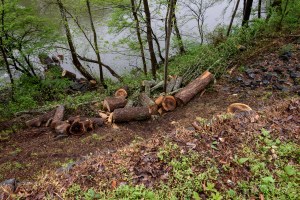
Along the way, on the towpath between the Billy Goat C and Billy Goat B trailheads, I noticed that a lot of trees along the stone retaining wall were missing.

What the heck? Wondering why, I decided to call the park and inquire when I got home.

I didn’t need to. A few hours later, on the way back, I saw a ranger taking photos, so I asked him about it. In summary, the retaining wall is historic, and it’s been in danger of being damaged by the trees, some of them were quite large. If one had gone down in a storm, the root mass lifting out of the ground could have caused a breach in the wall. Not only would that severely damage the canal and make that part of the towpath unusable, but an 8′ diameter sewer main, part of the Potomac Interceptor sanitary system, runs along there. It, too, would be severely damaged by a breach in the wall.
20160502-_DSC0012

The flags marked a line 20 feet from the base of the wall; all the activity is being kept within that zone. They will be installing some monitoring equipment in order to track changes to the wall in coming years.

My main concern, of course, was damage to plant communities. Good news: the park always has an expert come in for a plant survey before they do any work.

20160502-_DSC0110

Annoyingly the narrow strip of land between the towpath and the wall gets moved every few weeks, but if you go now, you’ll see some lyre-leaf sage blooming in there. The plants are quite short, but year after year they survive the mowers.


The spring ephemerals are almost entirely gone, just a few spring beauties left. Observed blooming on May 2:


  • wild blue phlox (waning)
  • star chickweed
  • Virginia waterleaf (just starting)
  • Coville’s phacelia (past its peak)
  • long-tube valerian
  • clustered snakeroot (just starting)
  • golden Alexanders (S3 – rare to uncommon)
  • rattlesnake weed
  • hairy beardtongue
  • moss phlox (waning)
  • field chickweed
  • wild geranium
  • rue anemone
  • lyre-leaved sage
  • Rubus species (probably a dewberry)
  • azure bluets
  • dwarf cinquefoil
  • plantian-leaved pussytoes (waning)
  • bastard toadflax
  • fringetree
  • deerberry
  • alumroot
  • violet wood sorrel
  • wild pink (a day or two away from being done)
  • spring forget-me-not
  • Virginia spiderwort
  • common wood sorrel
  • Philadelphia fleabane

Showy Orchis

20160426-_DSC0097

aka purple-hooded orchid
Galearis spectabilis
Orchidaceae


The morning before I left to go to Rachel Carson Conservation Park a second time, someone posted a picture of showy orchis on the Maryland Native Plant Society facebook page. So I went with two goals: to shoot the pinxters, and to find some orchids. It didn’t take too long to find them, but my planned two hour outing became three, then four, then five as I found more and more beautiful and interesting plants to shoot.

Showy orchis is low-growing, with a pair of large basal leaves and a single stem that may hold up to a dozen flowers. It ranges through most of the US and Canada east of the Mississippi River, and somewhat into the Great Plains states, growing in calcareous soils in rich, moist woodlands where there isn’t too much competition from other plants. As with other orchid species, showy orchis has very specific growing requirements (including the presence of certain fungi in the soil), which makes it a difficult plant to grow in the home garden. Attempts to transplant them from the wild are doomed to fail.

20160426-_DSC0133

Showy orchis is endangered in Maine and Rhode Island, threatened in Michigan and New Hampshire, exploitably vulnerable in New York. There’s one other species in the genus Galearis (G. rotundifolia), but it grows much further to the north.

“Orchis”, by the way, is not a typo. It’s a genus in the orchid family, consisting mostly of temperate Eurasian species. Galearis spectabilis was previously placed in that genus, so the common name is just a translation of the plant’s old Latin name, Orchis spectabilis.

20160426-_DSC0145