Reflecting

I’m not a religious person. I’ve spent many hours in various houses of worship of different religions, where I’ve found comfort (at funerals), and joy (at weddings), and boredom (at Catholic services, sorry), and peace (at meeting). But the religious experience eludes me in any place made by Man.

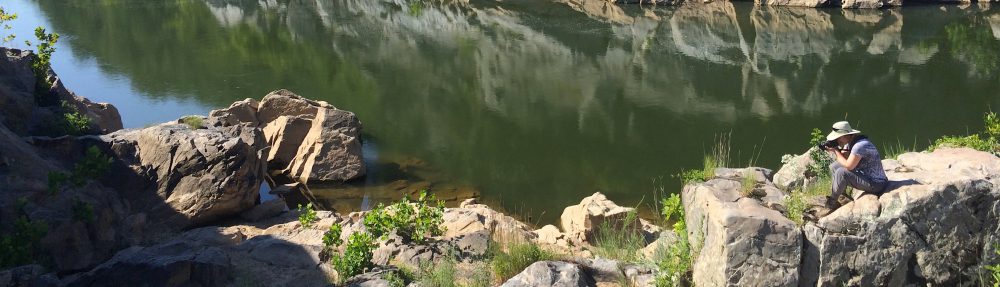
If I’ve ever had a religious experience, it’s been in the outdoors. Along the Great Cacapon River in West Virginia when I was a child, on Sugarloaf Mountain when I was a teen, in the Potomac Gorge nowadays, and any wild place I’ve visited: Canyonlands, Mount Rainier, the Olympic Range, Death Valley… in these places I experience the grandeur of creation (if I can use that word), the vastness of this planet, the insignificance of humankind. And I find comfort and joy and peace and an overwhelming sense of awe.

The wild is my holy place.

Which brings me to Anza-Borrego. As you’ve probably heard, the park was overwhelmed by visitors; the tiny town of Borrego Springs ran out of gasoline and was running out of food the first weekend. People were saying the media played up the super bloom like never before, and it showed, with miles-long backups on the main roads, and road closures, and full parking lots, and cars parked on roadsides, and long lines at restaurants, and No Vacancy signs everywhere.

On the one hand, I should be glad of this, that so many people want to experience something so unusual and special. Maybe some of them will be converted and become environmentalists, and begin to understand the interconnectedness of it all and why it’s so important to have wild places. That would be a good thing.

On the other hand, I was mighty pissed off. I go to the wild for solitude, and I was almost never alone in my four days there. I was getting increasingly annoyed by clouds of dust as cars sped by on dirt roads, by people walking anywhere, not watching their footing, trampling plants, by people talking loudly or shouting to each other. By people taking selfies.

By people.

Imagine worshipping in your synagogue or mosque or church while a troupe of loud-mouthed, ill-mannered, immodestly-clad tourists go through.

The wild is my holy place. I want to share it with you, but please: show some respect.

What Makes it a Desert?


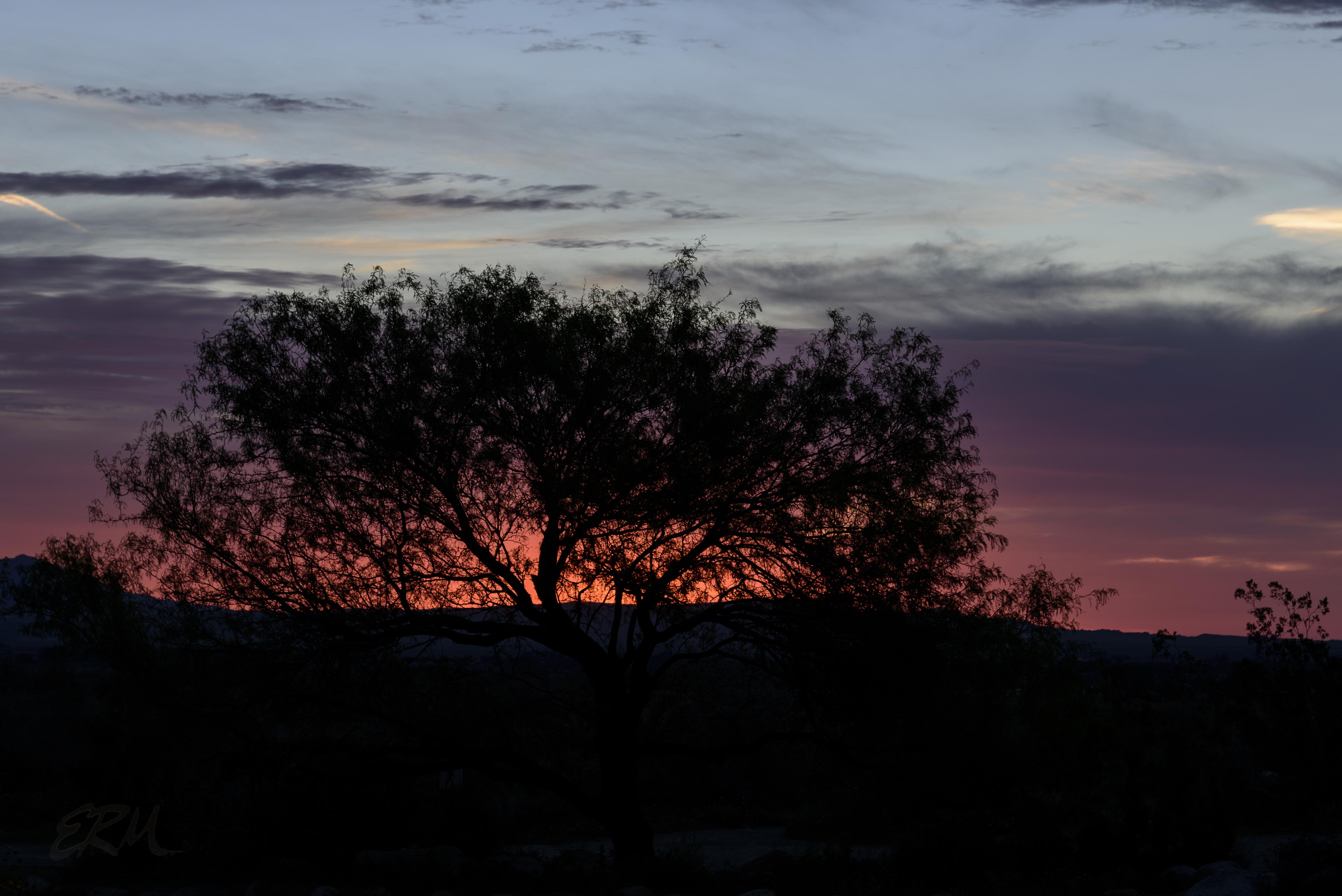
sunrise, March 15, near Palm Canyon in Anza-Borrego Desert State Park


Defining the word “desert” is not as straightforward as it may seem. Colloquially, desert usually means a hot, dry area, or sometimes a cold, dry area, without much vegetation or animal life. Technically, experts don’t agree. According to the US Geological Survey, “There are almost as many definitions of deserts and classification systems as there are deserts in the world.”

A useful definition of desert is: an area that receives 25 cm or less of precipitation annually.


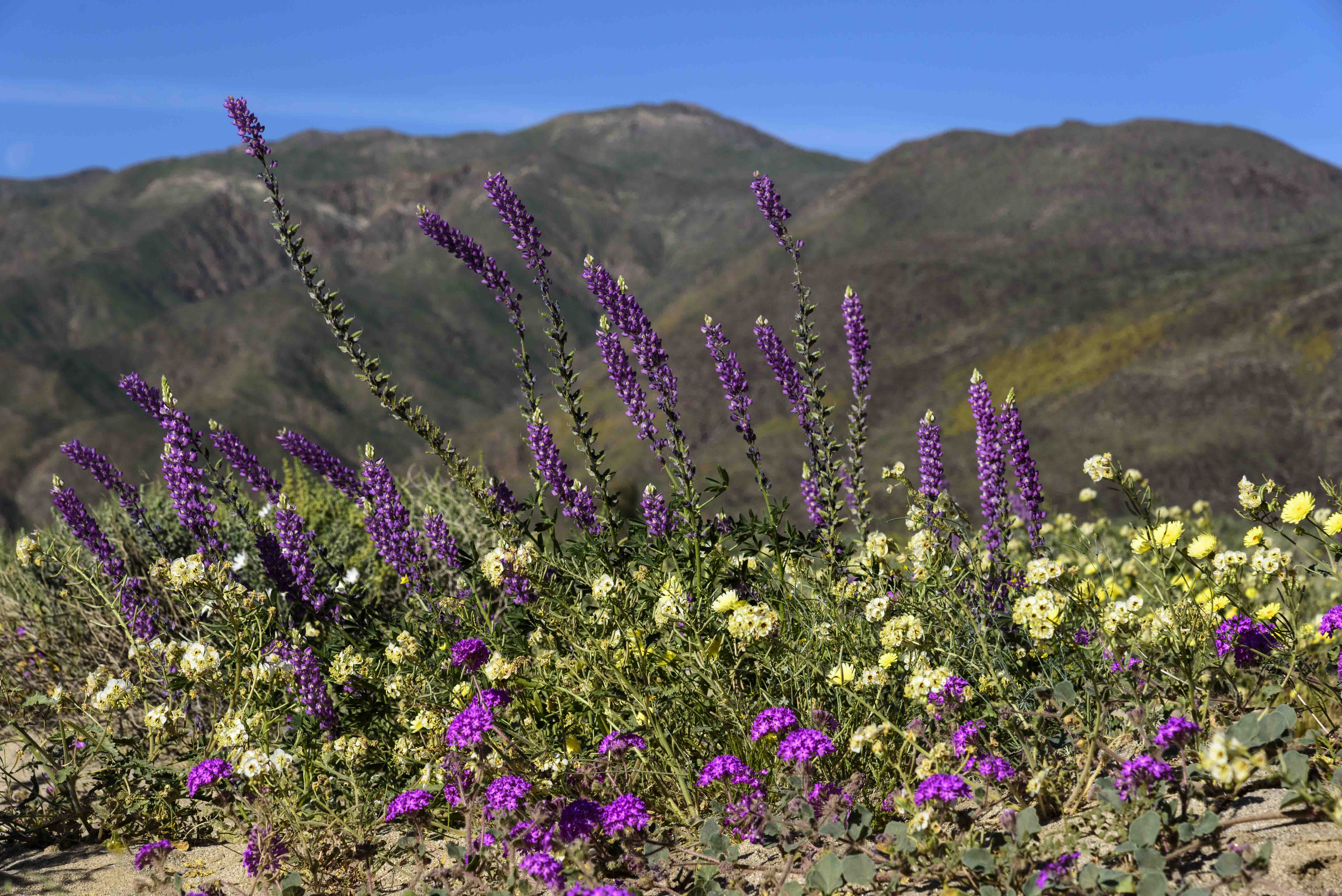
chuparosa, phacelia, desert dandelion, brown-eyed evening primrose, and pincushion near the Anza-Borrego Visitors Center


Experts don’t agree on the boundaries and names of the North American deserts, either, but various sources state that there are many minor deserts and four major ones: the Great Basin, Chihuahuan, Mojave, and Sonoran. The Great Basin is the most northerly of these, bounded by the Columbia Plateau, Sierra Nevada Mountains, and Rocky Mountains; geopolitically, this means southeastern Idaho, most of Nevada, western Utah, and east-central California. The Chihuahuan is the most southerly, ranging from southeastern Arizona, southern New Mexico, and west Texas south into Mexico.

The Mojave is a transition from the Great Basin to the Sonoran, and comprises the greater Death Valley area, extreme southern Nevada, a bit of northwestern Arizona, and a tiny smidgen of southwestern Utah. One of the defining features of the Mojave is the flora, as it contains about 200 endemic species. (Look in the March and April 2016 archives for lots of posts about Mojave Desert wildflowers.)

The Sonoran is where Anza-Borrego is. Actually, Anza-Borrego forms the western boundary; from there it spreads east into Arizona and south into Mexico. Although Death Valley in the Mojave boasts the highest air temperature ever recorded (134ºF, in 1913), the Sonoran is on average hotter. And wetter.


desert sand verbena, brown-eyed evening primrose, desert dandelion, Arizona lupine, and a few desert chicory on Coyote Canyon Road


The Mojave and Sonoran deserts share a few wildflower species, or more often a few genera, which made identifying the plants a bit easier. I found about 75 different species in 23 families (with half a dozen still unidentified). The Asteraceae and Boraginaceae were well represented. And this time I saw some cacti blooming, too.

Lily Hunting


On March 13, when “Ephemeral” posted on this blog, I was on my way to California to see a super bloom of wildflowers in Anza-Borrego Desert State Park. Unusually heavy autumn and winter rains, along with cooler than normal temperatures, allowed the growth and flowering of perennials and desert ephemerals in quantities that have been called “unprecedented.”

It was spectacular.

The trip was put together in a big hurry, and not knowing if I would hit the peak bloom or be too late, I tried not to have any goals. “Just be grateful you get to go, and enjoy whatever you find,” I told myself. “No disappointments. No regrets.”

But a little voice inside me kept whispering “…except for desert lily. You really have to find desert lily.” I admit, I enjoy the hunt.

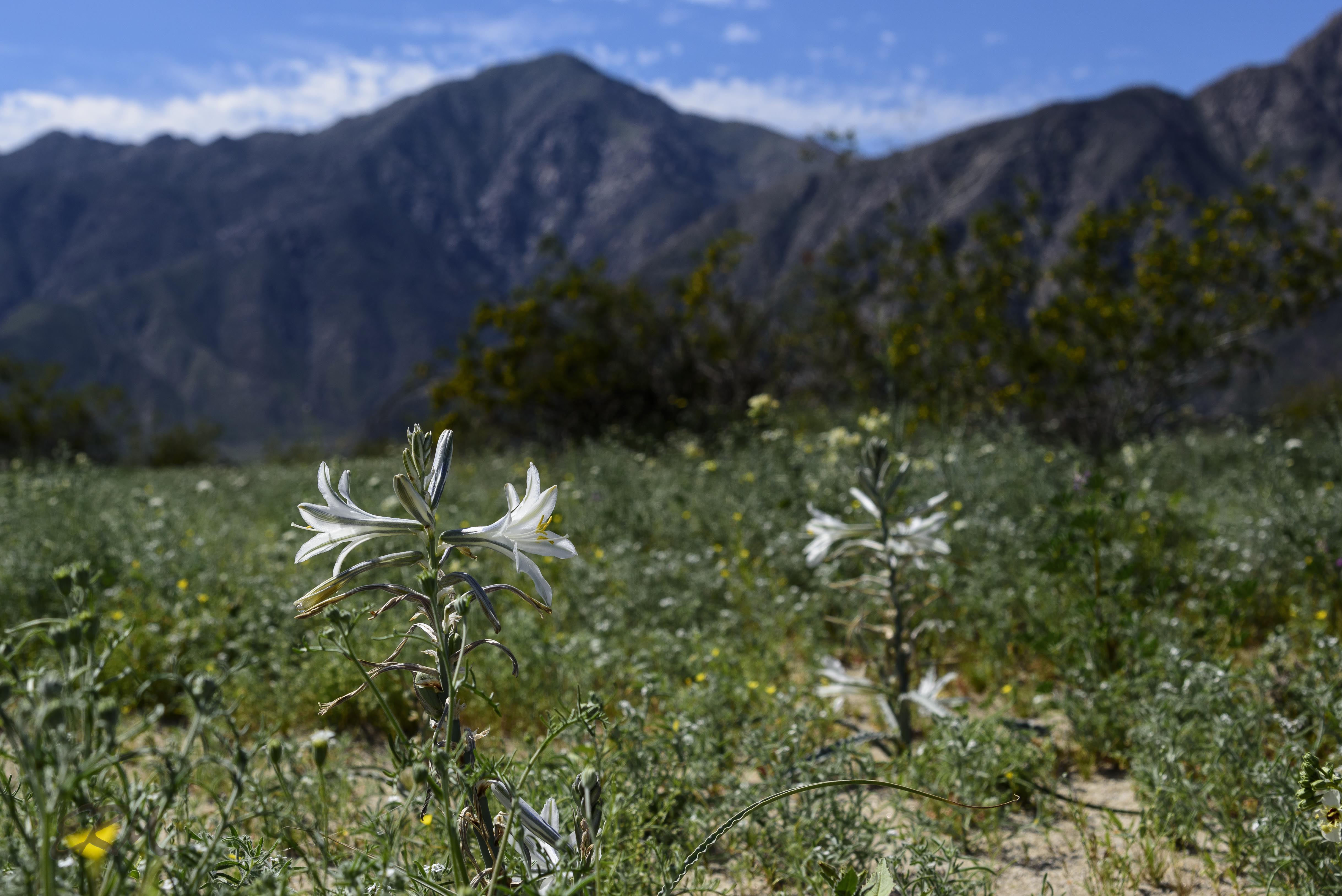
So on my second day in Borrego Springs, sipping an horchata and trying not to wilt while the temperature climbed to 97°F, I drove slowly along an almost traffic-free Big Horn Road, looking for glimpses of silver. Fifty yards or so west of Borrego Springs Road I saw it.

This beautiful plant is a perennial, with a growing season of six to ten months. A deep-set bulb produces a few long, narrow, wavy leaves and a single stem with a dozen flowers or more; the whole plant stands as tall as eighteen inches. Its range is limited to western Arizona, southern Nevada, and southeastern California, in the Sonoran and Mohave deserts.

According to older sources, Hesperocallis undulata is in the Liliaceae; later work by the Angiosperm Phylogeny Group put it in its own family, then into the Asparagaceae. Other sources placed it in the Agavaceae. If you search on-line you’ll see it listed in any of these families, but as far as I can tell the most current placement is Asparagaceae. I have no idea why classifying this species has been so difficult.

Note

For this and upcoming posts about Sonoran Desert wildflowers, I’ve relied on the following resources:
San Diego County Native Plants (James Lightner, 3rd edition 2011)
Calflora and CalPhotos
Anza-Borrego Desert Natural History Association
Desert USA
SEINet

Greetings From Borrego Springs

…and Anza-Borrego Desert State Park, where the crowds are almost as thick as the flowers, but not nearly as pretty.

And where internet connectivity is crap.

I’d hoped to use my downtime this week to get some posts out about this incredible place, but they’re going to have to wait. Seriously – I’m typing this while eating in a diner, using my iPhone as a tether since even the public library network isn’t working, even though I appear to be connected.

Hopefully I can get a lot done in the airport Friday, awaiting my plane.

That’s a desert lily in the foreground, by the way.

More in a few days!

Ephemeral

momentary, transitory

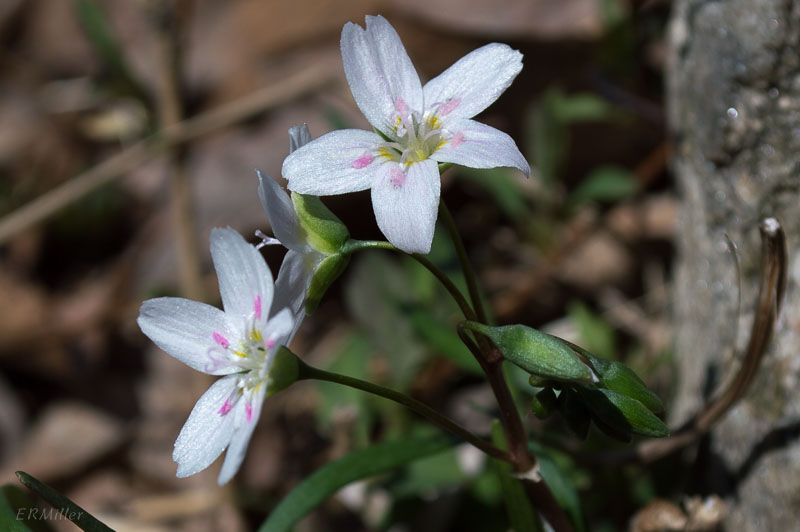
Claytonia virginica

One day about twenty years ago when I was a new Master Gardener, I plucked an entire small plant from my wooded front yard and took it to the office for identification. The plant consisted of a few grasslike leaves no more than two inches long, with a single five-petaled pinkish white flower.

The first MG I asked chided me for not bringing a larger sample. “But this is the whole plant!” I replied, “except for the roots.” Then another MG took a look and said “ooh! spring beauty! it’s one of the ephemerals.”

I’ve been in love with the concept ever since.

evanescent, fugacious

Forbs are herbaceous plants other than grasses; their growth is usually described as either annual or perennial. An annual grows roots, stem, and leaves from seed, then flowers and goes to seed all in one season, and dies. A perennial does the same, but the roots survive to allow the plant to grow again the next season. Some plants have a two year life cycle, producing flowers and seeds in the second year before dying; they’re called biennials.

There are some variations to this theme. Plants that grow and bloom through the winter and early spring are called winter annuals. Or hibernals, if they’re perennial.

Ephemeral describes plants with a very short life cycle. They are usually perennials that grow and bloom for about a month, or maybe two, but not the whole season. Here in the east we have spring ephemerals, woodland plants that take advantage of the sunlight coming through the leafless tree canopy. By the time the trees leaf out, most of these forbs are done and gone ’til the following spring.

Most of our early spring bloomers are ephemerals: Dutchman’s breeches and squirrel corn, trout lily and white trout lily, Virginia bluebells, harbinger-of-spring, cut-leaf and slender toothworts, rue anemone.

Jeffersonia diphylla
twinleaf

Although the foliage lasts a month or so, twinleaf flowers last only a few days. And all the plants bloom at the same time, so even if there are hundreds of plants in a stand, you have five days at most to see them flowering.


Phyla lanceolata
fogfruit

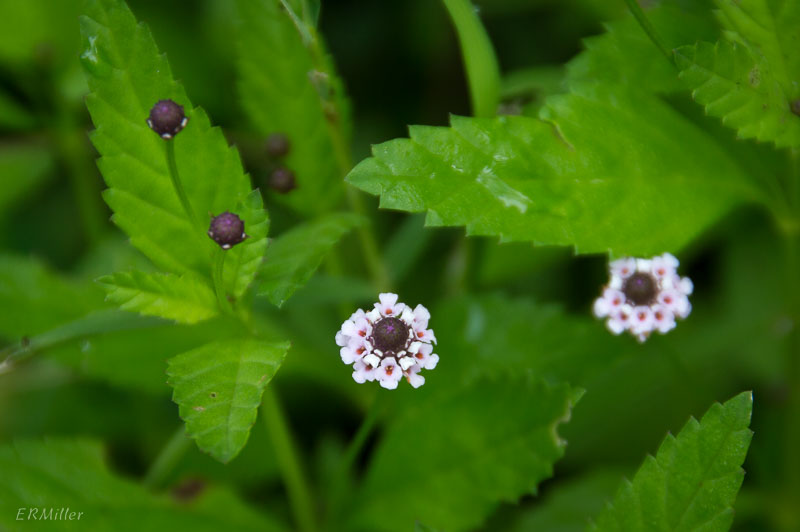
We also have mudflat ephemerals, plants that wait until summertime, when rivers run low, then grow from the resulting mud. I wasn’t able to find any official list of these, but I’ve seen this growth habit in the Potomac gorge. So as an educated guess, I’ll suggest the following as possible mudflat ephemerals: Lindernia dubia (false pimpernel), Phyla lanceolate (fogfruit), Teucrium canadense (American germander), and Eclipta prostrata (false daisy).

Out West there are desert ephemerals, that pop up and bloom only when the right conditions are met. Most of those plants are annuals.

 passing, fleeting

Just like springtime itself, the ephemeral flower show doesn’t last long enough. Perhaps that’s why we love it so: like the Japanese with their cherry blossoms, we treasure the things that don’t stay with us for long.