
It worked. With a friend’s help and introduction I was able to get a collecting permit. Unfortunately by that time Stand #1 had finished flowering, but I did collect one flower from Stand #2, and one capsule from each stand.
Here’s a summary of my notes. (Refer to the last four posts from this past May for details, particularly the one from May 27.)
Stand #1
No flowers remaining. Most flowering stems appear to have been cropped about halfway up. One untouched stem was flopped over [I. virginica]; the other (cropped) stems were upright [I. versicolor or I. virginica var. shrevei]. The collected capsule was conspicuously beaked [I. versicolor], measured 70mm long by 13mm wide, and was broadly triangular in cross section.The spathe associated with this capsule was dry and papery [I. versicolor]. The seeds were underripe: still green, with shiny outsides that did not appear to be corky [I. versicolor] and may or may not have been pitted.

Stand #1: capsule with spathe

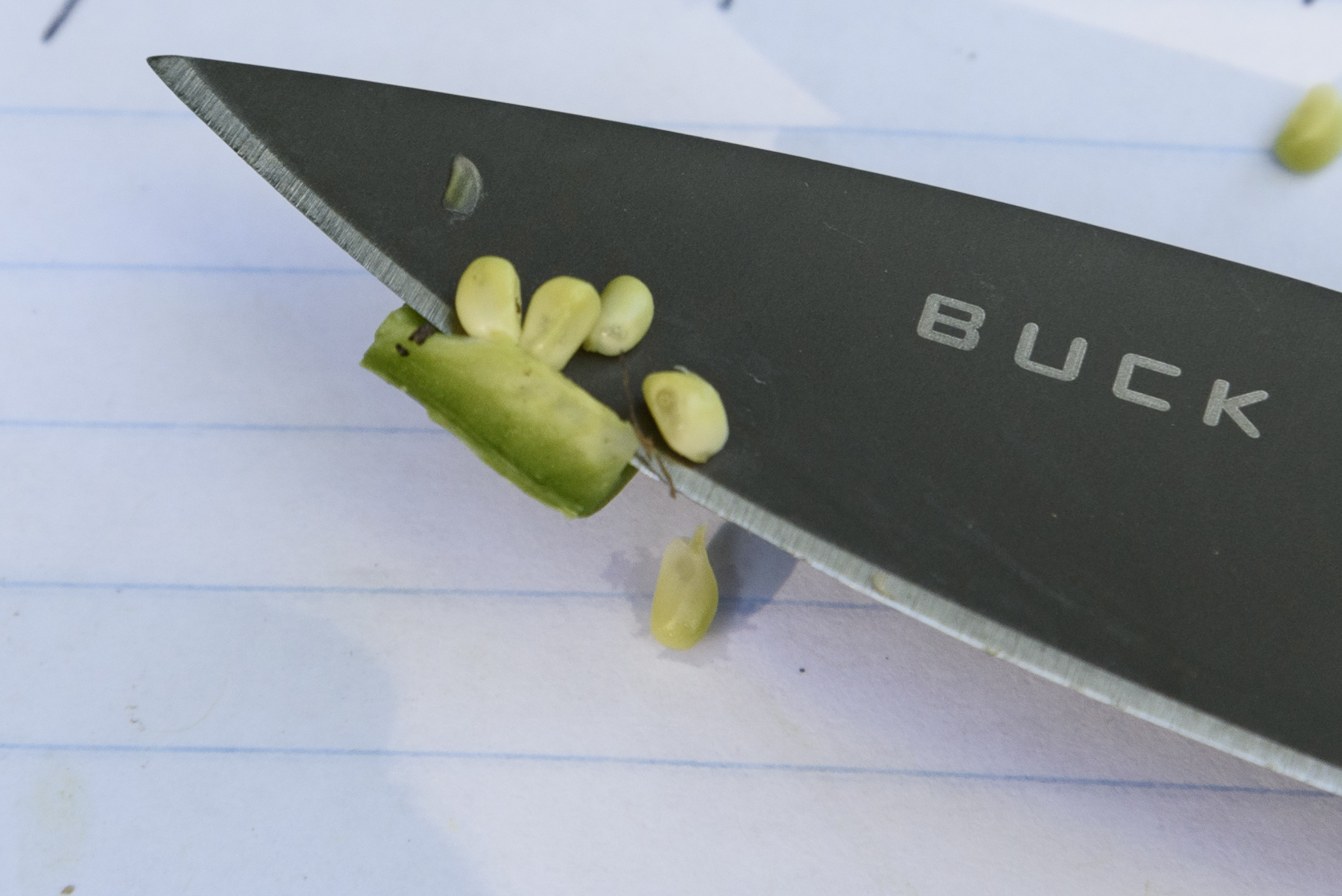
Stand #1: seeds
Stand #2
The collected flower had sepals measuring 55mm, 55mm, and 56mm long, and the corresponding petals measured 38mm, 38mm, and 39mm long, or 2/3 the length of the sepals [either species], The style arms appeared to have auricles at the bases [I. virginica]. The collected capsule measured 70mm long by 11mm wide and was not beaked [I. virginica by implication?]. The associated spathe was slightly dry and papery [I. versicolor]. Other observed (not collected) capsules were somewhat or not at all beaked, and their associated spathes appeared to be drying and papery [I. versicolor]. The seeds were underripe: still green, with shiny outsides that did not appear to be corky [I. versicolor] and may or may not have been pitted.
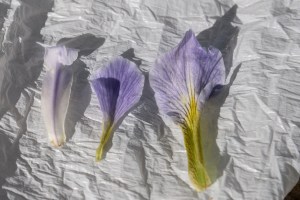
Stand #2: style arm, petal, sepal

Stand #2: two style arms

Stand #2: capsule

Stand #2: seeds
from Flora of North America:
Iris versicolor
…Capsules often persistent over winter, ovoid to oblong-ellipsoid, conspicuously beaked, obtusely triangular in cross section, 1.5–6 cm, tardily dehiscent. Seeds dark brown, D-shaped, 5–8 mm, shiny, thin, hard, regularly pebbled, not corky.
Iris virginica
…Capsules ovoid, ellipsoid, or long-cylindric, trigonal or polygonal in cross section, 3–6 × 1–2 cm. Seeds in 2 rows per locule, pale brown, usually D-shaped, 5–8 mm, pitted, corky….Plants of Iris virginica from the southeastern and south-central states having stems 2–3-branched and seldom falling to the ground after flowering, and with capsules long-cylindric have been recognized as var. shrevei.
So, I’m still not sure. Just looking at the flowers (and later, the pictures), I want to say that Stand #1 is I. virginica var. shrevei, and Stand #2 is I. versicolor. My instinct says they have to be I. versicolor (“go with the more commonly occurring species” is my rule). But I’m trying to be methodical about this.
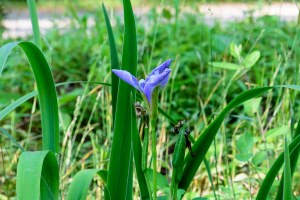
obligatory flower pic
I spent some time Wednesday morning in the Brookside Gardens library, reading about both these species in several different books, and taking lots of notes. If you’re truly interested in irises, keep reading…
from The World of Irises, Bee Wharburton, Editor, Melba Hamblen, Assistant Editor; The American Iris Society Wichita, Kansas 1978:
Iris Virginica and Versicolor
These two members of the Laevigatae are similar and have long been confused; they share the common name “Great Blue Flag.” They can ordinarily be separated in that virginica is overall a more slender plant, with full-size standards quite as long as the falls, while those of versicolor are shorter and rather bluntish. Seeds of virginica have a dull, corky look, while seedcoats of versicolor are brittle, thin, and shiny. Both are absolutely at home in shallow water or wet marsh conditions… [p. 304]
Iris versicolor has the highest chromosome number known in the genus iris [sic], 2n=108. Edgar Anderson (1936) demonstrated that it originated as an amphidiploid hybrid of I. virginica (2n=70) and I. setosa var. interior (2n=38) in preglacial or interglacial time. It is essentially a tetraploid hybrid with exceptional fertility and vigor. This is a famous case of the origin of a new species by hybridization. [p. 305]
from The World of Iridaceae, Clive Innes; Holly Gate International Ltd., 1985:
I. versicolor
Plants 20-80cm. tall. Leaves forming clumps, erect or curved, 1-2cm. wide, stained purplish at base. Stem branched, several-flowered, stout and erect. Flowers 6-8cm. diam., varying shades of purple to lavender veined yellow, green or white. Falls spreading, 5-9cm. long, the blade ovate, crestless, purple or violet veined deeper, haft broad, greenish yellow veined purplish. Standards erect, narrow, spathulate, shorter than falls, purple veined deeper or whitish, purple veined towards narrow base. Style branches lilac with whitish margins, broadly linear. Anthers blue. Flowering May to July. From Canada (eastern areas) to USA (southern states on east) on high ground and low, in moist marshy areas — very widespread. [p. 243]
I. virginica
Plans 30-100cm. tall. Leaves soft, green, buff to pale brownish at bases, 1-3cm. wide. Stem simple, rarely branched, arching, becoming almost pendent after flowering. Perianth tube very short, scarcely more than 1cm. long. Flowers 1-4 to a stem, 6-8cm. diam., lavender, blue, bluish-purple, violet — a white form is also known. Falls spreading, the blade oblong or ovate, 3-4cm. wide, blue with central yellow blotch, somewhat hairy, the haft yellowish-orange streaked. Standards erect, obovate or spathulate, 5-6cm. long (slightly longer than falls), 1-2.5cm. wide, wavy-edged or notched, purple. Anthers white or yellow. Flowering May to July. From USA (Louisiana, Virginia, Florida and east Texas in marshy, swampy areas). [p. 244]
from The Iris, Brian Mathew; Universe Books, 1981:
I. versicolor Linn. This robust clump-forming plant has stout creeping rhizomes giving rise to erect or arching leaves about 1-2cm wide and stems 20-180cm in height, equalling or slightly exceeding the leaves. The branching flower stems carry several flowers, each about 6-8cm in diameter and usually some shade of violet, blue-purple, reddish-purple, lavender, or dull slatey-purple. The falls are widely spreading and often have a greenish-yellow blotch at the center of the ovate blade, surrounded by a white area variegated with purple veins, this continuing down the haft. … I. versicolor is a very widespread plant in eastern North America from eastern Canada southwards to Texas. It grows n marshes, swamps, wet meadows and on lake shores and flowers in May, June or July. [p. 104]
I. virginica Linn. The Southern Blue Flag. This is sometimes considered by botanists to be inseparable from I. versicolor. [emphasis mine] I am not familiar with either in the wild and would not care to judge. Currently it is treated as a separate species by several American Floras. As its common name suggests, it has bluer flowers an is confined to a more southerly part of the United States. The height varies, 30-100cm, and the stems are often arching, falling to the ground in the fruiting stage. The leaves, 1-3cm wide, are soft and flopping over at the tips. In typical I. virginica there may be one short branch on the stem but usually it is simple. The one to four flowers are 6-8cm in diameter with spreading falls of blue, violet, lilac, lavender, or occasionally pinkish-lavender. In the centre of the 3-4cm wide, oblong or obovate blade there is a prominent yellow hairy patch which helps to distinguish I. virginica from I. versicolor. The standards are erect and smaller, usually narrowly obovate or spathulate in shape… I. virginica grows in marshes, damp pinewoods, ditches and wet grassy places in Florida and eastern Texas northwards to south-eastern Virginia. It flowers from May to July…. Although very similar in appearance to the latter [I. versicolor] it may be recognized by the flower colour which is usually in the bluer end of the spectrum (reddish-purple in I. versicolor) and by the yellow hairy patch on the falls. [p.105]
Note the sentence in bold above: some botanists consider the two species inseparable. Lumpers and splitters… Can I just call it an iris and be done?
But that’s not how I am. My permit is valid until June 30 and allows me to collect two more capsules, so I will be checking the condition of these plants a few more times, and when the capsules appear ripe, or on June 30, whichever comes first, I’ll be going through all this again. The resulting post will be shorter, though.

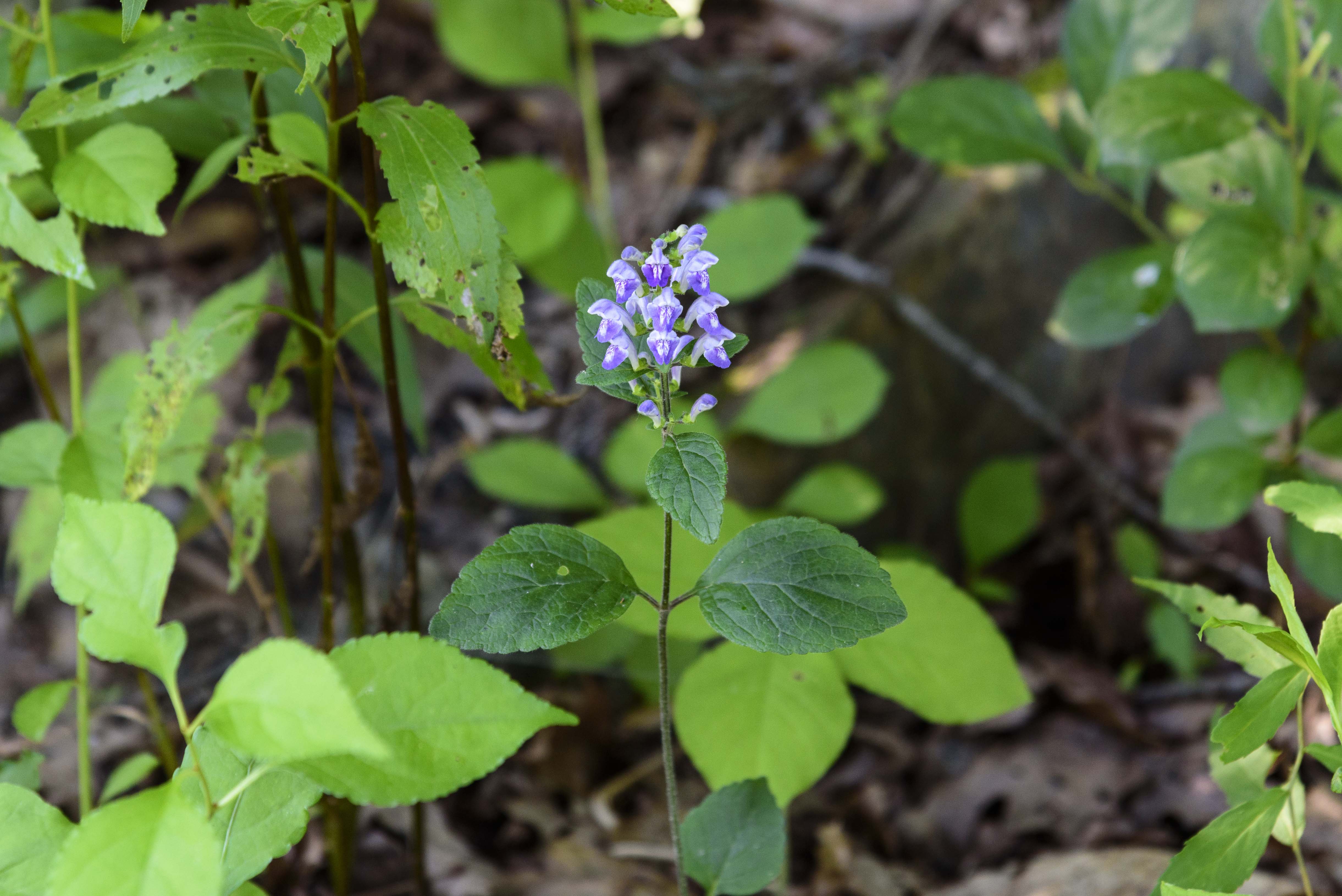
 “Wings,” I thought, zooming in on a not-too-clear picture of tiny purple flowers. Those little flowers look like birds about to take off. Could this plant be in the pea family (Fabaceae)?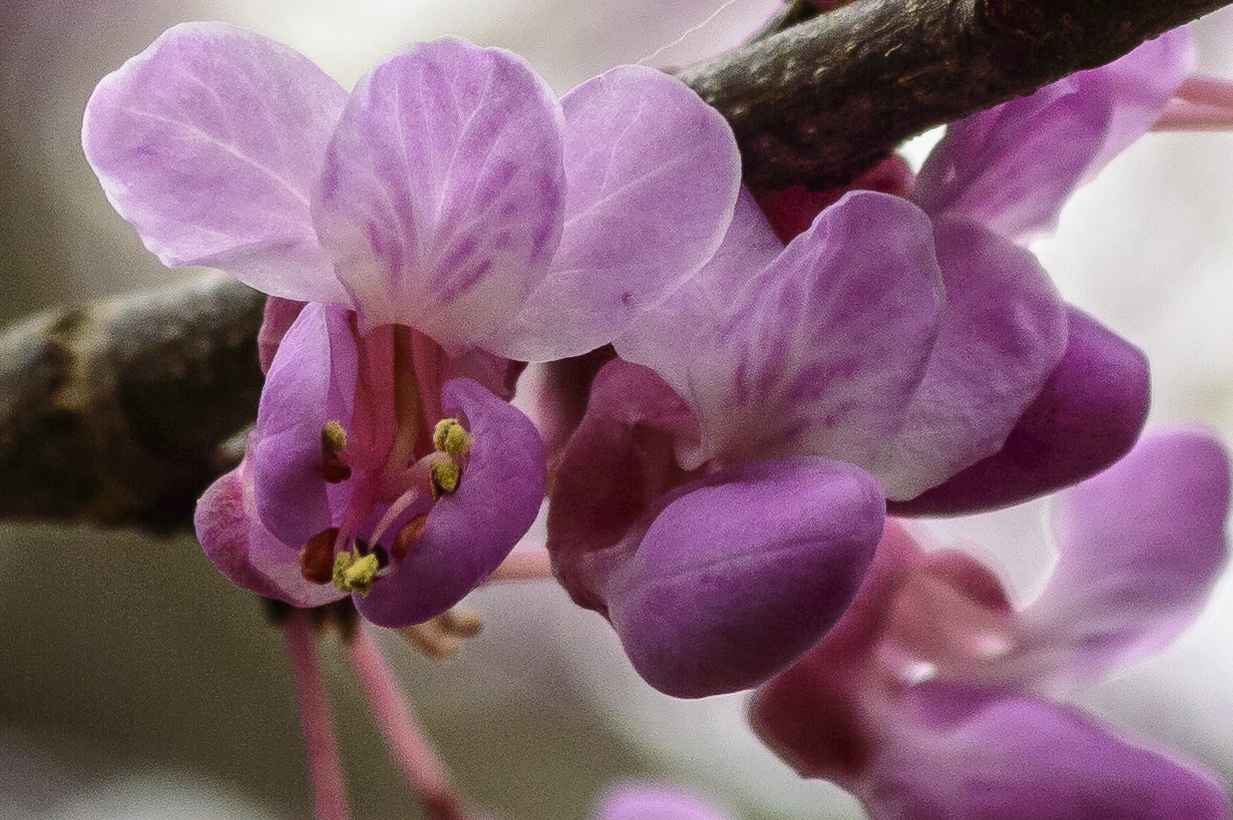

 But just a little. And the leaves are all wrong for something fabaceous. Orchid? The flower is a little orchid-like, but the plant just doesn’t look orchidy.
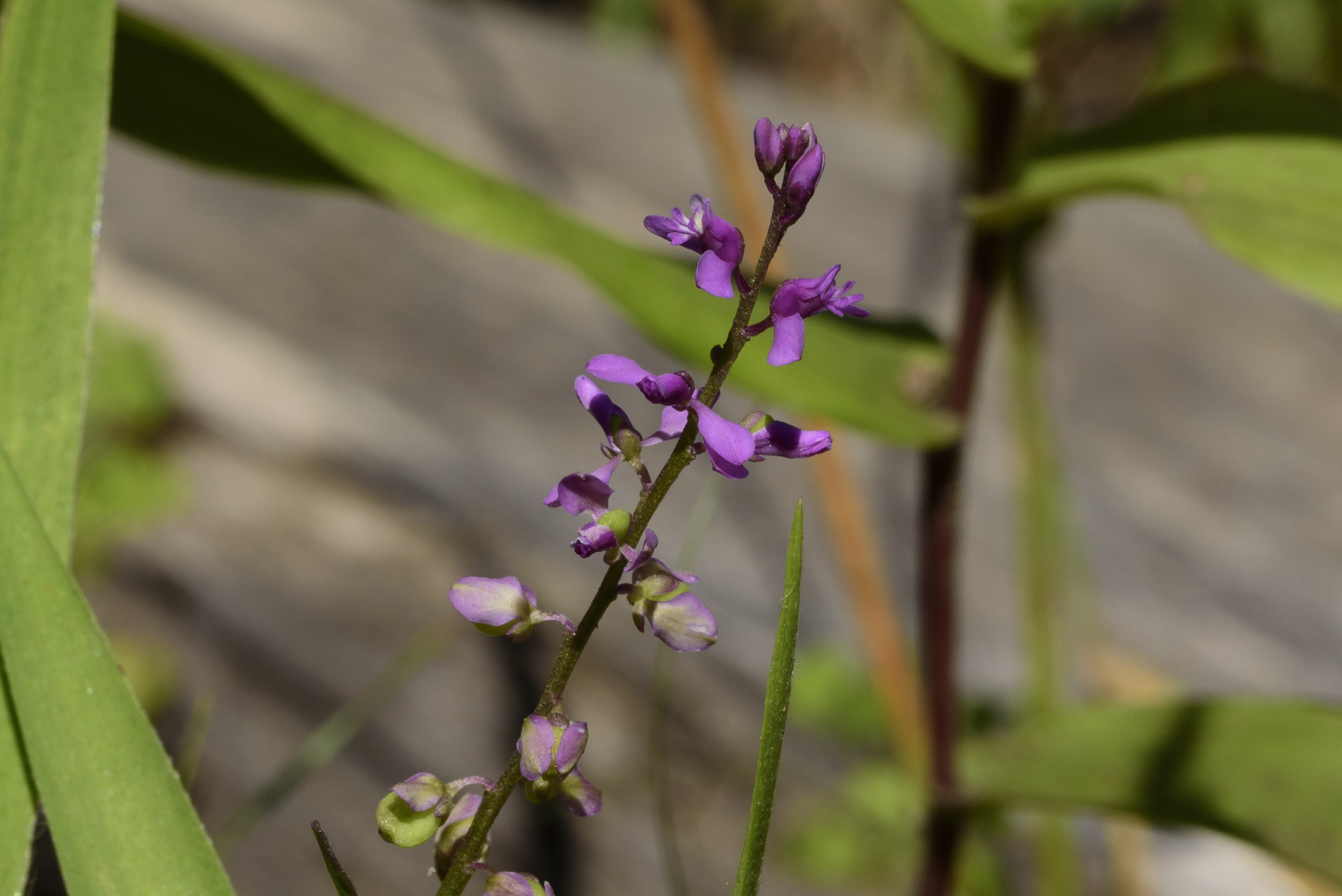 It’s Polygala polygama, commonly known as racemed milkwort, bitter milkwort, and purple milkwort.
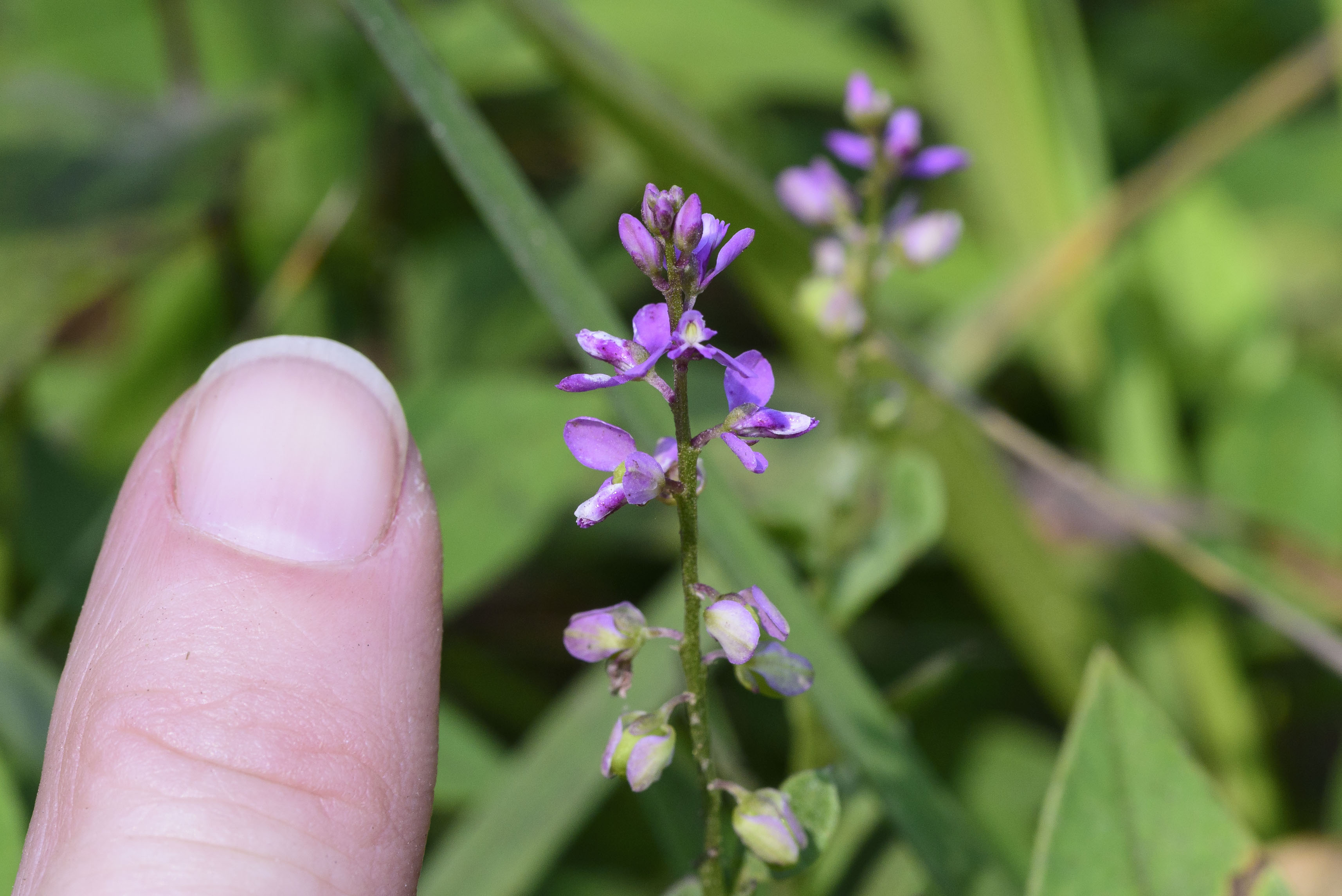
 This species is one of eleven milkworts found in Maryland. All are native, and most are found only in the coastal plain.





 Elizabeth's Wildflower Blog