Twinleaf Again

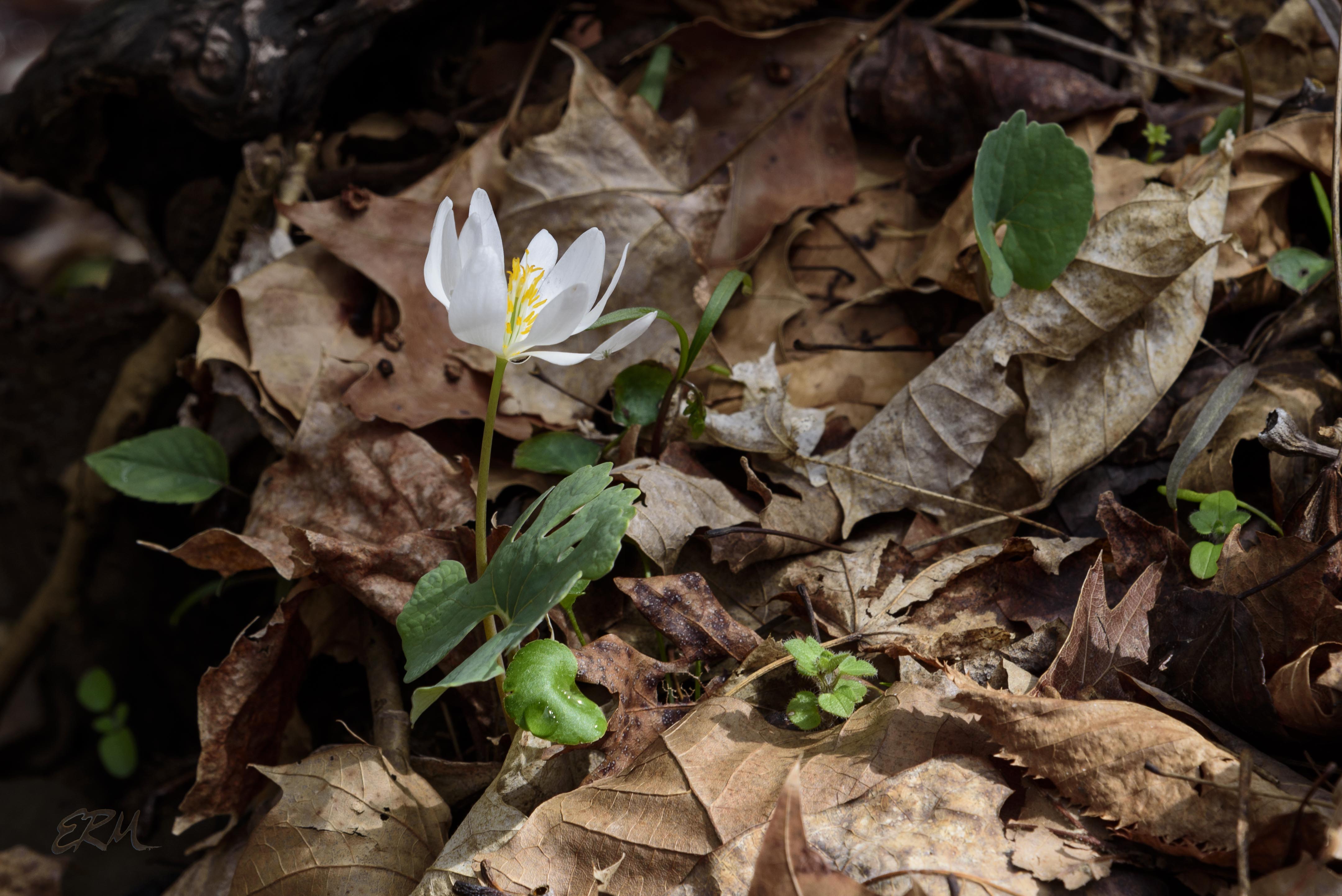
In 1792, when Thomas Jefferson was serving as the US Secretary of State, his botanist friend Benjamin Smith Barton decided that twinleaf must be in a genus of its own, “distinct from the Sanguinaria and the Podophyllum”*, and dubbed it Jeffersonia binata.

Twinleaf now goes by the name Jeffersonia diphylla (Berberidaceae). It isn’t exactly rare, but it isn’t common, either. It ranges from western New York south through the Appalachians to northernmost Alabama, then northwest as far as southeastern Minnesota. In all the states where it’s found, it occurs in only a handful of areas. It’s currently listed as endangered in Georgia and New Jersey, and threatened in Iowa and New York. The Biota of North America Project shows it present in Montgomery County, Maryland, and all counties to the west, but the Maryland Biodiversity project has records for it only in Montgomery, Washington, and Allegany counties.

As I wrote last week, this is a plant whose blossoms last only a few days. I saw two twinleaf flowers on Tuesday. On Thursday, a few more were blooming but were closed up tight because of the overcast. And yesterday, I saw maybe a dozen flowers, most of which were already fading and starting to set seed.

Twinleaf is a delicate-looking plant, consisting of several tall-standing basal leaves, each of which is nearly bisected into mirror image pairs. The leafless flower stem bears a single large, white flower, which has four sepals, eight petals, eight stamens, and one pistil.

The plant itself persists for another month or two past flowering before going dormant.

This is the earliest I’ve seen it blooming in the six years I’ve been tracking it.


*Thomas Jefferson’s Garden Book, 1766 – 1824; Edwin Betts, editor

Bluebells. And Pinkbells and Whitebells and More.

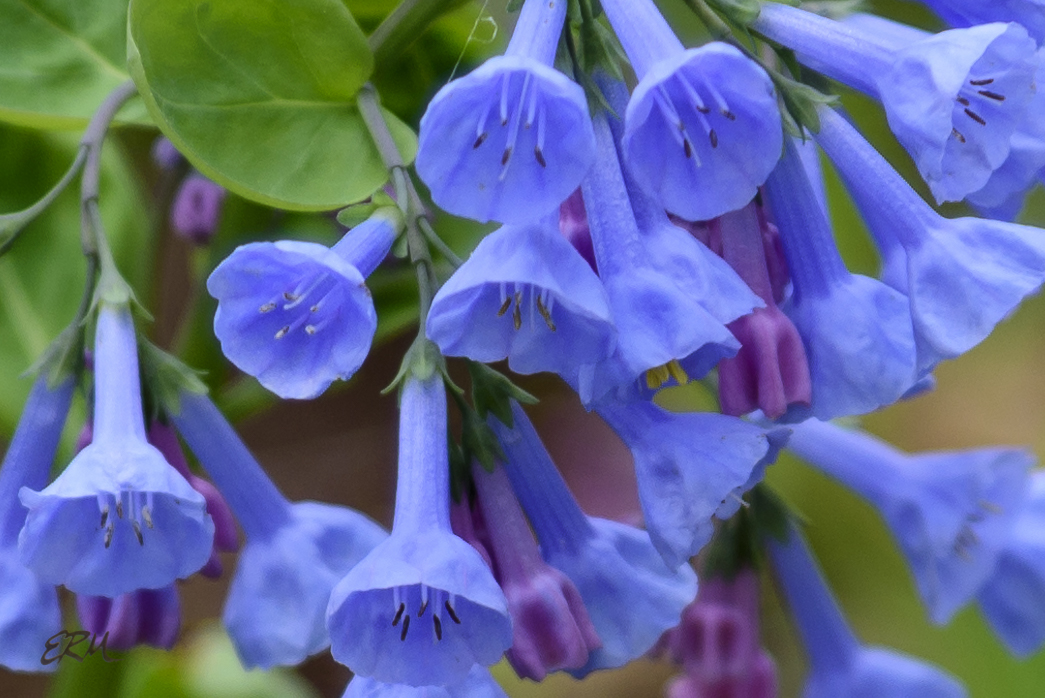
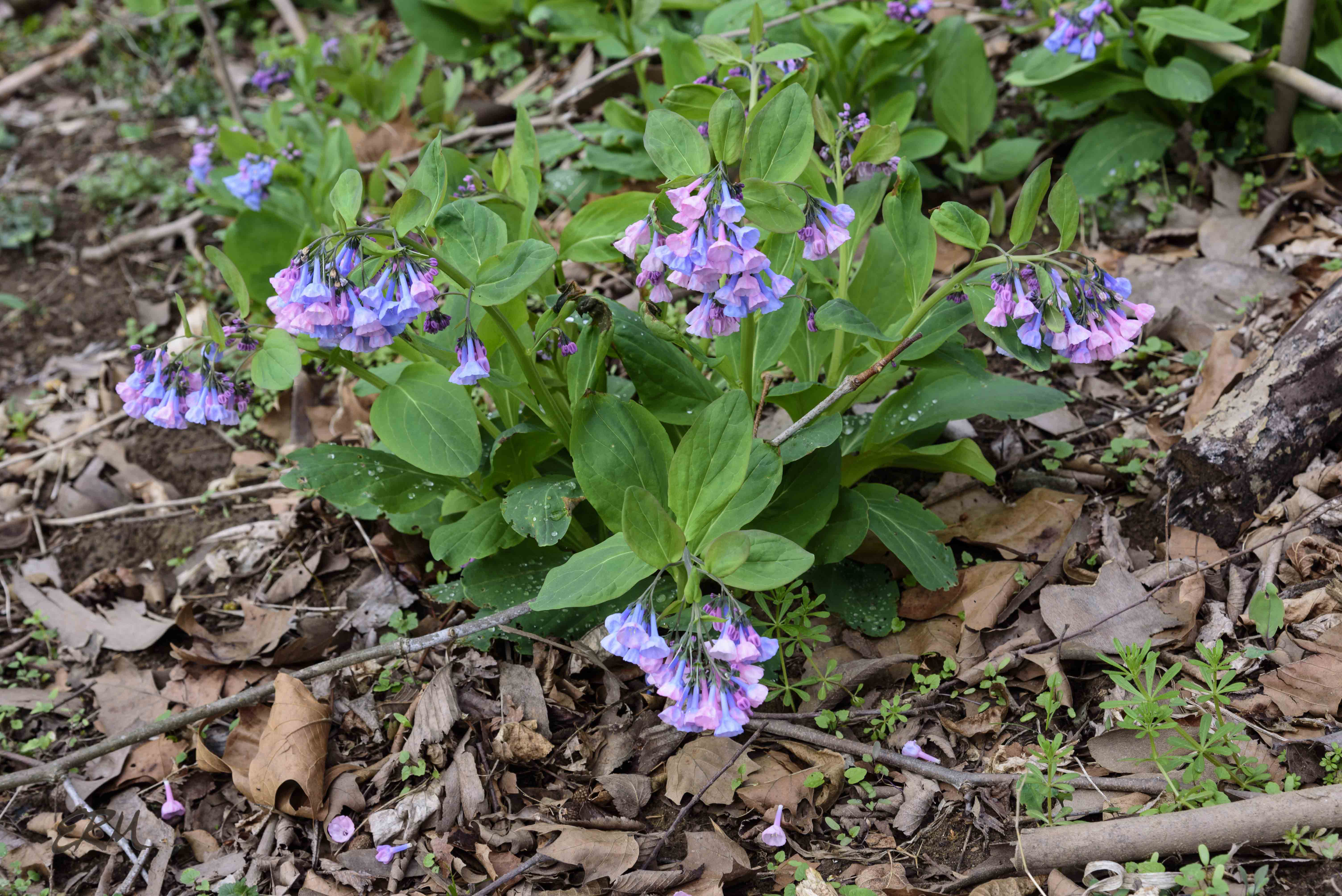
As the spring ephemeral wildflower show in the Potomac gorge slowly ramps up, the most eye catching plant must be Mertensia virginica (Virginia bluebells, Boraginaceae). The pale green leaves pop up in floodplains and moist to wet woodlands, in clumps that stand up to two feet tall, and then flowering shoots emerge. The blooming period is three or four weeks long; the leaves last another few weeks after that, then die back and the plants are done for the season.

The inflorescence is a cyme. The flowers have five petals fused into a long, lobed tube; a much shorter corolla formed from five sepals; five stamens, and a single pistil.

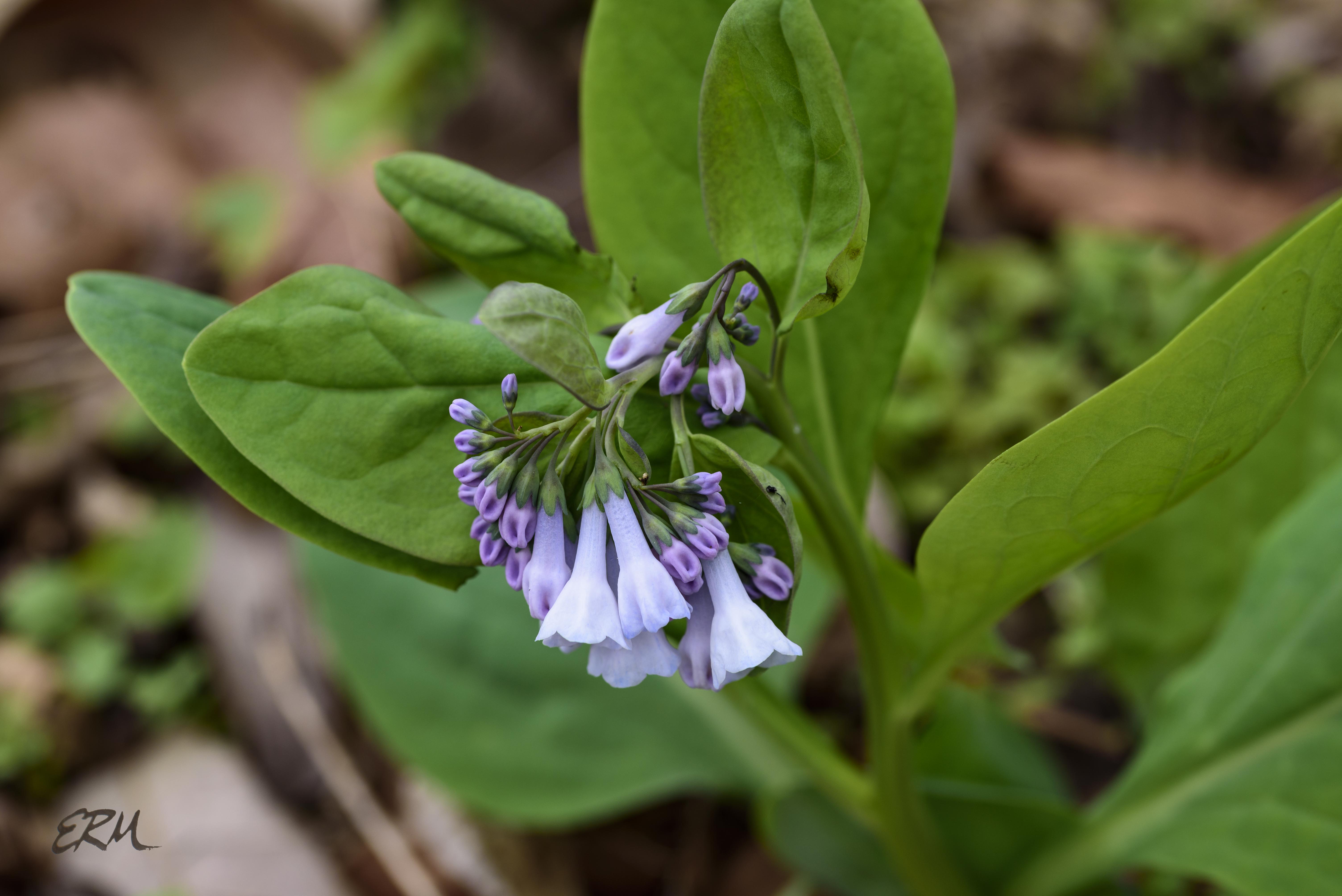
Year after year, what I find fascinating is the color display. The vast majority of bluebells are an intense blue (I call it borage blue), but sometimes they will be pure white, or pure pink, or violet-tinted, or even pink and blue on the same plant. I’ve seen several possible explanations for this, but nothing definitive.

As for the pure white and pure pink bluebells, I’m going to guess that those are genetic variations. I’ve seen the same stand of pink ones three years in a row now, and the same stand of white bluebells every year since 2011. I’ve also seen the violet-tinted ones in the same place two different years.


violet-tinted


pure white (even the buds are white)


This post is dedicated to my friend Brad, who in early 2014 talked me into starting this blog, which is three years old today. 

Cloudy Day Observations

I believe this is going to be a drawn-out wildflower season in the Potomac Gorge. In the past few years, I’ve observed that once the flowers start blooming, they bloom fast. The result is a spectacular mass of flowers all open at the same time, but then it ends quickly, too.

This year seems to be different, and I’m guessing it’s because of some early warm weather followed by many days of cool weather. I had a quick look ’round some favorite spots yesterday, and noticed that almost everything had closed up due to the overcast. A few more twinleaf had opened, but only a few.

Slow is not a bad thing. It means more time to find and photograph some favorites.

top: Sanguinaria canadensis (bloodroot) enjoying a shaft of sunlight on Tuesday
bottom: Erythronium albidum (white trout lily) closed for the day on Thursday

Desert Shrubs and “Trees”

There are so many interesting plants in the desert, and not just forbs. In mid March when I was at Anza-Borrego, shrubs were in full bloom, too, and one really unusual tree-like plant was just starting. And then there were the palms.

Encelia farinosa

This shrub goes by the common names brittlebush, incienso, and gold hills. I saw them all over the place, standing like good omens, saying “welcome to Anza-Borrego!” with their cheery yellow flowers. Brittlebush is in the Asteraceae, of course, and can be found on hillsides and slopes in the Sonoran and Mojave deserts, at elevations from below sea level to 3,000 feet above or more, depending on which authority you consult.

Justicia californica

Known commonly as beloperone, chuparosa, and hummingbird bush, this species is found mostly in the Sonoran Desert, with a few occurrences in the Mojave. It can grow to six feet tall and twelve feet wide. Justicia, a genus in the Acanthaceae, has over 600 species, only a few of which are found in North America. Of those, the most widespread is Justicia americana, which ranges from Texas to Quebec; there are vast stands of it in the Potomac River every summer.

Fouquieria splendens

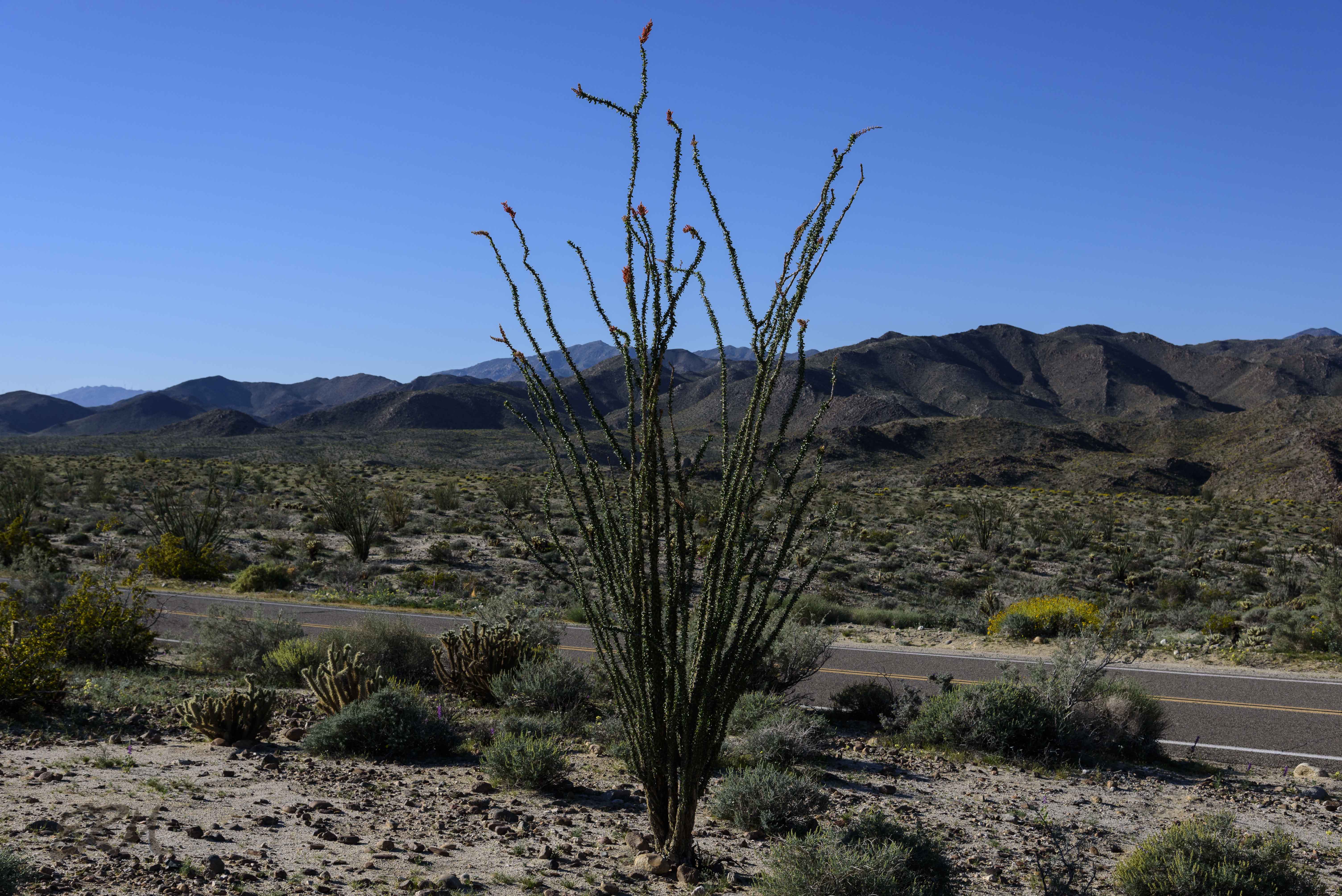
Ocotillo is such an unusual plant, it deserves a post all its own, but I’m short on time. Each stem can grow to 20′ tall, and a mature plant can have dozens of stems. They bear leaves only after sufficient rain. The bright red flowers attract hummingbirds.

From a distance you might think they’re a type of cactus, but they aren’t even closely related. (Going up on the taxonomic tree, cacti are in the order Caryophyllales, while ocotillo is in the Ericales.) There are only eleven species in the genus Fouquieria, which is the only genus in the family Fouquieriaceae. Ocotillo grows on slopes and hillsides, ranging from the southern Mojave through the Sonoran and Chihuahuan deserts.

Speaking of hummingbirds, while I was shooting some low-growing plant or other I heard this loud buzzing, and looked up to see this —>
That’s a black-chinned hummingbird, Archilochus alexandri. Once more I was both thankful to have a zoom lens, and wishing I had a longer zoom lens.

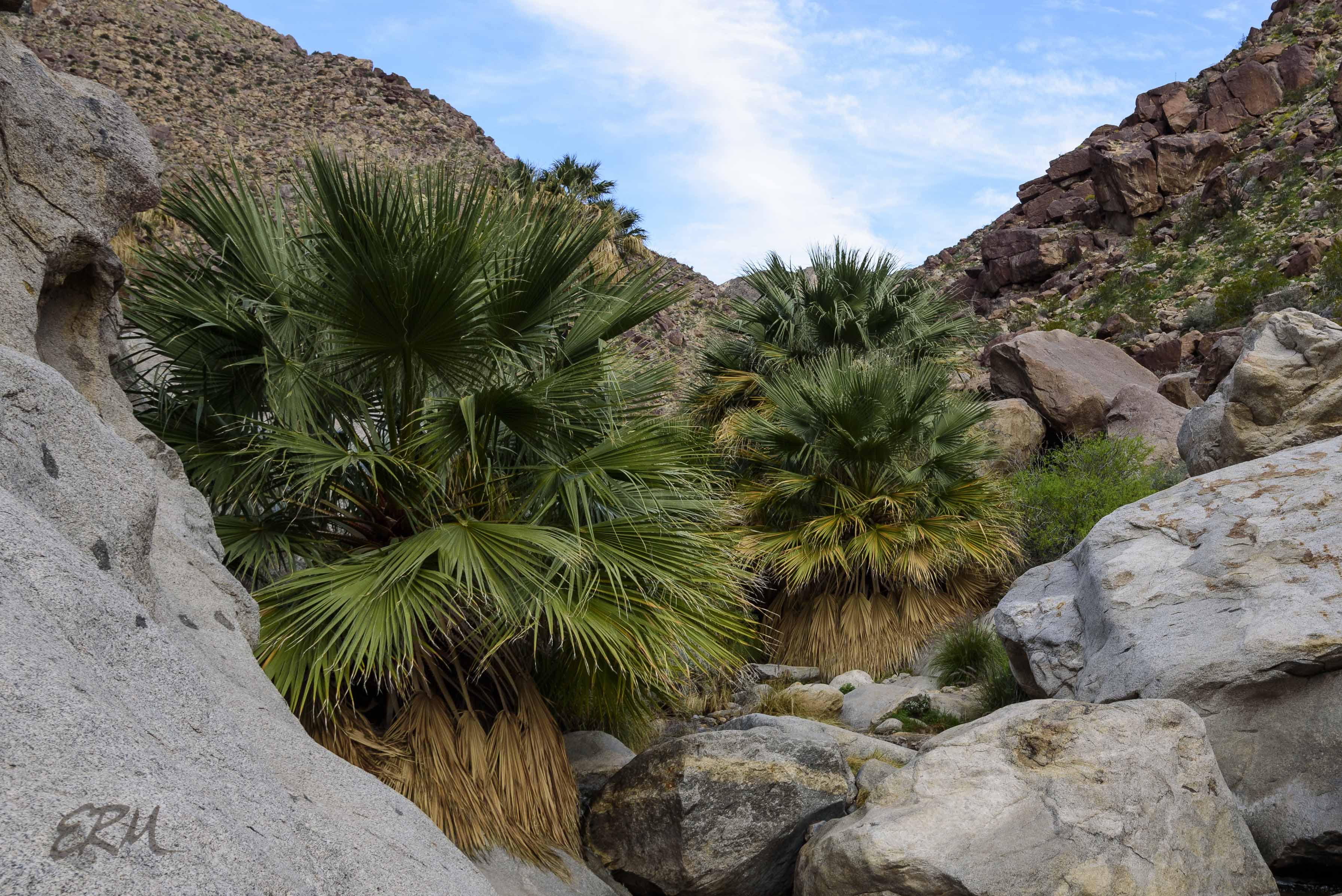
One of the greatest wildflower displays in Anza-Borrego was along the Borrego Palm Canyon trail, a nice, easy hike up a gentle grade that leads to actual running water and a big group of Washingtonia filifera, California fan palm. This plant in the Arecaceae can reach heights of 60 feet in the presence of open water. Click on the picture to see it larger; note the people on the boulder for scale, and how the brittlebush and chuparosa are growing together. California fan palm is native to the Sonoran and Mojave deserts, and is the only palm native to western North America.

Four O’Clock

So if the five petals of a desert sand verbena flower (see previous post) are not really petals, what are they?

In order to answer that, I’ll need to review some basic flower terminology.

The reproductive organs of a flower (the pistil and stamens) are usually surrounded by petals, which are modified leaves, often brightly colored. Collectively, the petals form an inner whorl of parts that is called the corolla.

There is usually an outer whorl, too. This consists of sepals, modified leaves that are often, but not always, green, and surround the flower bud as it forms. Collectively, the sepals are known as the calyx.

Taken together, the calyx and corolla are called the perianth.

In some species, there’s another set of modified leaves at the base of the flower, in addition to the calyx and corolla, that are called bracts. The bright “petals” of poinsettias and flowering dogwood are examples.

Detailed, technical descriptions of flowers in the Nyctaginaceae will mention the perianth, but say nothing of the petals, because there are none.

What looks like five petals on the sand verbena flower is actually a single five-lobed tube formed by five fused sepals. This is typical for flowers in the Nyctaginaceae. Some sources state that the perianth comprises fused tepals; think of a tepal as an intermediate between a petal and a sepal.

Flowers in this family often have bracts as well; Bougainvillea is an example. The reproductive parts usually consist of a single pistil and five stamens.

The inflorescence is typically a cyme. Most species are forbs, though there are a few shrubs, trees, and vines. There are about 300 species in about 30 families, found mostly in tropical and warmer temperate regions of the world.

Several species of plants from the Nyctaginaceae are found in the Sonoran Desert, including the following.

Allionia incarnata

Trailing windmills is a forb with a vine-like habit, growing along the ground. It can be either annual or perennial. The species is found in the Chihuahuan, Sonoran, and Mojave deserts, and the southern part of the Great Basin Desert. There are two varieties, incarnata and villosa. I believe this one to be the later based on location reports in CalFlora and the USDA PLANTS Database. I don’t have sufficient detail to identify it based on plant characteristics.

This flower consists of three clustered perianths. Unlike most other species in the Nyctaginaceae, trailing windmill flowers stay open all day. Most species in this family have flowers that open late in the day, hence “four o’clock”.


Mirabilis laevis

Depending on which authority you consult, there are four to six varieties of this small shrub, commonly called wishbone bush or wishbone plant. I believe this one to be  retrorsa, but lack sufficient detail to say for sure; it could also be villosa. Both have similar ranges in the Sonoran, Mojave, and Great Basin deserts.