Greetings From Borrego Springs

…and Anza-Borrego Desert State Park, where the crowds are almost as thick as the flowers, but not nearly as pretty.

And where internet connectivity is crap.

I’d hoped to use my downtime this week to get some posts out about this incredible place, but they’re going to have to wait. Seriously – I’m typing this while eating in a diner, using my iPhone as a tether since even the public library network isn’t working, even though I appear to be connected.

Hopefully I can get a lot done in the airport Friday, awaiting my plane.

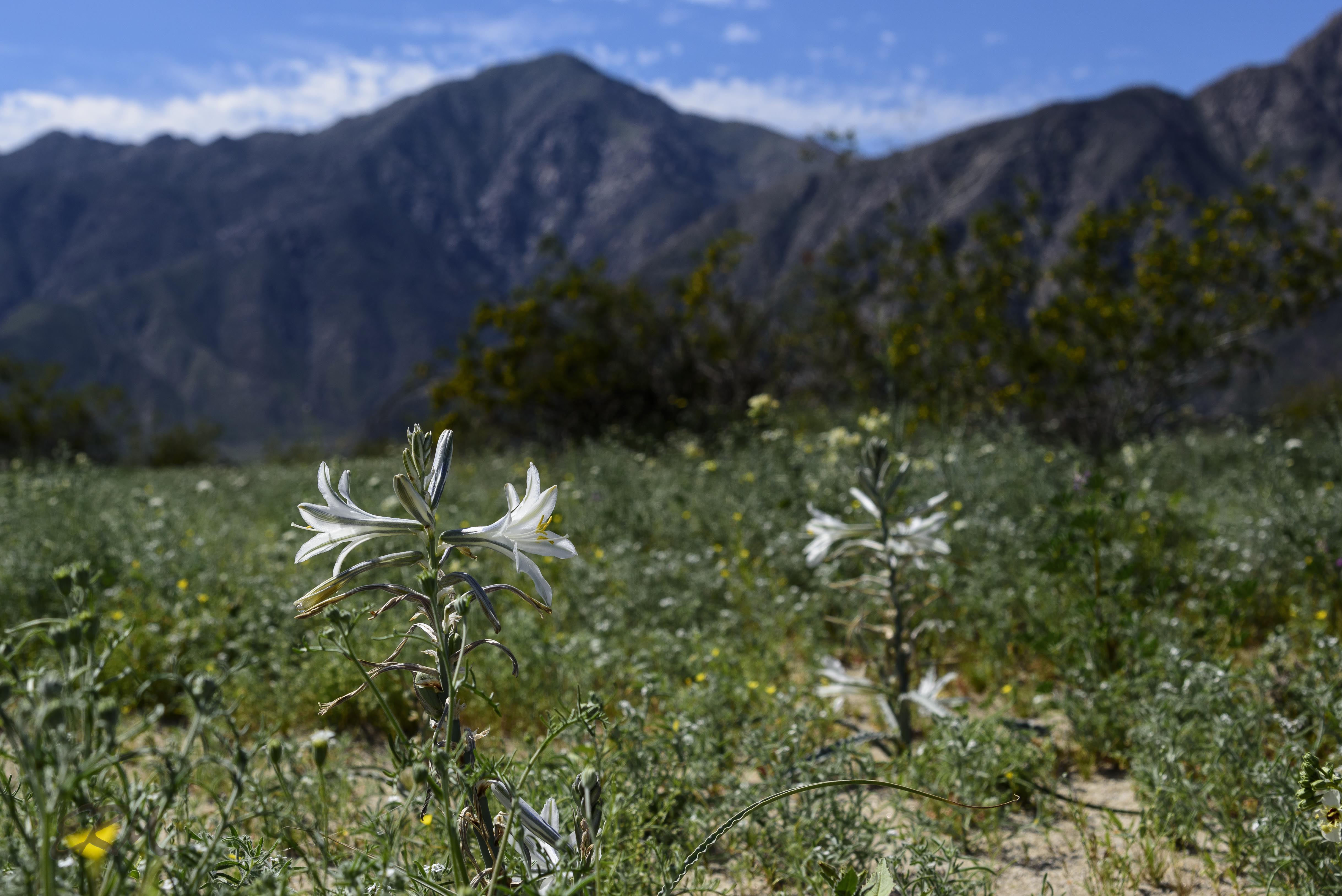
That’s a desert lily in the foreground, by the way.

More in a few days!

Ephemeral

momentary, transitory

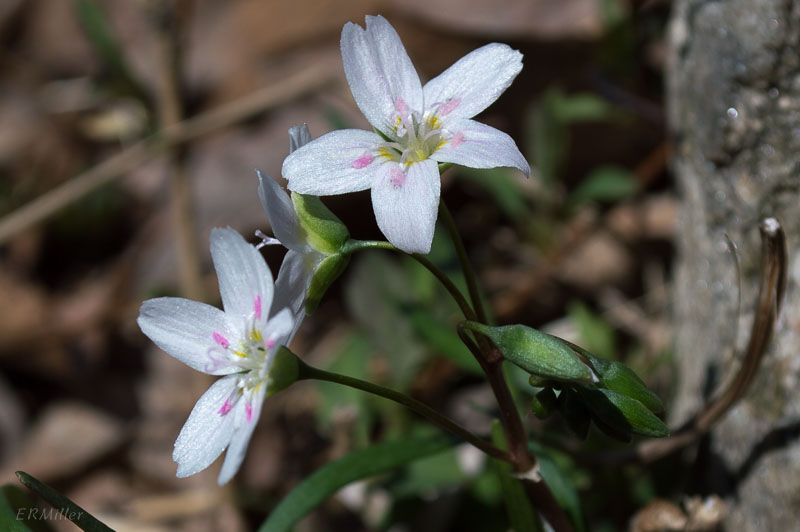
Claytonia virginica

One day about twenty years ago when I was a new Master Gardener, I plucked an entire small plant from my wooded front yard and took it to the office for identification. The plant consisted of a few grasslike leaves no more than two inches long, with a single five-petaled pinkish white flower.

The first MG I asked chided me for not bringing a larger sample. “But this is the whole plant!” I replied, “except for the roots.” Then another MG took a look and said “ooh! spring beauty! it’s one of the ephemerals.”

I’ve been in love with the concept ever since.

evanescent, fugacious

Forbs are herbaceous plants other than grasses; their growth is usually described as either annual or perennial. An annual grows roots, stem, and leaves from seed, then flowers and goes to seed all in one season, and dies. A perennial does the same, but the roots survive to allow the plant to grow again the next season. Some plants have a two year life cycle, producing flowers and seeds in the second year before dying; they’re called biennials.

There are some variations to this theme. Plants that grow and bloom through the winter and early spring are called winter annuals. Or hibernals, if they’re perennial.

Ephemeral describes plants with a very short life cycle. They are usually perennials that grow and bloom for about a month, or maybe two, but not the whole season. Here in the east we have spring ephemerals, woodland plants that take advantage of the sunlight coming through the leafless tree canopy. By the time the trees leaf out, most of these forbs are done and gone ’til the following spring.

Most of our early spring bloomers are ephemerals: Dutchman’s breeches and squirrel corn, trout lily and white trout lily, Virginia bluebells, harbinger-of-spring, cut-leaf and slender toothworts, rue anemone.
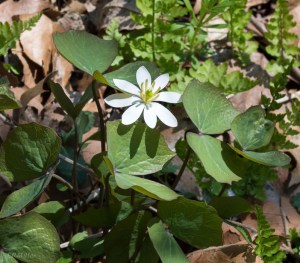
Jeffersonia diphylla
twinleaf

Although the foliage lasts a month or so, twinleaf flowers last only a few days. And all the plants bloom at the same time, so even if there are hundreds of plants in a stand, you have five days at most to see them flowering.


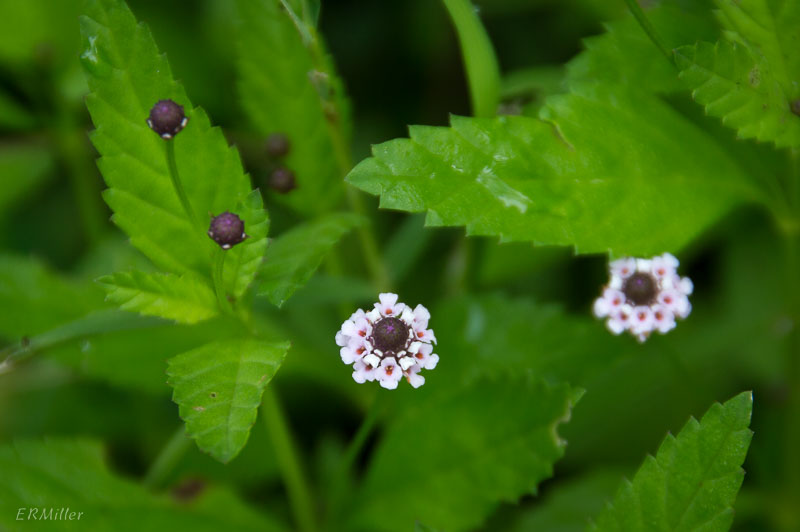
Phyla lanceolata
fogfruit

We also have mudflat ephemerals, plants that wait until summertime, when rivers run low, then grow from the resulting mud. I wasn’t able to find any official list of these, but I’ve seen this growth habit in the Potomac gorge. So as an educated guess, I’ll suggest the following as possible mudflat ephemerals: Lindernia dubia (false pimpernel), Phyla lanceolate (fogfruit), Teucrium canadense (American germander), and Eclipta prostrata (false daisy).

Out West there are desert ephemerals, that pop up and bloom only when the right conditions are met. Most of those plants are annuals.

 passing, fleeting

Just like springtime itself, the ephemeral flower show doesn’t last long enough. Perhaps that’s why we love it so: like the Japanese with their cherry blossoms, we treasure the things that don’t stay with us for long.
Lamiaceous Weeds Revisited

Now that I have a few more pictures, and now that the plants are blooming, I want to quickly revisit three mint family weeds. The first two are often confused, maybe because of similar habit and flowers.

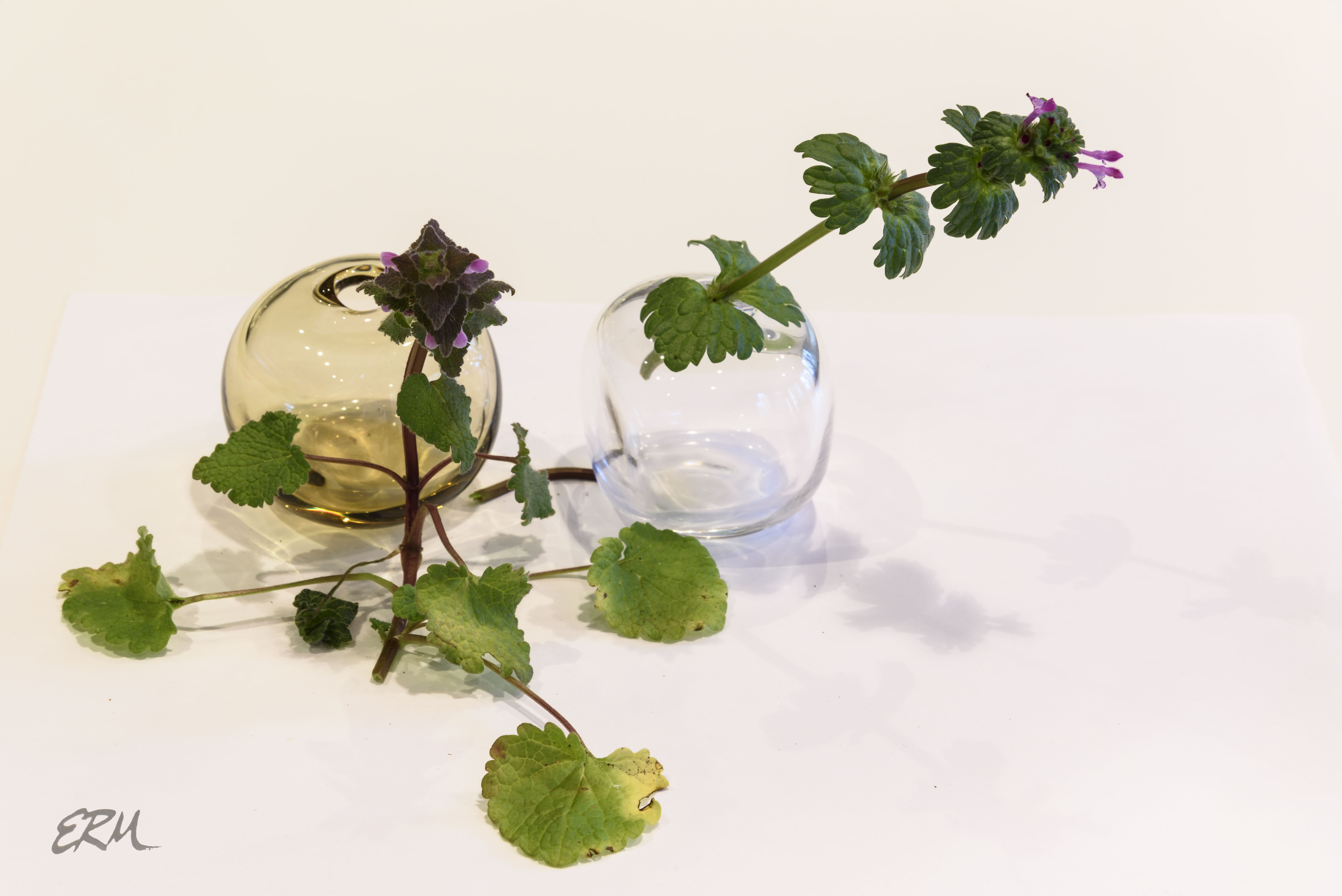
The plant on the left is Lamium purpureum (purple deadnettle), and the one on the right is Lamium amplexicaule (henbit). Both have similar-shaped leaves, but the deadnettle’s are pointier, and note how long the petioles are on the lower portion. The henbit’s leaves are sessile and appear to almost surround the stem. Also, the uppermost stem leaves of the deadnettle are purplish (hence the specific epithet), though not on very young plants.


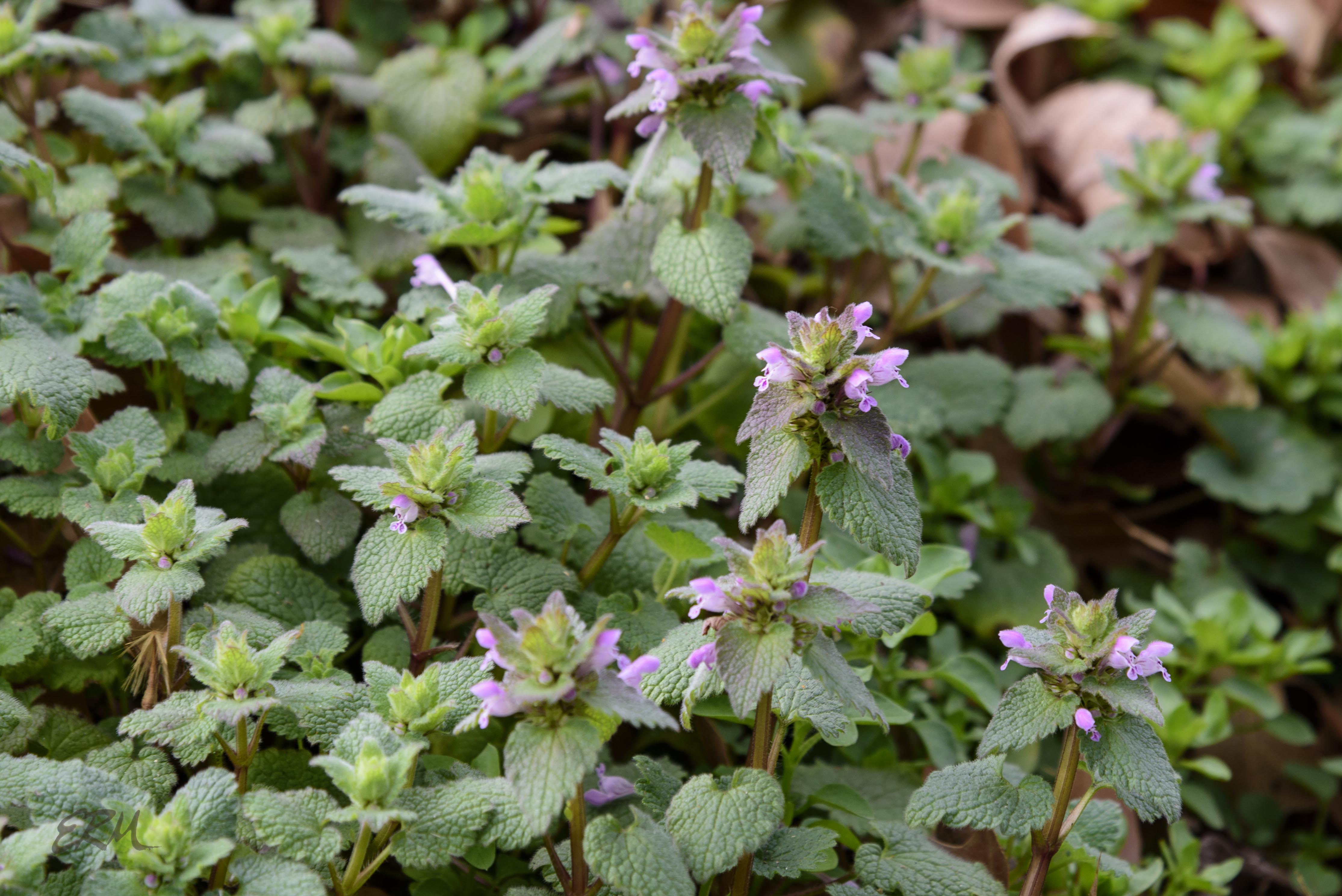
Lamium purpureum
purple deadnettle


Lamium amplexicaule
henbit


The third species is Glechoma hederacea (gill-over-the-ground, ground ivy, creeping charlie). Ground ivy’s leaves are close in shape to henbit’s, but they have distinct short petioles. Henbit spreads along the ground, but individual stems will stand straight up; ground ivy stays much closer to the ground.

Glechoma hederacea
ground ivy

The Alien Speedwells

There are a lot of low-growing, blue-flowering aliens out there now, like the periwinkle I wrote about two days ago, or the mint family weeds I’ll be writing about next. Among these are the speedwells (genus Veronica, in the Plantaginaceae).

Of the 30 or so species of Veronica that can be found in North America, about two-thirds are alien. There may be as many as 17 species in Maryland; of these one may be native (sources vary), another is a fairly common native, and a third is a listed S1/Endangered native.

So if you find a speedwell in the field, it’s likely an alien. They can be pesky to distinguish, since in many cases close examination of the tiny leaves is necessary.

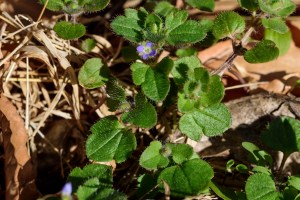
Trying to differentiate between bird’s eye speedwell (V. persica, pictured above) and ivy-leaved speedwell (V. hederifolia, sometimes spelled V. hederaefolia) was making me crazy, so I finally collected a few samples. In this picture, ivy-leaved speedwell is on the left, and bird’s-eye speedwell is on the right. The main differences are in the leaves. The former has leaves with 3-5 palmately compound lobes, hairy margins and hairy tops. The latter has much smoother leaves that are deeply indented (crenate or dentate).


This is V. hederifolia. Click on the picture for a closer look at just how hairy the leaves are.


This pretty awful picture from a few years ago shows just enough detail to identify the plant as corn speedwell, V. arvensis. The giveaway here is that the uppermost leaves are elongated, almost triangular in outline, with entire margins. The lower leaves of this species are rounder and toothed. Note its size compared to the blade of grass cutting across the upper left corner.

Here’s another old picture. Without details about the rest of the plant, I can’t say for certain, but it sure does look like the inflorescence of common speedwell, V. officinalis. As an aside, take a look at the flower. If you didn’t look closely and tried to key it out using Newcomb’s Wildflower Guide*, you could easily fall into the trap of calling it radially symmetrical, with four petals. But the bottommost petal isn’t the same shape as the others, which means it is bilaterally symmetrical; in Newcomb’s key it falls under “irregular”.

Last one. Again, I’m not certain, but the longish, smooth-margined, sessile leaves in pairs (more visible in other but worse pictures that I have) lead me to ID this as water speedwell, V. anagallis-aquatica. Another clue is habitat: I found it in a very wet, mucky area along the Potomac. It could also be American brooklime, V. americana, but in that species the leaves have more pronounced teeth along the margins, and the leaves have very short petioles.

I’m not an expert and had some trouble learning this genus, so if you disagree with any of my IDs please leave a comment!


*Newcomb’s Wildflower Guide is one of the best ID books for eastern North America flowers; the first question in the key is about symmetry.

Not Quite Yet

A quick stroll around the Carderock area and Billy Goat B up to the Marsden Tract on March 9 showed that the flowers are only just starting. I saw a fair number of spring beauties (Claytonia virginica), a few cut-leaved toothworts (Cardamine concatenata), and one clump of Virginia bluebells (Mertensia virginica) in bloom.

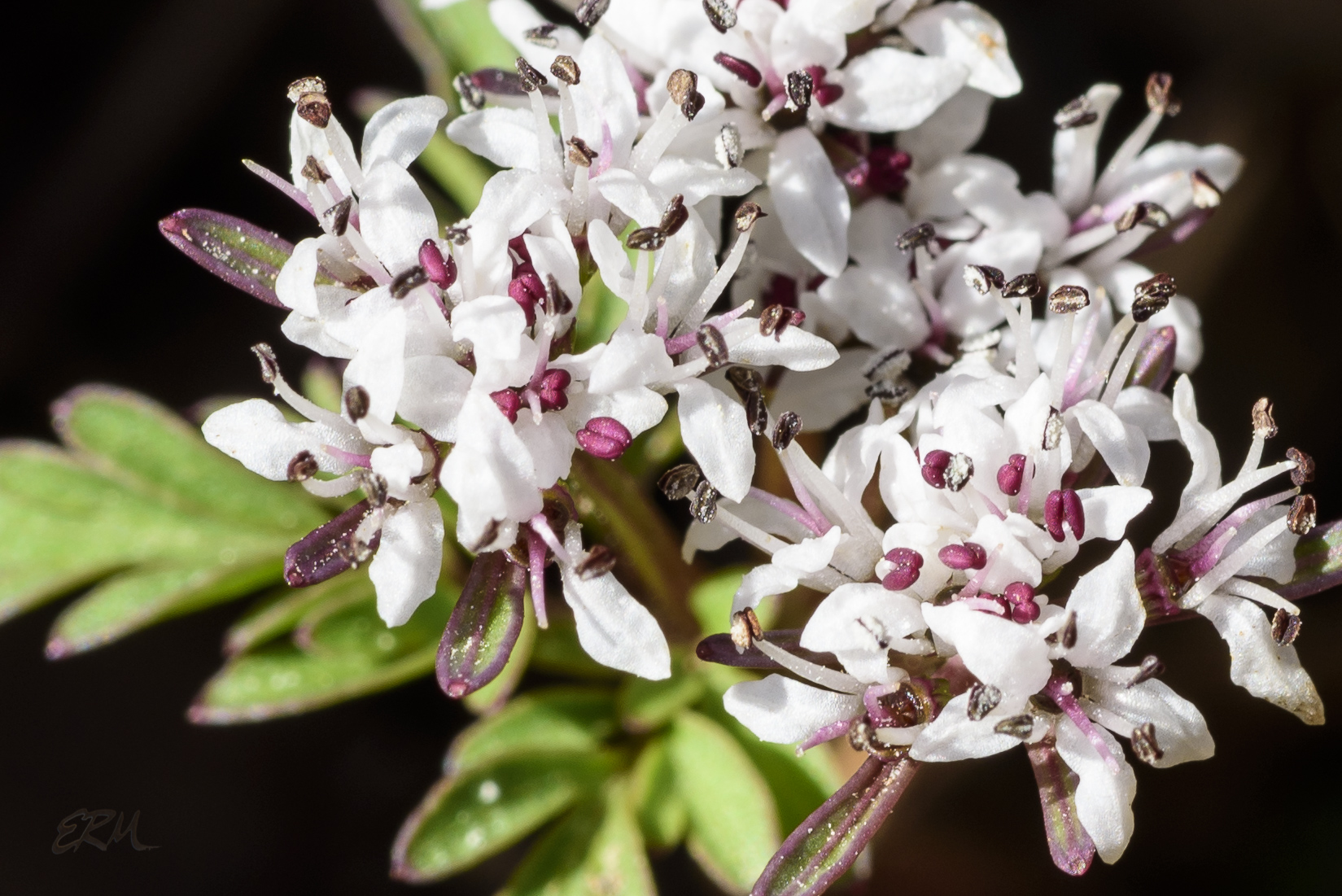
Harbinger-of-spring (Erigenia bulbosa) looks like it’s at its peak, though. There are a few really solid stands of it near the river, but they are hard to find if you aren’t looking closely, since an entire plant is about the width of a nickel.


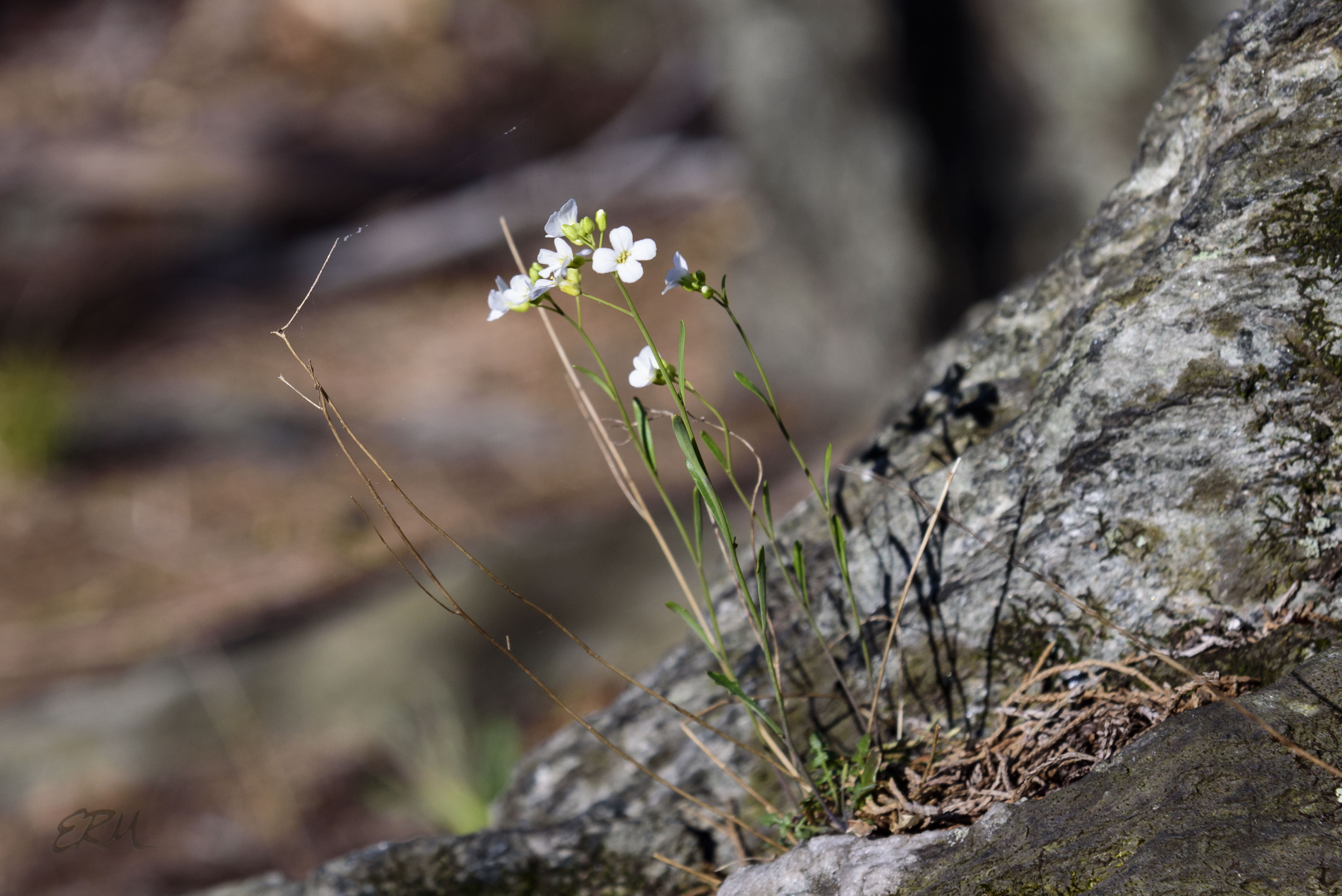
I was a bit surprised to find lyre-leaved rock cress (Arabidopsis lyrata) open already, though most plants had more buds than blossoms. Look for it growing right out of rocks near Carderock.