Many Little Feet

20150726-20150726-_DSC0140

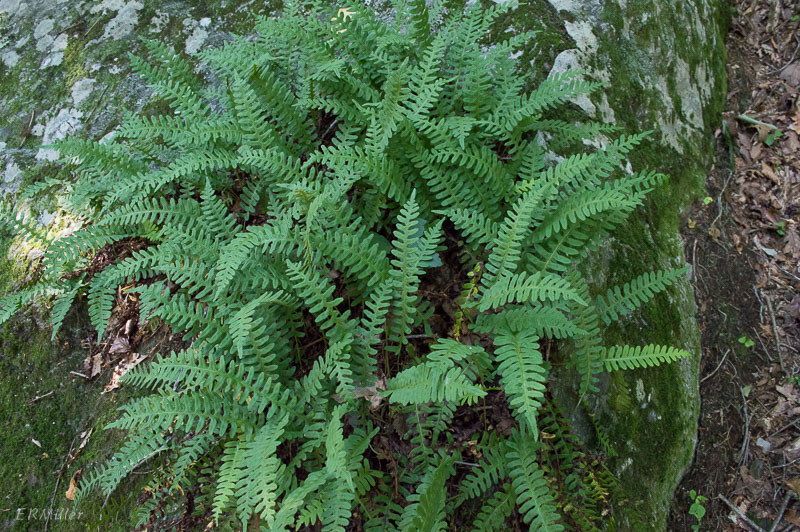
Common or rock polypody, American wall fern, rockcap fern
Polypodium virginianum

a small stand on the Cabin John trail


This little fern is no less charming for being incredibly common.  It’s found throughout most of the eastern US and Canada except for parts of the deep south.  Although short (the fronds are usually about twelve inches long), the rhizomes will form massive colonies in suitable habitat, which consists of all sorts of rock outcroppings and rocky soils in moist shade.

20140725-DSC_0156


an itty-bitty specimen at Carderock; it doesn’t have much soil to grow in!


It’s also an easy fern to identify, especially at this time of year, since it’s evergreen.
20150420-20150420-_DSC0082


new fronds in late April along the Cabin John trail

Conservation Terminology

20150416-20150416-_DSC0410


Erythronium albidum, listed S2 in Maryland


After a recent post, a friend asked what “exploitably vulnerable” meant. Which got me thinking, I usually report the conservation status of the plants I write about, but have never defined these terms.  So here’s a little primer.

Some time ago, The Nature Conservancy devised a system for ranking the rarity of plant species on a global scale*.  Many organizations and government agencies started using this system, or devised their own system based on it. The global system looks like this:

G1 – critically imperiled throughout its range due to rarity (5 or fewer sites or very few remaining individuals) or other factors
G2 – imperiled, high risk of extinction due to restricted range, low number of populations, or other factors
G3 – moderate risk of extinction due to range, number of populations, etc.
G4 – apparently secure, uncommon but not rare, some cause for concern
G5 – demonstrably secure throughout the range
GX – believed extinct, rediscovery unlikely
GH – known historically, currently no known occurrences, some hope of rediscovery

20140522-DSC_0073


Scutellaria nervosa, listed S1 in Maryland


When I write about a plant’s conservation status, I use data from the USDA Plants Database. I presume (but am not sure) that their reporting of rank comes from the various state agencies; certainly they are using each state’s terminology. And that’s where things get interesting.

Each state has essentially the same system of classification, based on the global ranking system, but with some variation in terminology and definitions. Thus, the state of Maryland’s ranking system goes

S1: Highly State rare. Critically imperiled in Maryland because of extreme rarity (typically 5 or fewer estimated occurrences or very few remaining individuals or acres in the State) or because of some factor(s) making it especially vulnerable to extirpation. Species with this rank are actively tracked by the Natural Heritage Program.

S2: State rare. Imperiled in Maryland because of rarity (typically 6 to 20 estimated occurrences or few remaining individuals or acres in the State) or because of some factor(s) making it vulnerable to becoming extirpated. Species with this rank are actively tracked by the Natural Heritage Program.

…and so on.
20150514-20150514-_DSC0141


Valeriana pauciflora (S1)


Based on these rankings, Maryland has a status list: Endangered, In Need of Conservation, Threatened, and Endangered/Extirpated (and a few more).

For Rhode Island, the status list is: State Endangered, State Threatened, Concern, State Historical.

For New York the status list is: Endangered, Threatened, Rare, Exploitably Vulnerable, Unprotected.

These are the phrases I’m reporting in my posts. The exact definition of “endangered” may vary from state to state, but it’s safe to assume that endangered is always the most imperiled condition, threatened is next, then rare, then come the terms like “exploitably vulnerable” or “special concern.”

You may be wondering, have I ever found any rare plants? Sure. I wrote about climbing dogbane last June, and I’ve found a few other S1s and S2s, and quite a few S3s, and reported them to the DNR when appropriate. Since I haven’t memorized the sadly long list of rare, threatened, and endangered plants in Maryland, it’s only after I return home and start researching that I realize what I’ve found. Such a discovery is often followed by a clearing of my calendar so I can get back to the site as soon as possible and get more and better pictures, and geotag them.

It’s rather like a treasure hunt, except of course I only observe them, and make damn sure I’m not harming them or their environment.

20150406-20150406-_DSC0005

Dirca palustris (S2)

—–

* for much of the information in this post I am indebted to the publication “Rare Native Plants of Rhode Island” by Richard W. Enser of the Rhode Island Natural Heritage Program, and NatureServe.  I was unable to find the original source material on the global ranking system, but found several other state websites that described the global ranking system; all used minor variations on the same language.
 

Ebony Spleenwort

20150429-20150429-_DSC0034


Asplenium platyneuron
new fronds with croziers, May 2015


The day after my last post, I went to Hoyles Mill Conservation Park (in the Little Seneca Creek watershed, near Boyds), hoping to find some evergreen ferns. There was a nice stand of Christmas fern along a bank:

20151226-_DSC0017

Looking closer I saw a second species: ebony spleenwort.  It’s the smaller, lighter-colored fronds on the left in this picture:

20151226-_DSC0010

At twelve to twenty inches tall, ebony spleenwort is one of the larger members of its genus.  It’s wide-ranging, from Quebec south and west as far as Arizona, and can be found in a variety of habitats.  Look for it on embankments, rock outcroppings that have a little soil, even old stone fences.  It’s listed as special concern in Maine and exploitably vulnerable in New York.

20150728-20150728-DSC_0054


a specimen near C&O Canal lock 8, August 2015


The name “asplenium” is from the Latin, meaning “without spleen”.  The specific epithet “platyneuron” can be translated as “flat-nerved”.
20150713-20150713-_DSC0020


underside of a pinna on a fertile frond, showing indusia and sporangia


Several other evergreen ferns can be found in the Maryland Piedmont; I’ll be posting about them in the coming weeks.

Oh, Christmas Fern

20150628-20150628-_DSC0002

Polystichum acrostichoides
Dryopteridaceae (wood fern family)

specimen showing sterile and fertile fronds; pardon the boot!
——>

If you’ve been walking around the woods during this freakishly warm season, you’ve probably seen Christmas fern, a widespread evergreen fern of moist to dry woodlands that’s found all over the eastern part of North America.  It’s a lovely plant for the garden, with glossy dark fronds adding winter interest, and a tidy, clump-forming habit.

20150731-20150731-_DSC0449


young frond in July


Christmas fern stands about two feet tall, and is easily identified (especially in winter). Each pinna has a distinctive upward-pointing lobe near the base, variously described as a thumb, or toe, or ear. (The technical term is auricle, meaning ear-shaped lobe.)

The fertile fronds have a distinctive shape, with the sori-bearing pinna becoming shorter, narrower, and more widely spaced on the upper portion of the fronds:

20150709-20150709-_DSC0058

20150709-20150709-_DSC0062


sori on underside

20150731-20150731-_DSC0448


crozier in July


ps: please refer to my posts about fern terminology and fertile fronds for definitions of some of the jargon

Three Views

And here’s the final view for 2015, after a few days of rain. Don’t forget to visit the Three Views page to see how things change month-by-month.

December 4
41 degrees F at 9:40 am; sunny 

20151204-_DSC0005

9: 54 am EDT  31mm  f/8.0  1/250sec  ISO 100

Billy Goat B trail, east end, looking southeast across a narrow channel toward Vaso Island


20151204-_DSC0014

11:11 am EDT  30mm  f/10  1/100sec  ISO 100

Billy Goat B, mid-way between trailheads, looking upstream (more or less northwest) with Hermit Island on the left.


20151204-_DSC0021

11:45 am EDT  28mm  f/8.0  1/640sec  ISO 100

boat launch ramp near Old Angers Inn, looking downstream and more or less south