Mentzelias

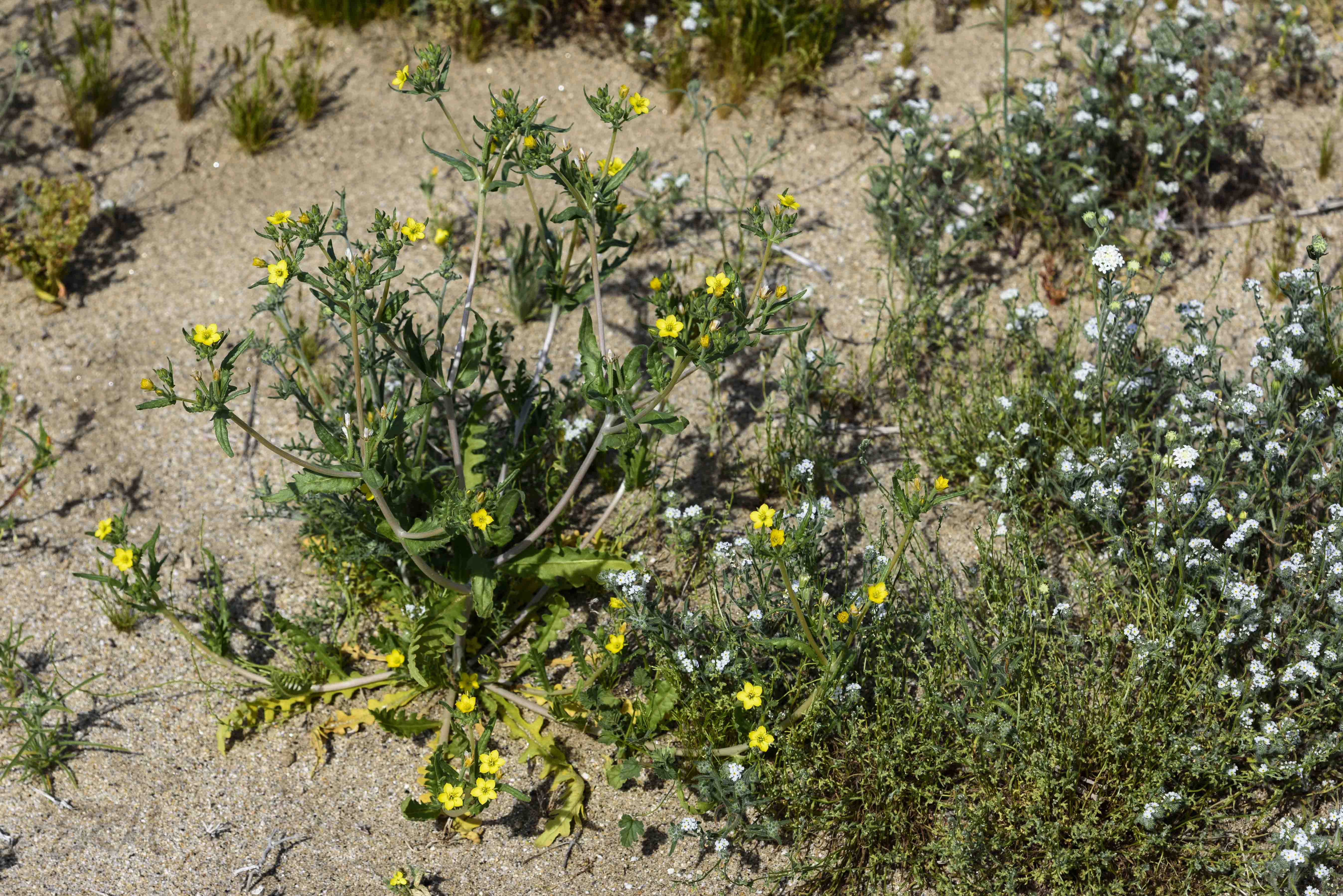
Blazing stars (Mentzelia species) can be tricky to identify. There are over 70 species, some not well-described in the literature, at least not in the readily-available literature. Mentzelia involucrata is easy enough, though, since it’s rather showy and common.

Even so, I second-guessed myself with some of the pictures. There’s a similar-looking, M. hirsutissima, which I thought I’d seen. But it’s a rare species, and you know what they say about extraordinary claims. I was able to eliminate that possibility once I read that only M. involucrata has floral bracts that are white with green edges.

M. involucrata is an annual plant growing to a little over a foot tall in both the Sonoran and Mojave deserts.

There were a few other small, yellow flowers that weren’t so easy, though. I could place them in the Loasaceae by observing the leaves, the flower shape, and the number of petals and stamens. Plants in this family tend to be low-growing, with thick, sometimes hairy, lobed or dentate leaves; the flowers have five radially symmetrical petals and many stamens.

Once I figured out Loasaceae, getting to Mentzelia was easy, since it’s the only genus represented in the area (according to the comprehensive San Diego County Native Plants). Then it was over to the excellent CalFlora website, which showed 18 Mentzelia species in the Anza-Borrego area. A close look at the location records and habitat information allowed me to eliminate all but four species as possibilities. Detailed descriptions at SEINet led me to eliminate two more, with some uncertainty, leaving two likely candidates: M. affinis (yellowcomet, yellow blazing star) or M. albicaulis (small flowered blazing star, whitestem blazing star). I just don’t have enough of the right details in the pictures to be certain, but after reading various descriptions I’m leaning toward identifying this one as M. affinis.
More Cacti

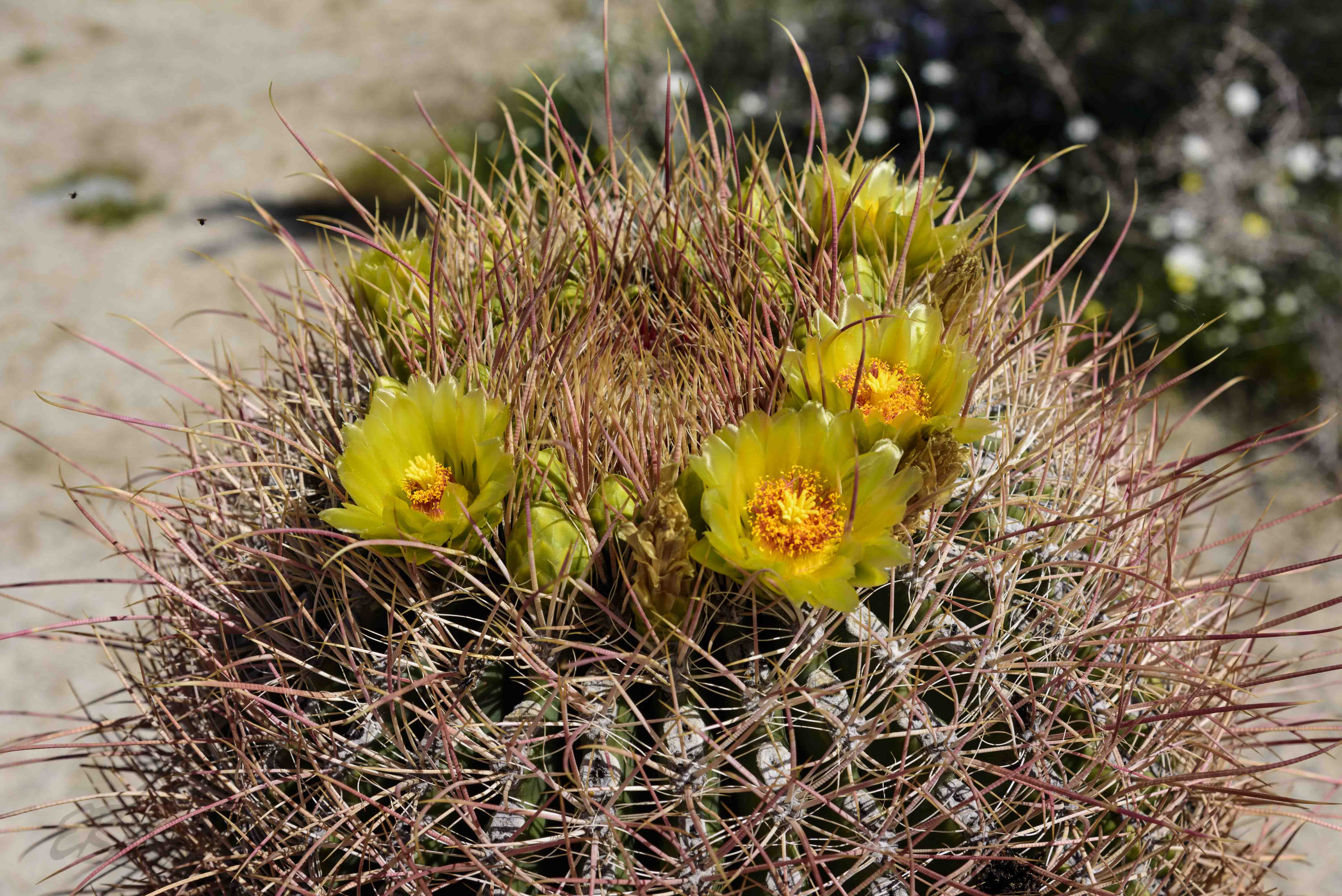
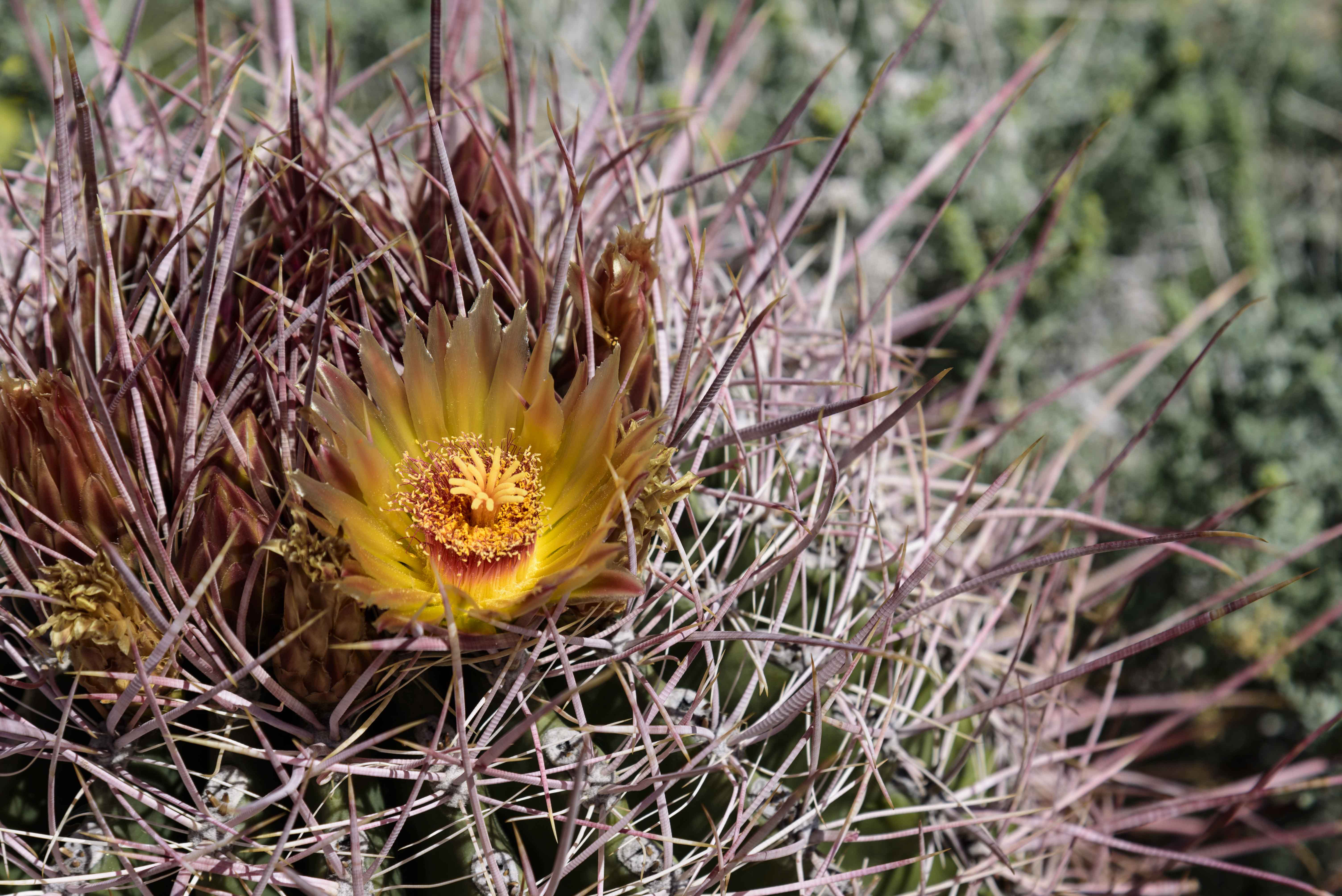
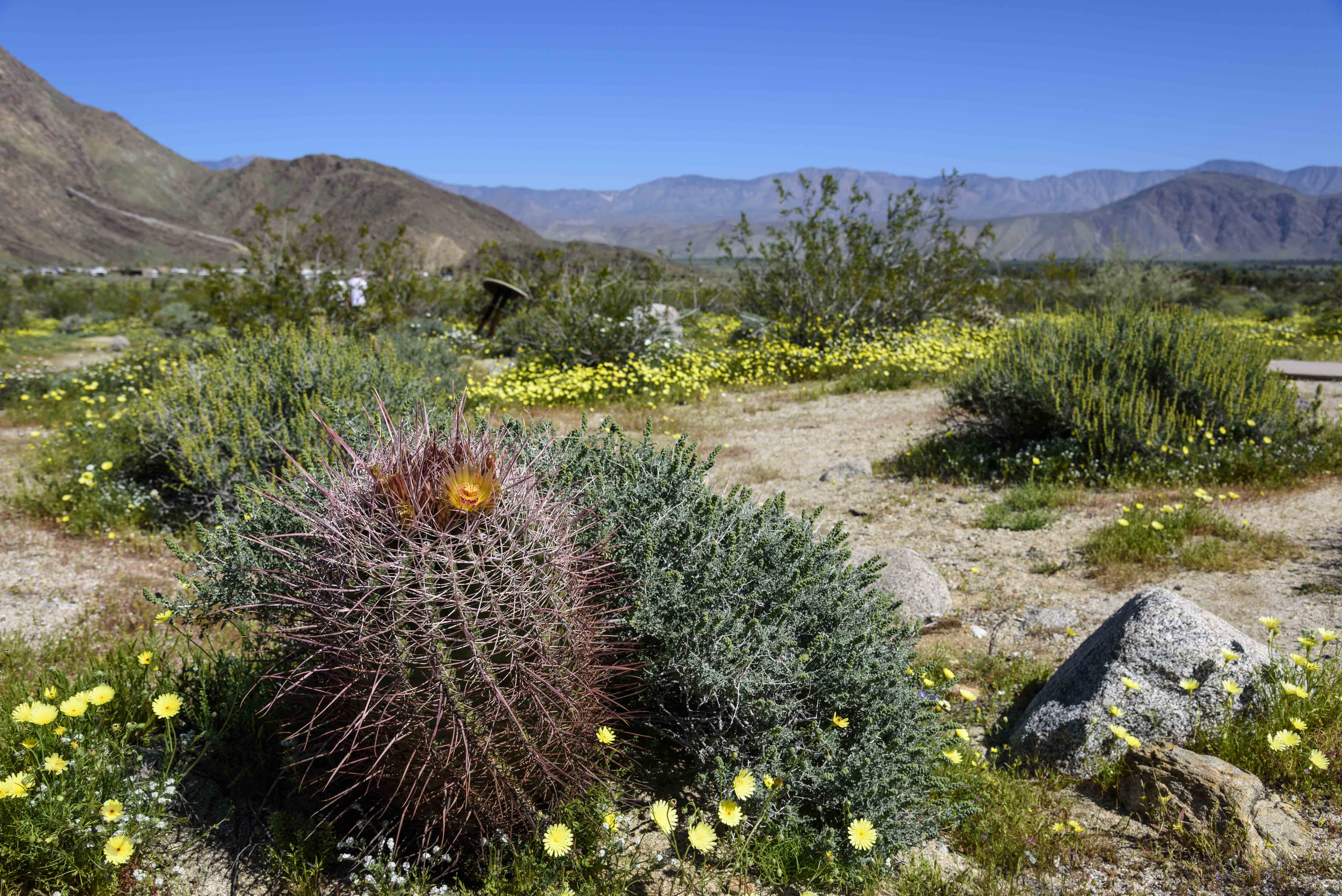
Ferocactus cylindraceus

California barrel cactus is native to the Sonoran and Mojave deserts, growing in various rocky and gravelly habitats. Younger specimens have redder spines and a more rounded stem, while older specimens have grayish spines and a cylindrical stem that typically grows to about five feet tall, sometimes taller.

Weird fact: this species is known to grow somewhat faster on its shaded side, so that older plants lean toward the southwest, which explains the common names “compass cactus” and “compass barrel”.

Although the IUCN* Red List categorizes California barrel cactus under “least concern”, some sources claim that the species is vulnerable to poaching by collectors.

I found this and many more specimens of California barrel cactus mostly in the flat plains near Borrego Springs, rather than on the slopes of canyons.


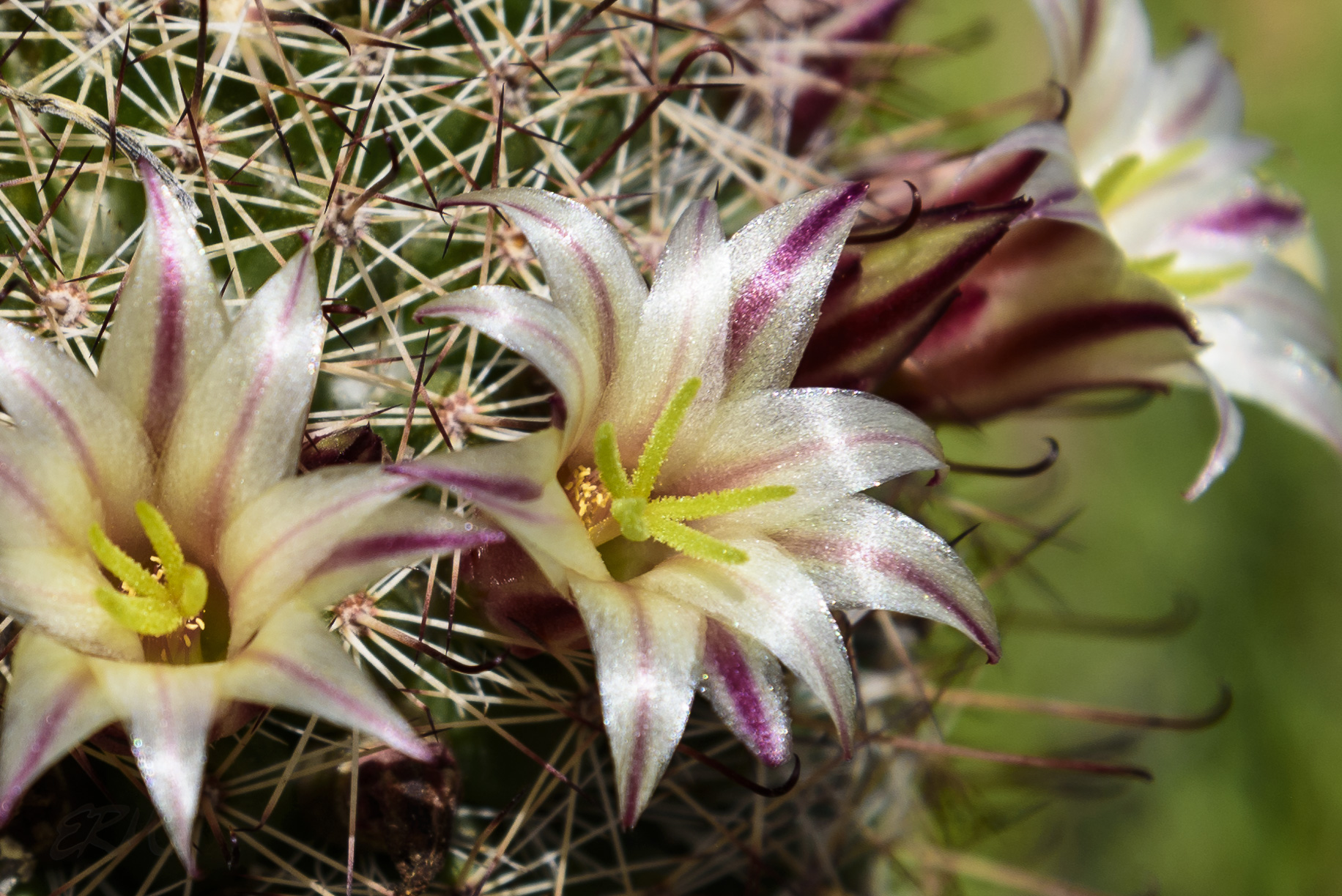
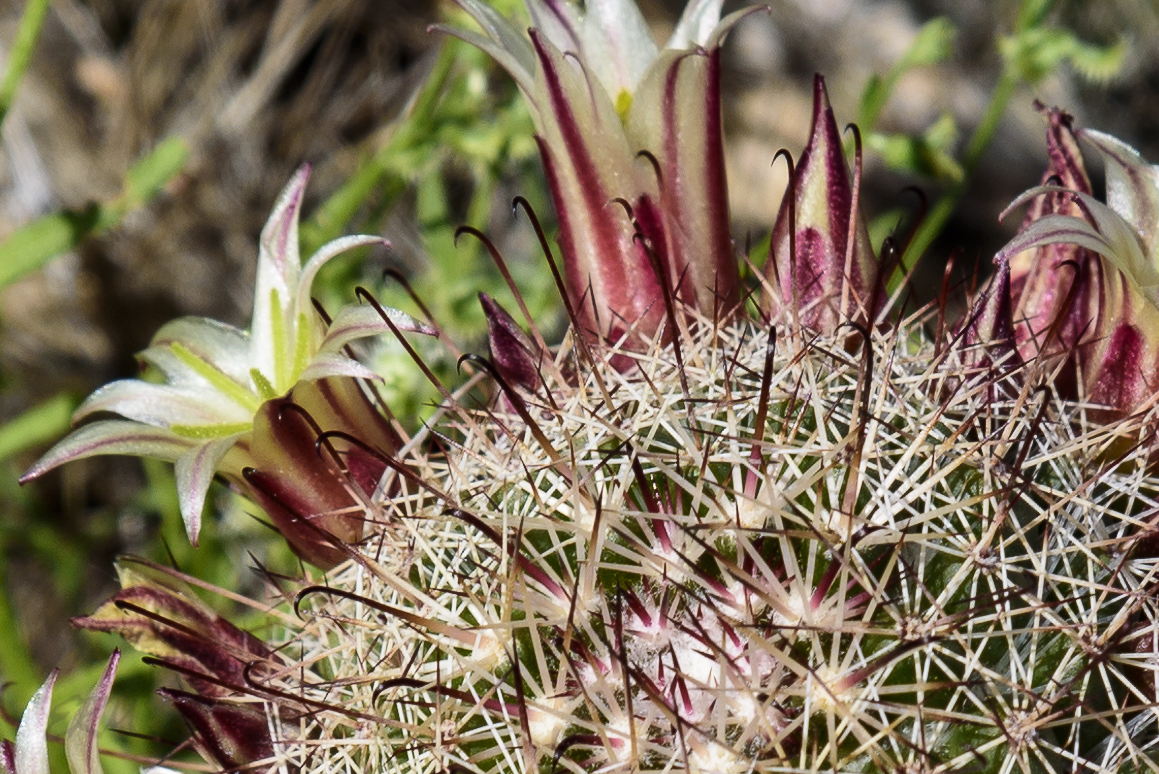
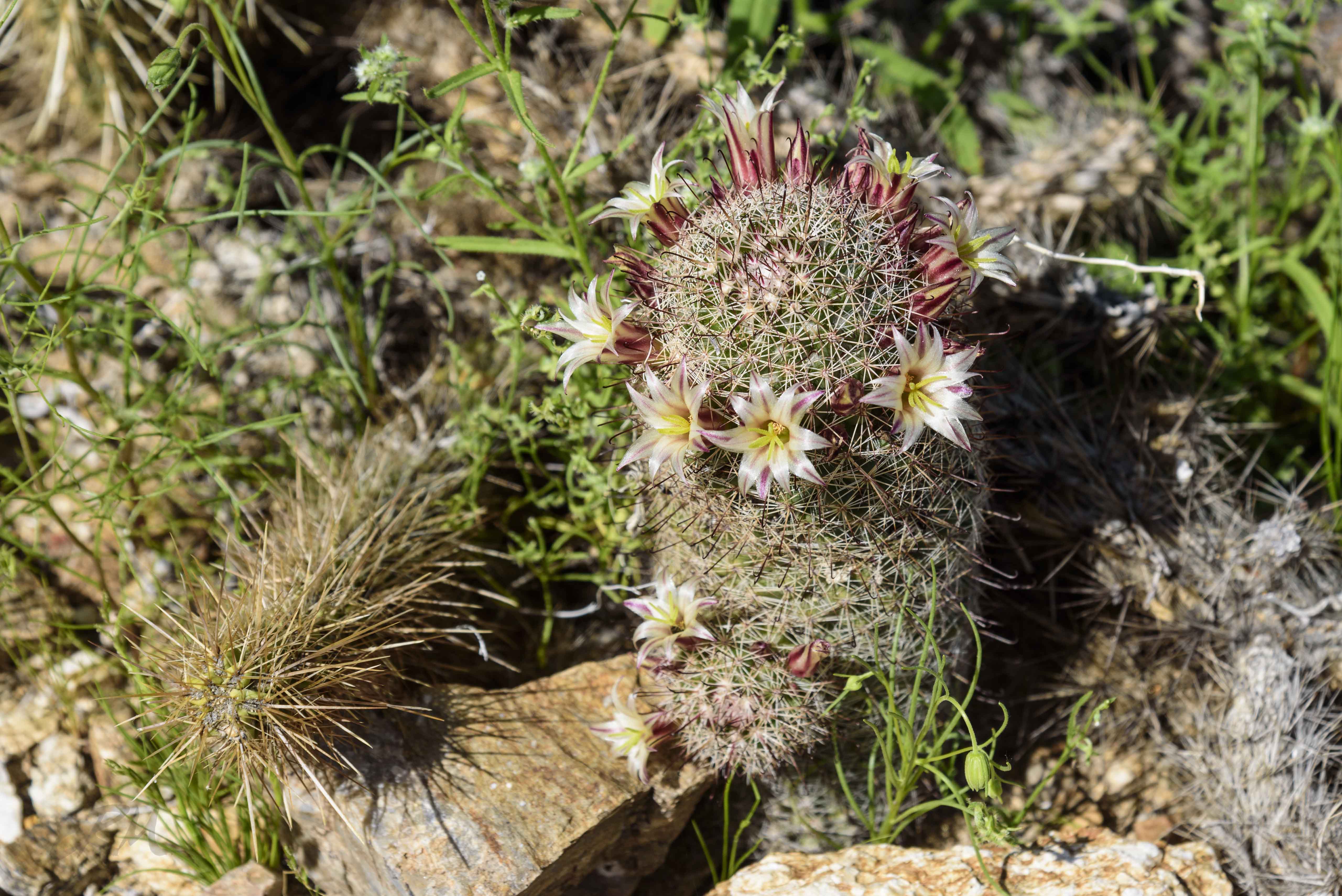
Mammillaria dioica

Fishhook cactus, aka strawberry cactus, has a small range that includes San Diego, Riverside, and San Bernardino counties as well as Baja California and Sonora states in Mexico; some sources also show it present in Imperial County. But it is not a rare species; IUCN calls it “locally abundant” and it’s on the Red List as “least concern”. Nonetheless, I found only two specimens, near Hellhole Canyon. Several authorities agree that there are three subspecies of M. dioica, though IUCN notes “this is a taxonomically complex species”. I don’t have enough information to say which subspecies this might be.

Fishhook cactus grows on dry slopes. Authorities state its size as anything from six inches to one foot tall; this specimen was closer to one foot.

This is one of the few cactus species that doesn’t always bear perfect flowers. Some specimens do, while others bear flowers with functional “female” parts and sterile anthers.

Note the other cactus in the lower left of the last photo. With not much information to go on I’ve tentatively identified it as Echinocereus engelmannii (hedgehog cactus). If you know it, please leave a comment!


*the International Union for Conservation of Nature; the Red List is a global accounting of species’ conservation status.

What Makes it a Cactus?


And, back to wildflowers.

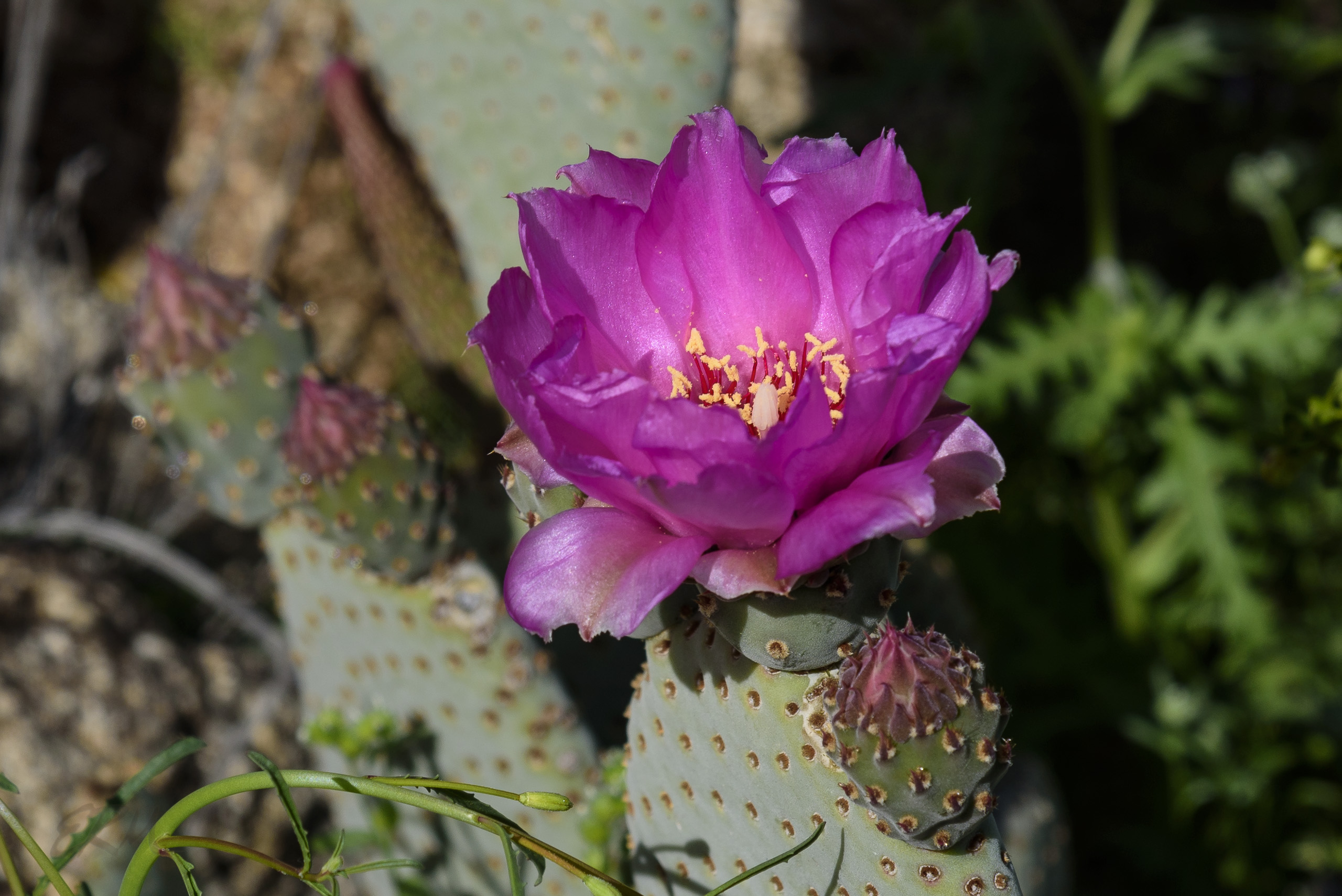
The pictures in yesterday’s post were of beavertail cactus, Opuntia basilaris, one of the earliest blooming cacti in the Anza-Borrego region. It grows in many different habitats of the Sonoran and Mojave deserts, and is easily identified as an Opuntia by the characteristic flat pads that appear to be spineless. It’s further identified as O. basilaris by the pink flowers (other species’ flowers are yellow). About those spineless pads: they aren’t spineless. The spines are just very small. They’re also barbed. Since this is botany, there has be be a word for them. They’re called glochids.

Beavertail has a cousin here in the Maryland piedmont: eastern prickly pear (Opuntia humifusa).

Cactus is one of those botanical terms that’s often mis-used colloquially, referring to any succulent plant. Succulent just means that the plant has organs that store water, while a cactus is any plant that is a member of the cactus family, Cactaceae.  There are many succulent plant species in the world, but only some of them are cacti.

So what makes it a cactus?

A number of things, taken in combination. First, cacti have spines, which are modified leaves. Spines are not the same as thorns, which are modified stems, or prickles, which arise from epidermal tissue.

Since (with very few exceptions) cacti don’t have true leaves, photosynthesis happens via the stems, which are succulent and often cylindrical, globular, or pad-shaped.

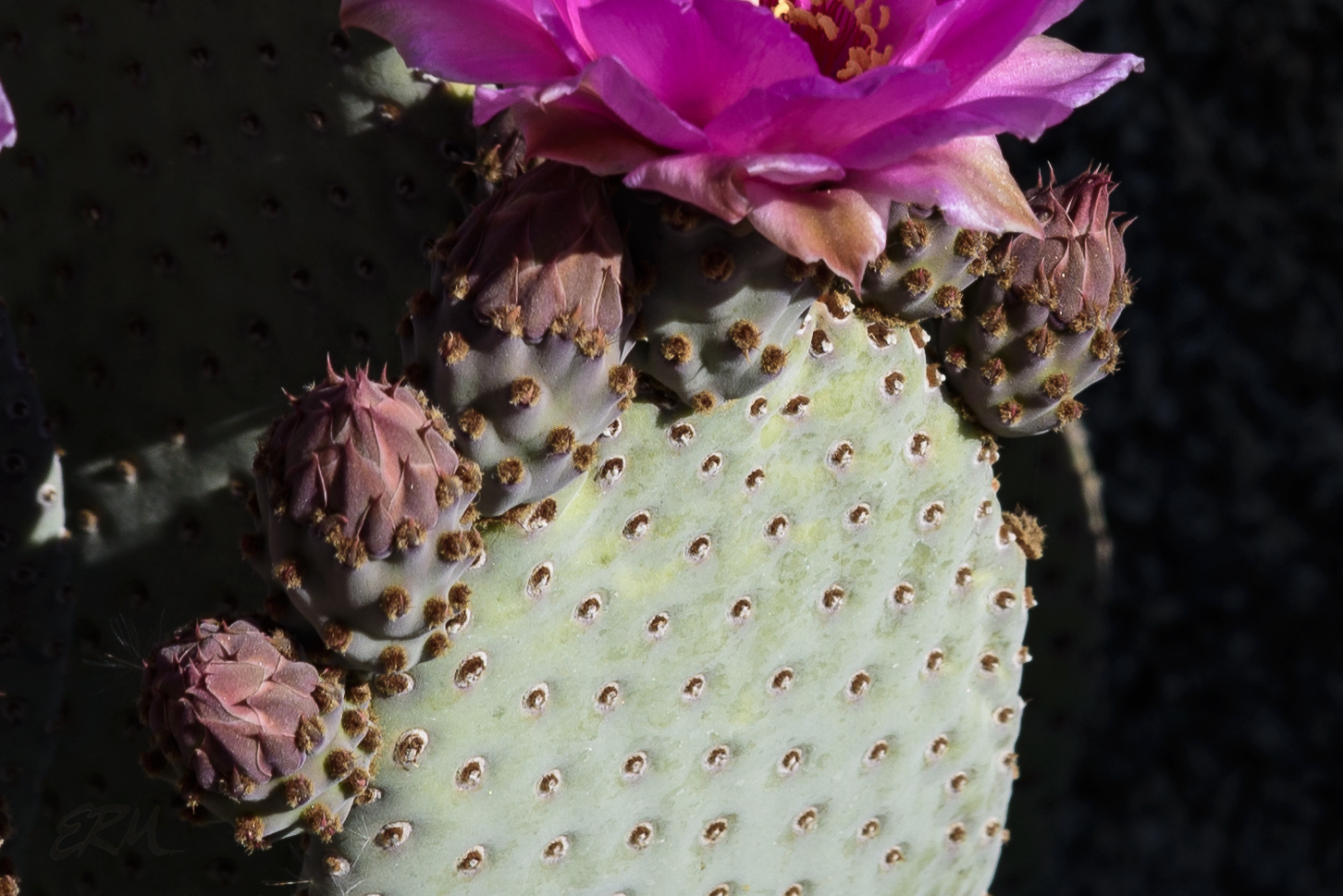
the things that look like dots on the stem are the aureoles; zoom way in to see some glochids in the upper ones

The spines arise from structures called aureoles, which are a defining feature of cacti; no other plants have them. Aureoles also give rise to new stems (on branching species) and to flowers.

Cactus flowers are showy and usually radially symmetrical, with numerous petals and sepals (which can’t be distinguished from one another). They are also usually bisexual, with numerous stamens and a single pistil with an inferior ovary (which means that it is located below the petals and sepals).

With the exception of a single species, all cacti are native to the New World.

Weird cactus fact: there are cactus species native to the the rainforests of Central and South America. Yes, cacti grow in the rainforest, as epiphytes on trees where there’s little organic detritus to form soil and water doesn’t collect, a situation like an extremely localized arid-yet-humid microclimate. Isn’t that nifty?! The common household plant Christmas cactus (Schlumbergera species) is one example.

next time: more cacti

interesting reading
CactiGuide.com
Spines, Photosynthetic Tricks, and Other Marvels of Cacti Evolution

Reflecting

I’m not a religious person. I’ve spent many hours in various houses of worship of different religions, where I’ve found comfort (at funerals), and joy (at weddings), and boredom (at Catholic services, sorry), and peace (at meeting). But the religious experience eludes me in any place made by Man.

If I’ve ever had a religious experience, it’s been in the outdoors. Along the Great Cacapon River in West Virginia when I was a child, on Sugarloaf Mountain when I was a teen, in the Potomac Gorge nowadays, and any wild place I’ve visited: Canyonlands, Mount Rainier, the Olympic Range, Death Valley… in these places I experience the grandeur of creation (if I can use that word), the vastness of this planet, the insignificance of humankind. And I find comfort and joy and peace and an overwhelming sense of awe.

The wild is my holy place.

Which brings me to Anza-Borrego. As you’ve probably heard, the park was overwhelmed by visitors; the tiny town of Borrego Springs ran out of gasoline and was running out of food the first weekend. People were saying the media played up the super bloom like never before, and it showed, with miles-long backups on the main roads, and road closures, and full parking lots, and cars parked on roadsides, and long lines at restaurants, and No Vacancy signs everywhere.

On the one hand, I should be glad of this, that so many people want to experience something so unusual and special. Maybe some of them will be converted and become environmentalists, and begin to understand the interconnectedness of it all and why it’s so important to have wild places. That would be a good thing.

On the other hand, I was mighty pissed off. I go to the wild for solitude, and I was almost never alone in my four days there. I was getting increasingly annoyed by clouds of dust as cars sped by on dirt roads, by people walking anywhere, not watching their footing, trampling plants, by people talking loudly or shouting to each other. By people taking selfies.

By people.

Imagine worshipping in your synagogue or mosque or church while a troupe of loud-mouthed, ill-mannered, immodestly-clad tourists go through.

The wild is my holy place. I want to share it with you, but please: show some respect.

What Makes it a Desert?


sunrise, March 15, near Palm Canyon in Anza-Borrego Desert State Park


Defining the word “desert” is not as straightforward as it may seem. Colloquially, desert usually means a hot, dry area, or sometimes a cold, dry area, without much vegetation or animal life. Technically, experts don’t agree. According to the US Geological Survey, “There are almost as many definitions of deserts and classification systems as there are deserts in the world.”

A useful definition of desert is: an area that receives 25 cm or less of precipitation annually.


chuparosa, phacelia, desert dandelion, brown-eyed evening primrose, and pincushion near the Anza-Borrego Visitors Center


Experts don’t agree on the boundaries and names of the North American deserts, either, but various sources state that there are many minor deserts and four major ones: the Great Basin, Chihuahuan, Mojave, and Sonoran. The Great Basin is the most northerly of these, bounded by the Columbia Plateau, Sierra Nevada Mountains, and Rocky Mountains; geopolitically, this means southeastern Idaho, most of Nevada, western Utah, and east-central California. The Chihuahuan is the most southerly, ranging from southeastern Arizona, southern New Mexico, and west Texas south into Mexico.

The Mojave is a transition from the Great Basin to the Sonoran, and comprises the greater Death Valley area, extreme southern Nevada, a bit of northwestern Arizona, and a tiny smidgen of southwestern Utah. One of the defining features of the Mojave is the flora, as it contains about 200 endemic species. (Look in the March and April 2016 archives for lots of posts about Mojave Desert wildflowers.)

The Sonoran is where Anza-Borrego is. Actually, Anza-Borrego forms the western boundary; from there it spreads east into Arizona and south into Mexico. Although Death Valley in the Mojave boasts the highest air temperature ever recorded (134ºF, in 1913), the Sonoran is on average hotter. And wetter.


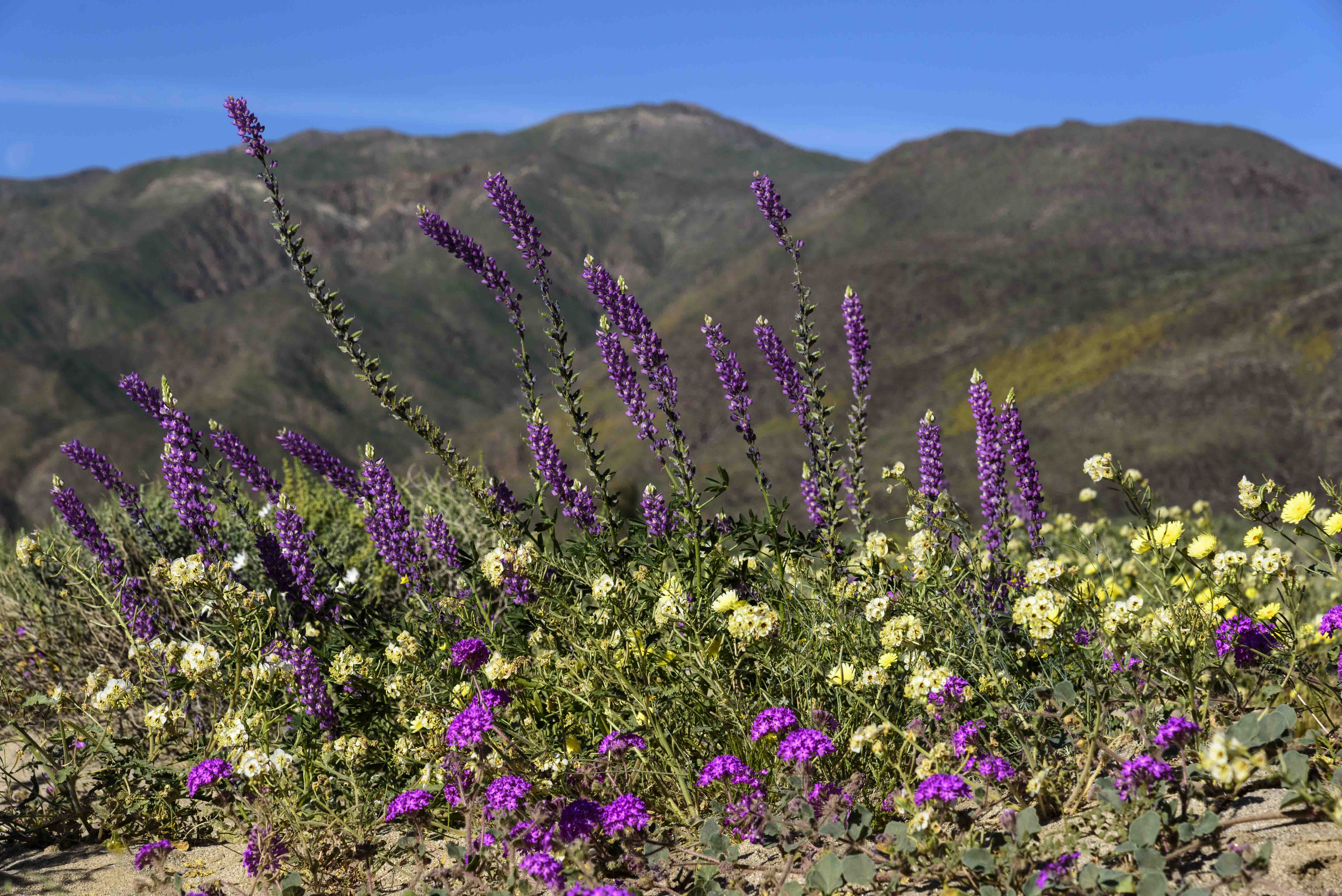
desert sand verbena, brown-eyed evening primrose, desert dandelion, Arizona lupine, and a few desert chicory on Coyote Canyon Road


The Mojave and Sonoran deserts share a few wildflower species, or more often a few genera, which made identifying the plants a bit easier. I found about 75 different species in 23 families (with half a dozen still unidentified). The Asteraceae and Boraginaceae were well represented. And this time I saw some cacti blooming, too.