
Fern Morphology and Terminology: an Illustrated Guide

20150711-20150711-_DSC0070
purple-stem cliffbrake (Pellaea atropurpurea) and maidenhair spleenwort (Asplenium trichomanes) growing together from a crevice in a wall

It’s been said that botany is the study of terminology.  Ferns have a language all their own (mostly).  Here’s a little primer on how ferns are structured and described.

A fern consists of a rhizome (a horizontal underground stem), with roots below and fronds above.

The frond is the entire “stem and leaf” arising from the rhizome.20150724-20150724-_DSC0080


fertile frond of christmas fern (Polystichum acrostichoides)


The frond consists of a stipe, blade, rachis, and pinnae.

The stipe is the portion of the stem from ground level to the lowest pinna (analogous to the petiole of a flowering plant).20150724-20150724-_DSC0080-3


the highlighted portion is the stipe


The blade is the portion of the frond carrying the leafy tissue (analogous to the leaf of a flowering plant).20150724-20150724-_DSC0080-2


everything except the stipe is the blade


The rachis is the midrib portion of the stem within the blade, and the pinnae (singular pinna) are the green parts of the frond (analogous to the leaflets of a compound leaf).20150724-20150724-_DSC0080


a single pinna highlighted; the pinnae are attached to the rachis


In twice cut (bipinnate) ferns, the pinnae are further divided into pinnules (sub-leaflets).20150724-20150724-_DSC0089-2


a single pinna with pinnules


In thrice cut (tripinnate) ferns, the pinnules are divided into pinnulets (sorry, no pictures!).

There’s terminology for blade shapes, too.  An undivided blade is simple.20150730-20150730-_DSC0350


a frond of walking fern (Asplenium rhizophyllum)


A blade with divisions reaching all the way to the rachis is pinnate (once-cut).
20150724-20150724-_DSC0103


a blade of maidenhair spleenwort (Asplenium trichomanes)


If each pinna is further divided all the way to the midrib, the blade is bi-pinnate.20150724-20150724-_DSC0086


a blade of marginal wood fern (Dryopteris marginalis)


If each pinnule is further divided all the way, the blade is tri-pinnate (again, no picture).

A blade with divisions not reaching all the way to the rachis is pinnatifid:
20150727-20150727-DSC_0021


a frond of common polypody (Polypodium virginianum)


These terms can exist in combination.  This broad beech fern (Phegopteris hexagonoptera) is pinnate-pinnatafid according to one authority,20150724-20150724-_DSC0091
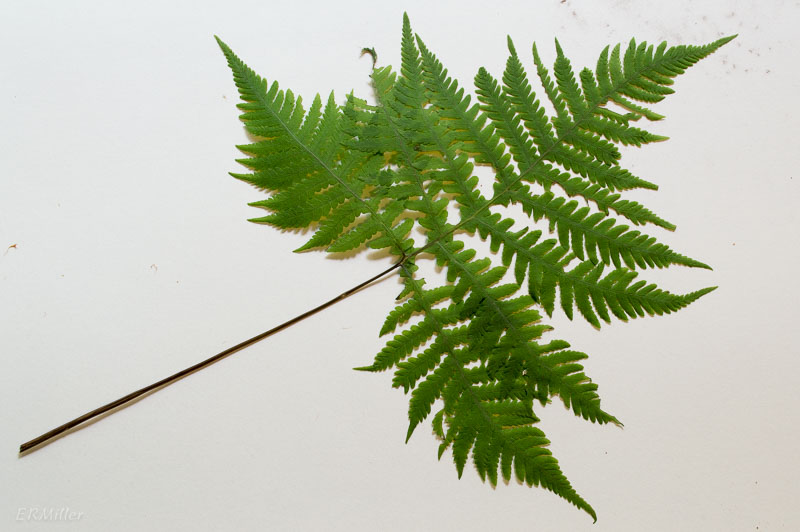
but it sure looks bi-pinnatafid to me:20150724-20150724-_DSC0096


Next time, a look at some fertile fronds.

Ferns and Lycophytes: an Introduction

20150711-20150711-_DSC0030

marginal wood fern
Dryopteris marginalis


This summer I took an Audubon Naturalist Society class on ferns and lycophytes.  You’re probably wondering, “what is a lycophyte?”  Hang tight, I’ll get to that.

Apparently I’m not the only wildflower enthusiast to keep a log or life list of finds; turns out I’m also not the only one who includes ferns on that list, though ferns aren’t even flowering plants.

So what does that mean, “ferns aren’t even flowering plants”?

20150527-20150527-_DSC0002


that kind of looks like a flower spike, but it isn’t; it’s the fertile (spore-bearing) stalk of a rattlesnake fern, Botrypus virginianus

20150527-20150527-_DSC0004


If you recall from grade school science, the taxonomic hierarchy starts with the plant and animal kingdoms, then moves down to division (phylum for animals), class, order, family, genus, and finally species.

Flowering plants are in the class Magnoliopsida.  They are vascular (containing tissues that transport fluids and nutrients), and reproduce via seeds.  Ferns are in a different class: Polypodiopsida.  They are also vascular plants, but they reproduce via spores.  Lycophtyes are in a third class, Lycopodiopsida; like ferns, they are vascular and reproduce via spores, but the morphology is different: ferns consist of rhizomes with roots below and fronds above, while lycophytes have stems with roots and tiny, scale-like leaves (called microphylls) that cover the stem above ground.

Ferns and lycophytes have differing evolutionary lineages as well, but I’ll spare you the details.

The current state of taxonomy is way different from what we learned in grade school. It gets complicated because there are different systems and the scientific community doesn’t seem to be in agreement about which one best fits our current understanding of evolutionary history.  For anyone who’s interested, here’s a little detour.

One widely used system (Woese) starts with domain, of which there are three; kingdoms are the next step down.  The differentiation is rather technical, but the domains are named Archaea, Bacteria, and Eukaryota.  The plant kingdom (Plantae) is in the last of these.

ITIS (the Integrated Taxonomic Information System, one of the more authoritative sources) has adopted a seven-kingdom system as its standard. The kingdoms are  Bacteria, Protozoa, Plantae, Fungi, Animalia, Chromista, and Archaea.

A google search on the phrase “kingdoms of life” will show other systems, dividing life into five or six kingdoms.

In ITIS, the next levels below kingdom are more divided than in the old KDCOFGS system.  If you go down the tree looking for ferns and lycophytes , you’ll see below the plant kingdom two subkingdoms; the one containing ferns is divided into two infrakingdoms; one of those is composed of two superdivisions; then after that come the divisions, of which there are eight.  Ferns and lycophytes are in the Tracheophyta (vascular plants).

Ignoring the three subdivisions, there are seven classes within the division Tracheophyta:

Cycadopsida: cycads (seed plants that vaguely resemble palms)
Ginkgoopsida: ginko (Gingko biloba, all by itself way up here in the taxonomic hierarchy!)
Gnetopsida: three genera of woody plants resembling conifers
Pinopsida: conifers (non-flowering, seed-bearing plants)
Magnoliopsida: flowering, seed-bearing plants
Lycopodiopsida: clubmosses, firmosses, spikemosses, quillworts
Polypodiopsida: ferns

Older field guides and text books refer to certain plants as “fern allies” or “fern relatives”.  These include the clubmosses, firmosses, ground cedars, horsetails, scouring rushes, quillworts, and a few others.  Of those, horsetails and whisk ferns are now considered to be true ferns.  The rest are considered lycophytes.  All of this reclassification is quite recent and based on molecular phylogenetic studies.

The point I’m trying to make, other than taxonomy is messed-up but fascinating, is that ferns and lycophtyes are only distantly related to the flowering plants I usually write about.  But they are abundant, beautiful, and interesting, so I’ll be posting about them.

20140605-20140605-DSC_0034-2


a lycophyte, commonly called “ground pine”, generally known as a “clubmoss”, but it isn’t in the same class as pines, and isn’t in the same division as mosses!


Next time, a look at fern morphology and nomenclature.

What’s Green Now? Rock Polypody

20150131-_DSC0151

Polypodium virginianum; Polypodiaceae

There are a few native ferns that are evergreen: ebony spleenwort, some of the woodferns (Dryopteris species), Christmas fern (in milder winters).  I’ve seen a few around but haven’t been able to identify them.  Rock polypody is pretty easy, though.  I love how it grows right out of stone, needing very little soil. Being a fern, of course, it won’t flower, but here’s how it looks in mid July:

20140725-DSC_0156

There are vast stands of it on the rocky bluffs around Carderock.