Bluets: A Closer Look

Warning: more than typical amount of plant geekery follows.

IMG_6685


my trusty D3200 poised by some bluets


As you may recall from yesterday, I went to the C&O Canal to determine if there were indeed two different species of bluets (Houstonia) in the area.

After 15 minutes of walking I arrived at the stand in question, and took a close look.  A really close look.  And lots of pictures.  What I found:
20150617-20150617-_DSC0020


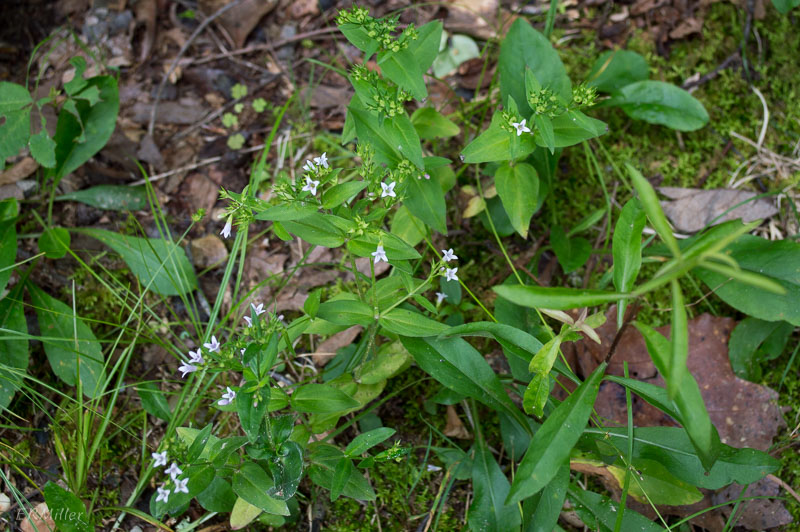
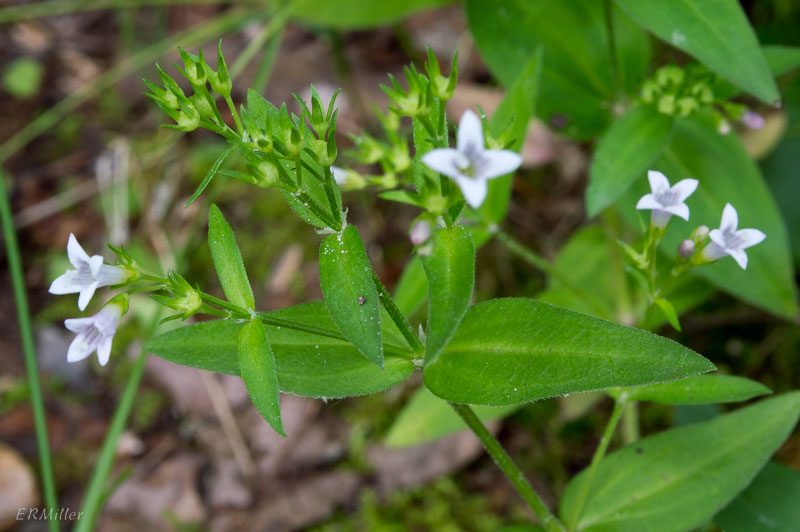
Two plants, one with five flowering stems, one with three flowering stems.  All were about seven inches tall.

20150617-20150617-_DSC0036


The uppermost stem leaves were narrow and one-veined.

20150617-20150617-_DSC0046


The middle and lower stem leaves were oval and three- or five-veined.
20150617-20150617-_DSC0090


It seems this species is Houstonia purpurea.


I walked another 50 yards or so, knowing that there was another stand somewhere, but I couldn’t find it, so I went back to the first stand and studied it a little more. Kneeling on the towpath and looking around me, I spotted some other flowers that I’d missed while standing.
20150617-20150617-_DSC0069


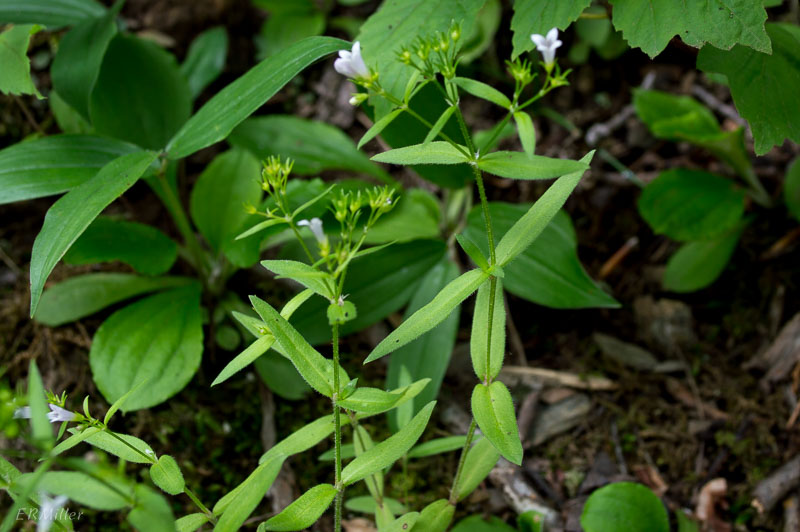
This was about eight feet away from the first stand.  It’s a single plant with six flowering stems, all about seven inches tall (just like the first stand).
20150617-20150617-_DSC0069-2


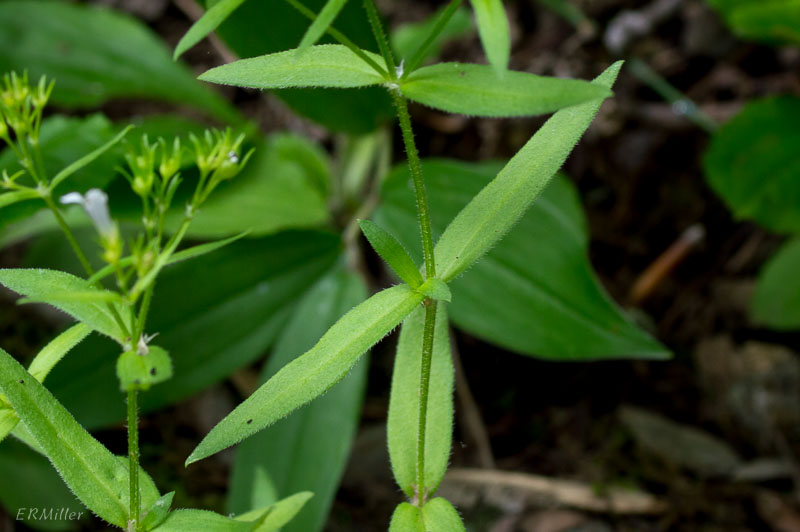
Look how long and narrow the leaves are compared to the other plant.  This one is H. longifolia.  I think.  Note the pair of leaves at top and bottom of the picture; they’re a little more oval and rounded at the base.  Could this be an intermediate form?!
20150617-20150617-_DSC0022


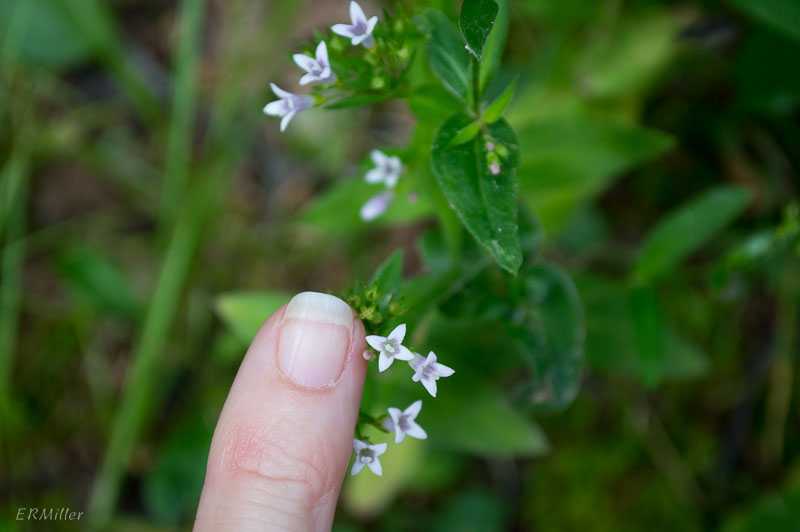
the flowers of H. purpurea…


20150617-20150617-_DSC0065


…are almost identical to the flowers of H. longifolia


Both Venus’ pride (H. purpurea) and longleaf bluets (H. longifolia) can be found across most of the eastern and mid-west US, with the latter species ranging further north and west into Canada. Longleaf bluets are endangered in Connecticut and Massachusetts, of special concern in Maine, and historical in Rhode Island.

20150612-20150612-_DSC0029

Bluets Illustrate a Lesson in Plant Identification

Houstonia species
Rubiaceae

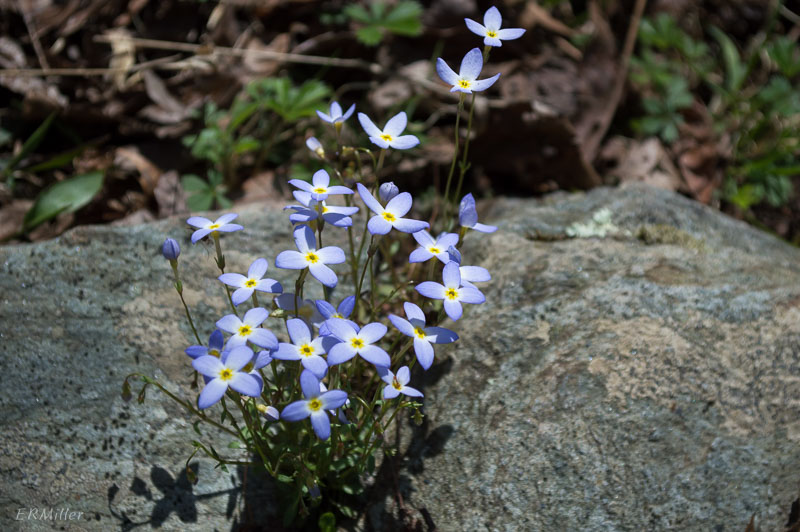
20150416-20150416-_DSC0359From mid-April to mid-May, the dryer, rocky soils around Carderock will be carpeted in rattlesnake weed and this adorable plant [left].  Standing only a few inches high, each stem bearing a single, terminal flower and few or no leaves, it’s very easy to identify as Houstonia caerulea (azure bluets).

20150612-20150612-_DSC0026

Half a mile or so west on the C&O Canal towpath, come early June, you might see just a dozen or so of these plants [right] on a certain dry hillside.  Standing about a foot to a foot and a half tall, with a small terminal cluster of flowers and three-nerved, oval leaves, it’s pretty easy to tell that this one is Houstonia purpurea, variously known as large bluets, woodland bluets, and Venus’ pride.

20150612-20150612-_DSC0029

Here’s when I get into trouble. Satisfied with the identification, I fail to examine every single plant and start concentrating on taking lovely photos, until I get one that I really like.

<—– Like this one.

Yesterday, I posted that photo to an internet discussion group and was quickly challenged: isn’t this Houstonia longifolia (long-leaf bluets)?  Let’s consider it, with descriptions from my three favorite ID books.*

H. purpurea: stem leaves egg-shaped or broadly lance-shaped, with 3-5 veins (Newcomb); plants erect, 6-20″, leaves rounded or notched at the base, stalked or stalkless (C&G); leaves oval, paired, sessile, entire, 3-veined (Peterson).

H. longifolia: stem leaves lance-shaped or oblong, 1-veined (Newcomb); plants erect, 4-10″, leaves narrowly oval or narrowly oblong, 1-nerved, tapering to base, stalkless (C&G); a small plant, slender paired leaves (Peterson).

Note that I didn’t describe the flowers; in all three sources the descriptions pretty much match, but more importantly, there can be a lot of morphological variation in flowers.  Color is probably the worst clue, because it can vary so much.  And look at the previous picture again: can you see that the topmost flower has 5 petals, while the others have 4?  These things happen.  To distinguish these two species, you need to examine the leaves.

Back to the question: which species is pictured?  There isn’t enough information to say for sure. Only the uppermost stem leaves are shown clearly, and while they appear to be narrow and 1-veined, the same can be said of the uppermost stem leaves on the plants ID’d as H. purpurea (in other pictures; I’ll spare you). Is it possible there are two different species in a single stand of plants?  Sure. Is it likely?  I don’t know enough to say.

These things bother me.  As I finish my third cup of coffee, I’m going to hit “publish immediately”, get my camera out, and go to the canal.  If I’m lucky these plants will still be blooming and I’ll get a good look.  If they aren’t, I probably won’t be able to pick them out from all the other foliage in the area.

I’ll post an update later today.

———–
*Newcomb’s Wildflower Guide; Wildflowers in the Field and Forest (Clemants and Gracie); Peterson’s Field Guide Wildflowers Northeastern/North-central North America

Flower of the Day: Partridgeberry. Again.

20150520-20150520-_DSC0051

Mitchella repens
Rubiaceae

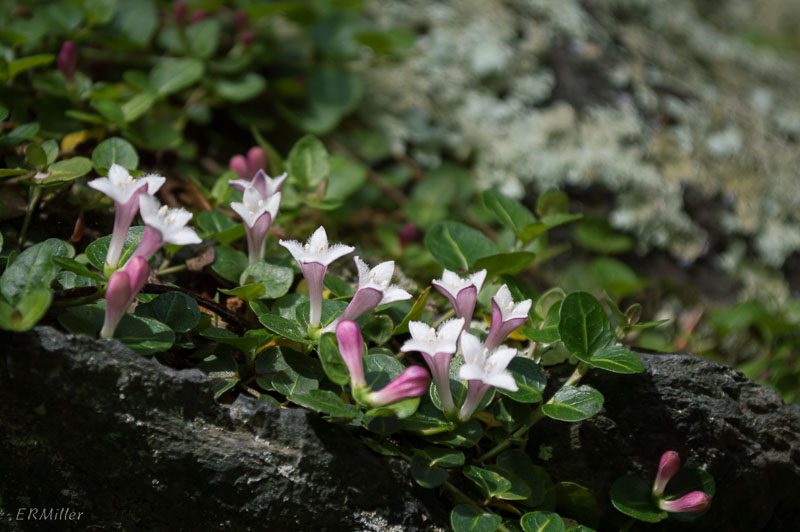
I’ve written about partridgeberry before, I know. But it’s such a neat little plant, I can’t resist posting about it. And it’s in full bloom now.
20150520-20150520-_DSC0052


It’s a trailing vine that can grow many feet long but rarely more than an inch tall.

(<—pinkie finger shot to give sense of scale)

20150520-20150520-_DSC0045


Amusing fact: you’ll find it in the Peterson Field Guide “Trees and Shrubs”, I suppose because it’s woody (barely) and evergreen.

Partridgeberry ranges from Quebec to Florida and west to Texas, and is threatened in Iowa.  No other species of Mitchella grow in North America. It likes moist, acidic soils and can often be found trailing along rocks.

20150520-20150520-_DSC0053

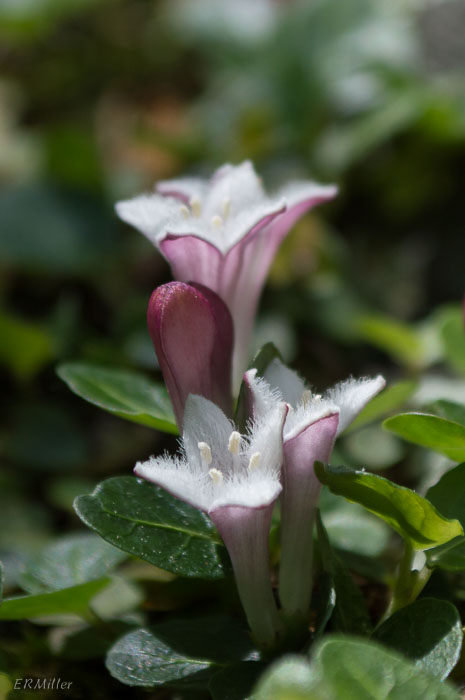
The plants produce pairs of blossoms; if both are pollinated, the ovaries will fuse to produce a single oval, red berry with two dimples.


20150520-20150520-_DSC0047

Other common names include squawberry, running box, twinberry, and pigeon plum.

(You know how people squeal over puppies and kittens?  I could almost squeal over partridgeberry.  I mean really, isn’t it just precious?)

What’s Green Now? Partridgeberry

20150131-_DSC0157

Mitchella repens; Rubiaceae

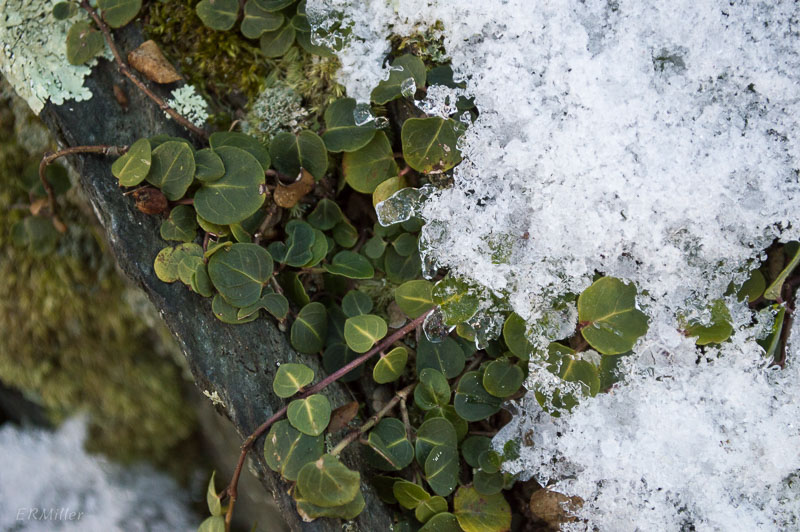
Last one for the “what’s green now’ feature.  Growing in tiny pockets of soil, cascading along rocks, never more than an inch tall (but often many feet long), partridgeberry is one of my favorites.  Look for the twin blossoms

20140527-DSC_0005

in late May, and the two-eyed fruit

20141021-_DSC0063 copy

in late July.

How can you not love this plant?  It’s adorable.  And tough.