Yellow Star Grass

20160512-_DSC0100

aka common goldstar
Hypoxis hirsuta
Hypoxidaceae
(formerly Liliaceae)

This is a common plant, found through most of Maryland and much of the eastern US (but not Florida), and into the Midwest and Great Plains, with scattered occurrences further west. And yet I’ve never seen it until this spring, when I found this single plant blooming on Sugarloaf Mountain. I really do need to get out to new places more often.

There’s not much to say about it. The plant stands no taller than twelve inches, looking rather like a tuft of grass, but it isn’t. A flowering stem can hold several flowers.

Yellow star grass is threatened in New Hampshire and possibly extirpated in Maine.

20160512-_DSC0096

A Drier Place, Two Not-So-Big Ferns

In the drier (but still moist) woodlands towards the top of Sugarloaf Mountain you can find more species of ferns, not as big as the ones I posted about last time. Both these species are light-colored and medium-sized, and both will form large colonies.

20160512-_DSC0138

New York fern
Thelypteris noveboracensis
Thelypteridaceae

20160512-_DSC0030-2

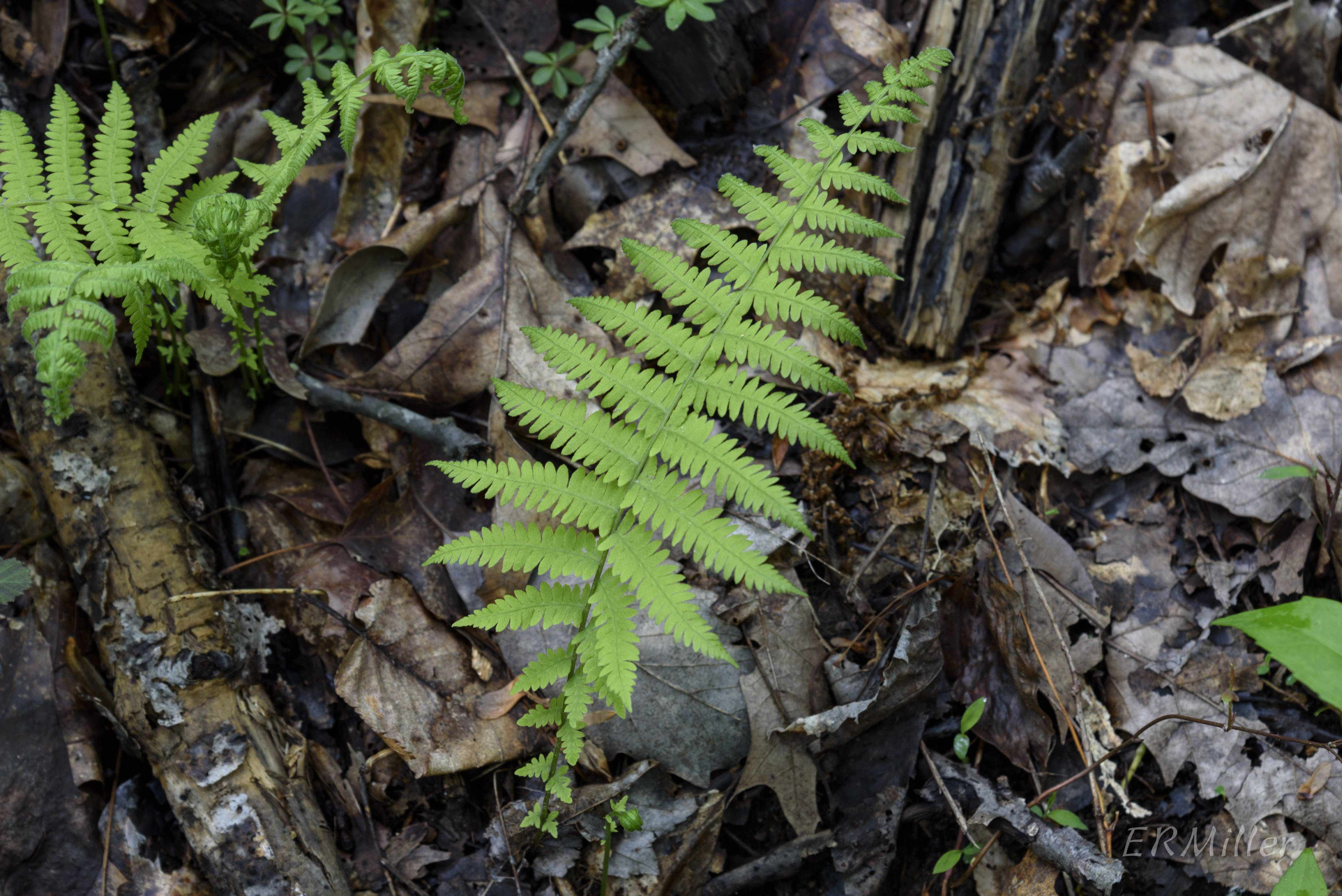
New York fern’s distinguishing characteristic is the shape of the blade, which tapers at both ends.


Each pinna is deeply lobed, but not cut all the way to the costa (midrib). Note that the rachis, costa, and pinnae are smooth (as opposed to hay-scented fern below).


20160512-_DSC0028

a good-sized colony of New York fern about halfway up Sugarloaf Mountain

New York fern ranges from Oklahoma and Louisiana east and north up into Quebec and Newfoundland. It’s endangered in Illinois and exploitably vulnerable in New York.


20160512-_DSC0033

hay-scented fern
Dennstaedtia punctilobula
Dennstaedtiaceae

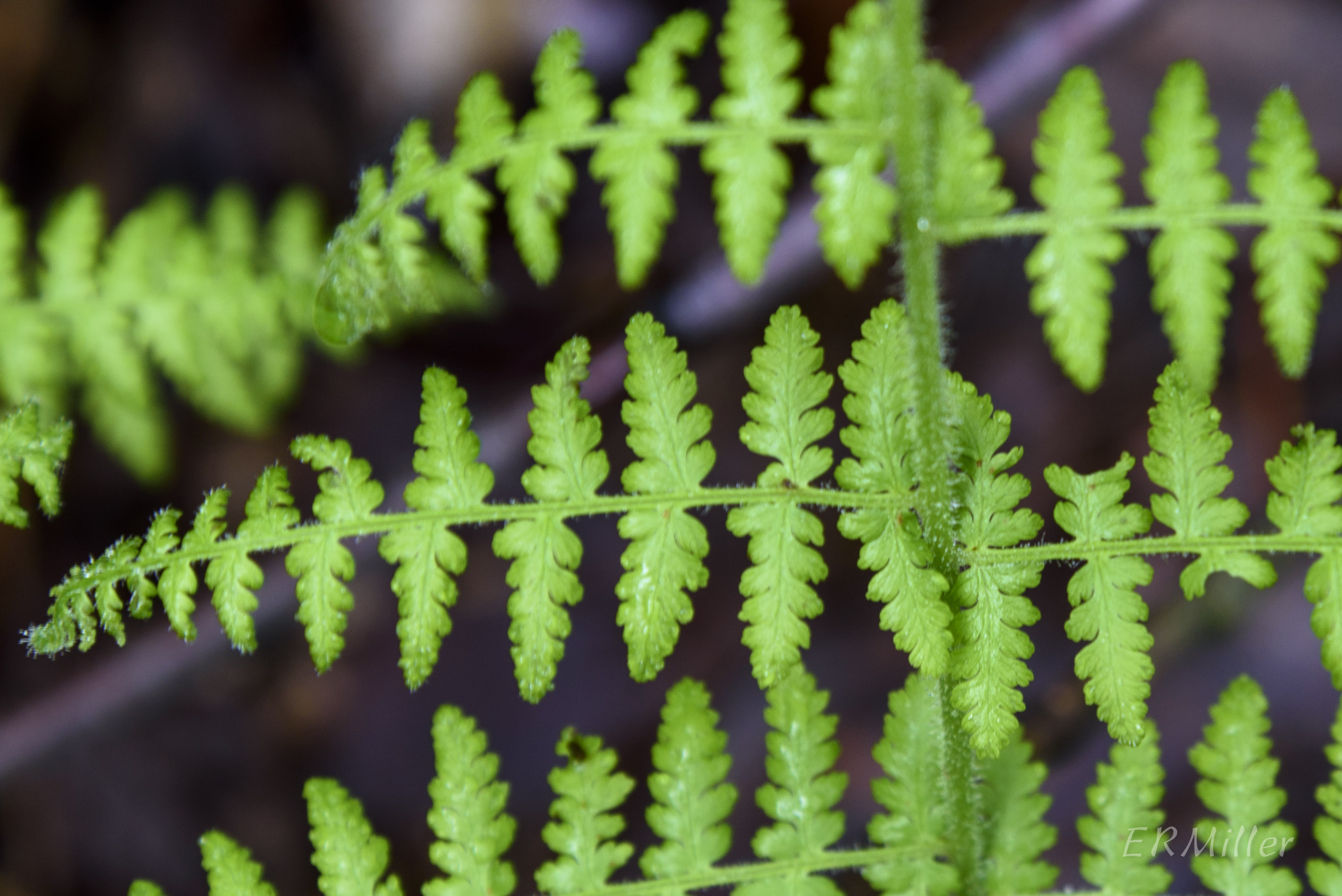
The blade of hay-scented fern is 2 pinnate-pinnatifid (meaning twice cut, the pinnules deeply lobed but not cut all the way to the costa).

20160512-_DSC0035


If you zoom in you can see fine hairs on the rachis, costa, and pinnules.

20160512-_DSC0038

forest floor carpeted with hay-scented fern

Hay-scented fern ranges from Missouri and Arkansas east to the Atlantic and north into Canada. It’s endangered in Illinois and possibly extirpated in Michigan.

One Wet Place, Three Big Ferns

20160507-_DSC0022

cinnamon fern
Osmundastrum cinnanomeum

A small stream called Bear Branch, a tributary of Bennett Creek (which is a tributary of the Monocacy River) flows through the Sugarloaf Mountain Natural Area. It’s a nice place to go botanizing, despite some pretty heavy deer browse. The understory is full of mountain laurel (Kalmia latifolia). I’m slightly embarrassed to say that I’m not sure of the canopy; chestnut oak mostly, and some beech, but I have a bad habit of looking down when I should be looking all around.

Anyway, the more or less flat area where the two forks of Bear Branch meet, by Mt. Ephraim Road, is almost swampy. Last month I noted many croziers coming up there, but I don’t know ferns well enough to identify them by their fiddleheads. By last week most were fully opened into tall fronds, and some had fertile fronds as well. Fertile fronds make identification much easier.

All three of these species are in the Osmundaceae. All three have similar ranges, mostly east of the Mississippi River as far south as Georgia and north well into Canada (cinnamon fern ranges further into the southwest). All three are tall, clump-forming ferns of wet places, and all three have distinctive fertile fronds.

(Apologies for all the jargon in this post. Have a look here and here for some definitions.)


20160507-_DSC0038

a young royal fern; fronds can grow to 3 feet in length

royal fern
Osmunda regalis var. spectabilis 

Royal fern has an unusual look. The pinules of the bi-pinnate fronds are simply-shaped and widely spaced along the costa, giving the frond an open, airy appearance.

20160507-_DSC0052

pinules (leaflets) along the costa (midrib)
 

20160507-_DSC0054

portion of a blade showing bi-pinnate form


20160507-_DSC0055

closer look at clumps of sporangia on fertile frond


Royal fern is commercially exploited in Florida, threatened in Iowa, and exploitably vulnerable in New York.


20160507-_DSC0027

cinnamon fern
Osmundastrum cinnamomeum
(formerly Osmunda cinnamomeum)

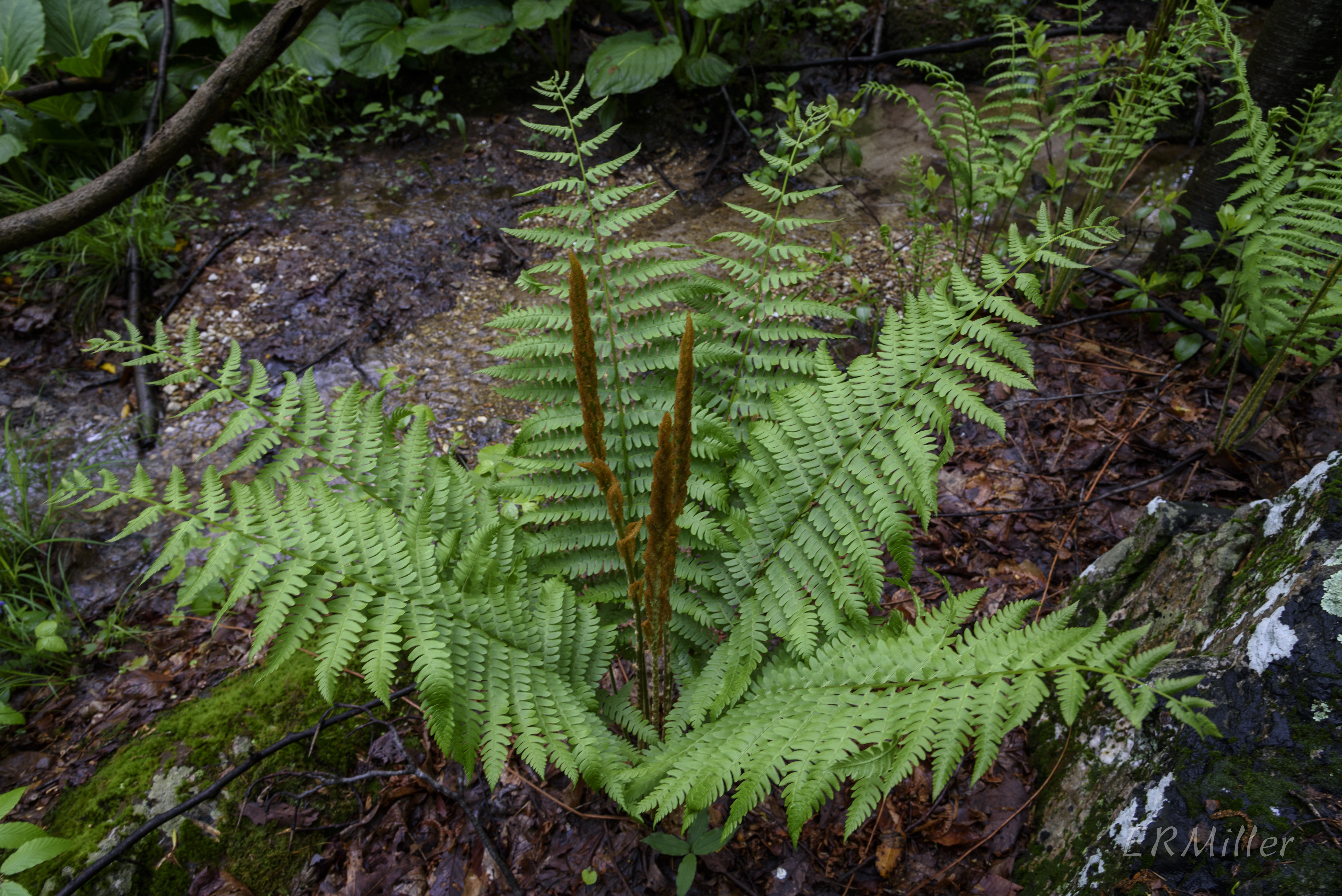
When fertile fronds are present, cinnamon fern can’t be mistaken for anything else. You can see how it gets its common name (and specific epithet) from the fertile fronds, borne separately from the sterile fronds; when mature, the sporangia turn brown, giving the look of a cinnamon stick.

20160507-_DSC0025

the leafy, sterile fronds are pinnate-pinnatifid, meaning the blade is once cut into pinnae, and each pinna is lobed but not cut all the way to the costa (midrib)

Cinnamon fern is commercially exploited in Florida, endangered in Iowa, and exploitably vulnerable in New York. It’s commonly available in the nursery trade, and is a great landscaping plant for a large, shady, wet part of the yard.


20160507-_DSC0007

interrupted fern
Osmunda claytoniana

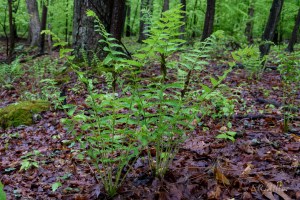
As with cinnamon fern, the fertile fronds of interrupted fern make identification easy, and you can see how it gets its name. The sporangia (green when young, tan or brown when mature) cluster on the rachis between the pinnae.  This fern likes wet places, but not as wet as the previous two. Each species I found growing in distinct stands in the same general area, but well apart from each other. The interrupted fern was significantly further uphill, on a bit of a slope in a slightly rockier area.

20160507-_DSC0005

clusters of mature sporangia “interrupting” the pinnae along the rachis

Interrupted fern has pinnate-pinnatifid blades. It’s threatened in Arkansas and exploitably vulnerable in New York.

20160507-_DSC0010

a single pinna, showing pinnatifid form (pinnules not cut all the way to the costa)
 

Another Orchid Added To My List

20160508-_DSC0136

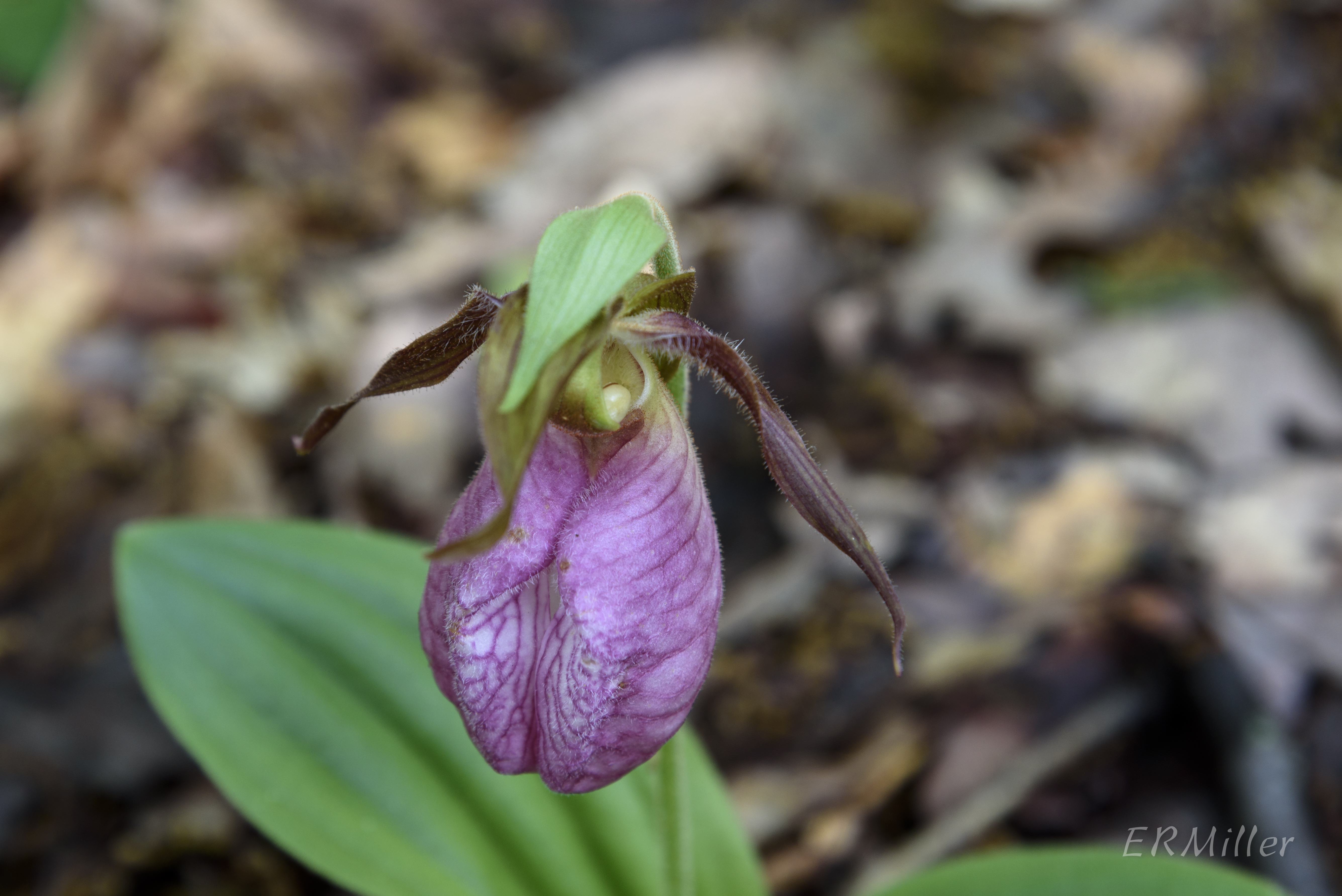
pink lady’s slipper
aka moccasin flower
Cypripedium acaule
Orchidaceae

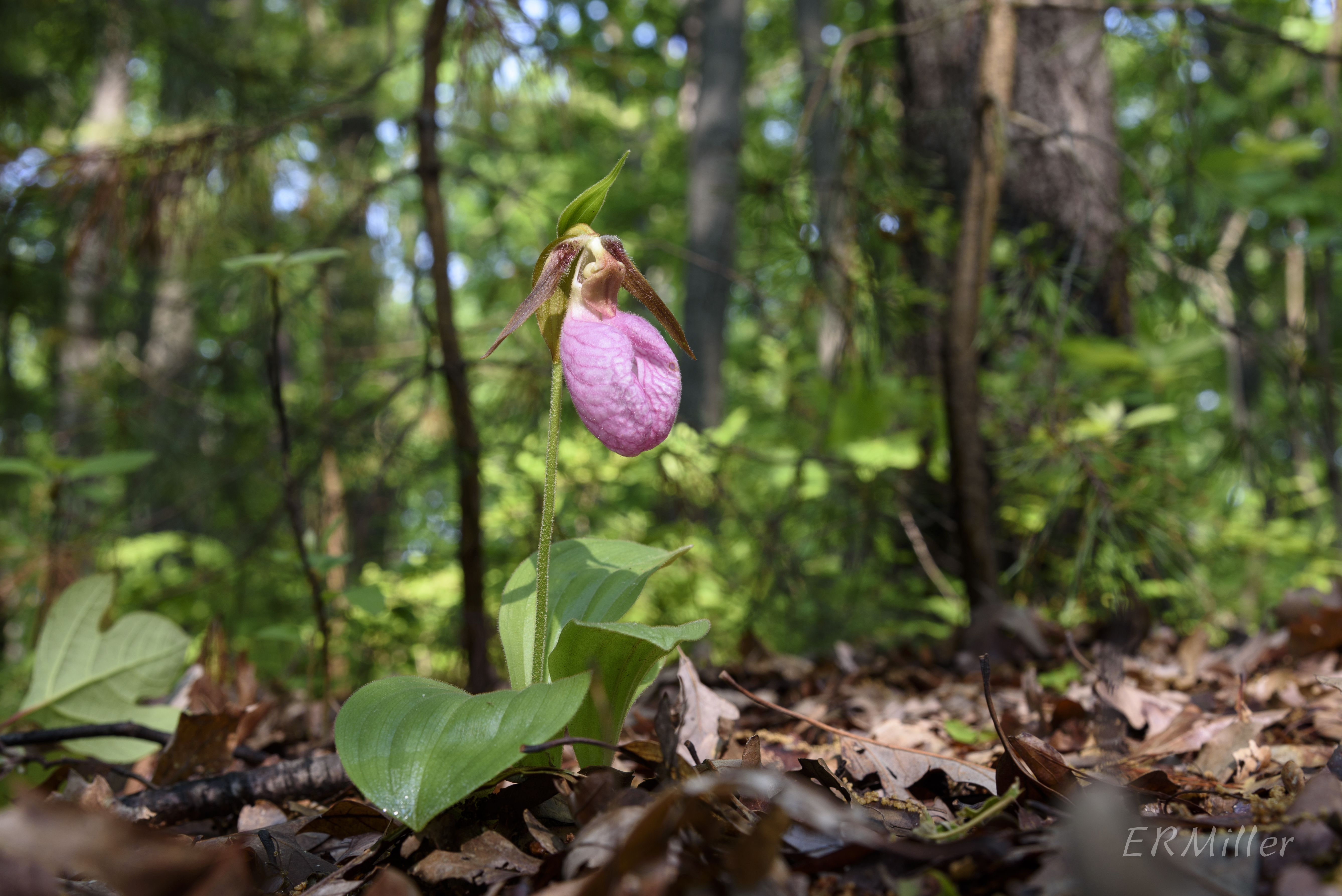
The state of Maryland is home to more than 50 species of native orchids. Until this past weekend, I have seen only three of those in bloom (and the leaves of a fourth).

I was going a little crazy trying to find any of the three species of lady’s slippers in Maryland. After hours of searching on Sugarloaf Mountain I found a plant, I think, but it wasn’t flowering. I might have seen several plants in Rachel Carson Conservation Park, but can’t be sure until they flower.

20160508-_DSC0151

Then a very kind member of the Maryland Native Plant Society came to my rescue. The instructions were explicit and excellent, and I was able to spot eleven plants in a somewhat spread out area. Three of them were in bloom.

It helps to be looking in the right places, of course. Interestingly, pink lady’s slipper grows in several different habitats. I’ve seen references to it growing in dry woods and moist woods, on slopes and in bogs, in hardwood forests and mixed deciduous-coniferous woods.

20160508-_DSC0163

It does like acidic soils and dappled sunlight.

Like most orchids, this plant depends on a symbiotic relationship with a species of soil fungus in order to reproduce and grow. For this reason (among others, like its very large root system), attempts to transplant it from the wild are doomed to fail.

20160508-_DSC0168

Pink lady’s slipper ranges from the upper Midwest into New England, then south into Virginia and a little further south along the Appalachian Mountains. It can be found all over Maryland, though there are no records for it in four counties per the Maryland Biodiversity Project. It’s endangered in Illinois; exploitably vulnerable in New York; commercially exploited, endangered in Tennessee; and unusual in Georgia.

20160508-_DSC0157

An now, a confession: I actually find this flower rather ugly. That doesn’t change how happy I am to have finally seen it in the wild.

20160508-_DSC0182

Wild Sarsaparilla


20160505-_DSC0111-2

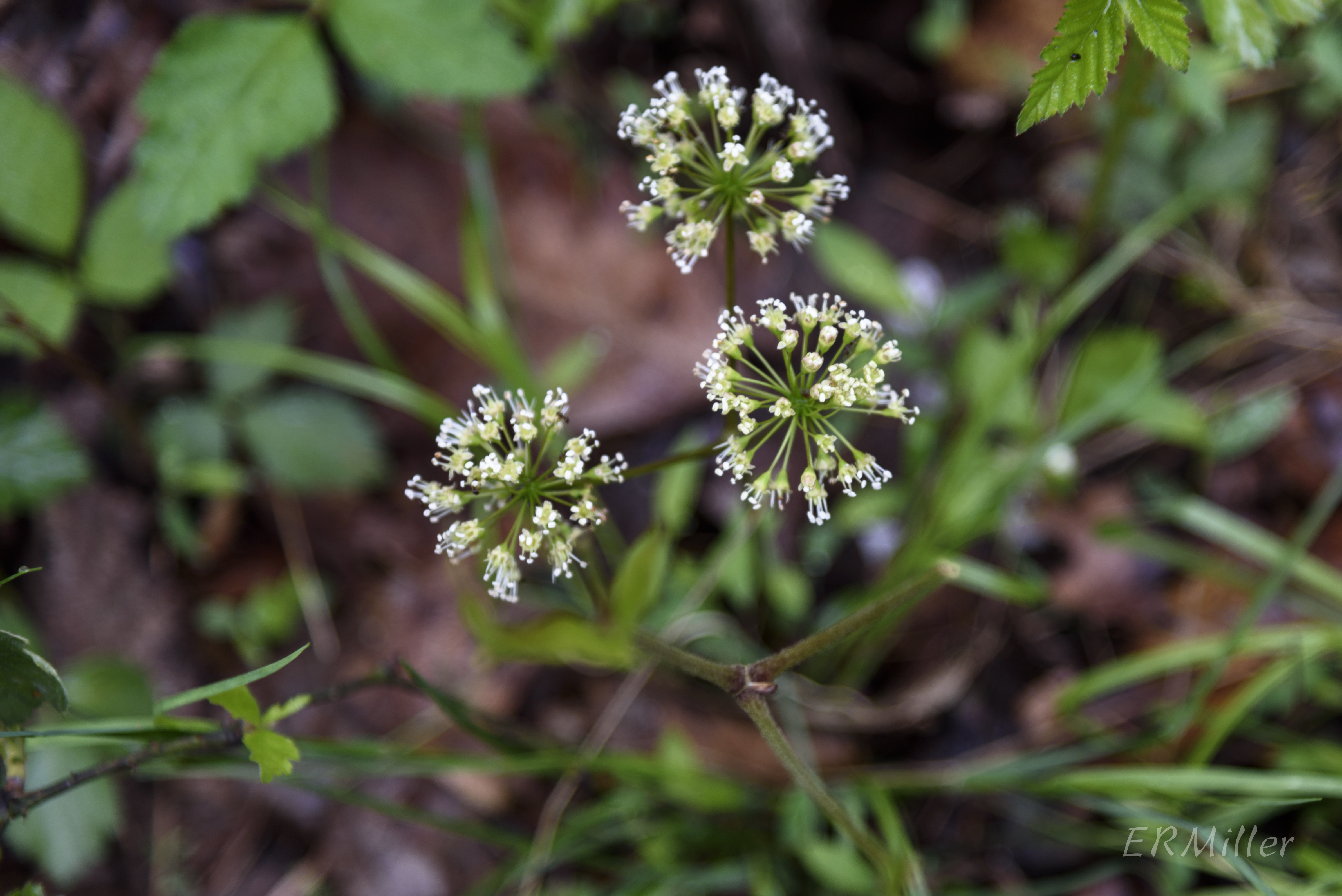
Aralia nudicaulis
Araliaceae

Last week I went back to Sugarloaf Mountain with one goal: find lady slipper orchids. After four cool, humid hours, the rain started and I had to leave. Never saw any orchids, but I did find some great stands of ferns, a new-to-me violet which I think I’ve id’d correctly, and another new-to-me plant: wild sarsaparilla.

Wild sarsaparilla is a woodland plant found in almost all of Canada, across the northern US, and south along the Appalachian Mountains into South Carolina.

20160505-_DSC0090

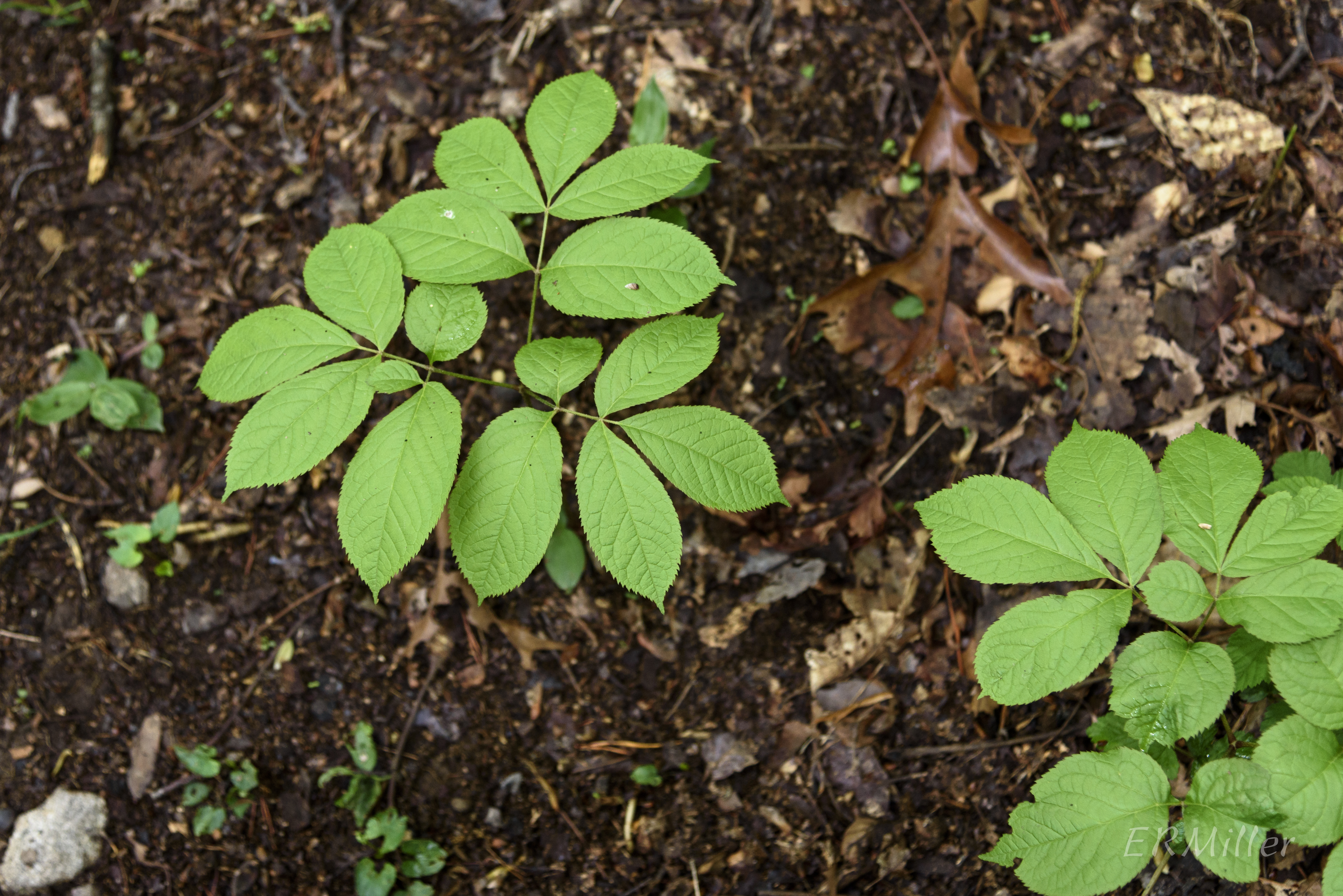
The form of the plant is interesting: there’s a single leaf-bearing stem and a single flowering stem. The flowering stem is shorter, and has three spherical clusters of flowers. The leaf stem looks at first like it has three compound leaves, and many websites describe it this way. The excellent Illinois Wildflowers site describes it as a single leaf, in three discreet segments, each segment comprising three to five leaflets.

20160505-_DSC0130 copy

“Sarsaparilla” is also the name of a beverage that tastes a lot like root beer. Traditionally it’s flavored with root extracts from any of several different species of Smilax*, all of which go by the common name “sarsaparilla”, and all of which are tropical. Since Aralia nudicalis roots yield a similar flavor, they’ve been used as a substitute for sarsaparilla, as flavoring agents and for medicinal purposes.

*an aside for taxonomy nerds: the two genera aren’t in the same family or even order, but they are in the same class, Magnoliopsida