Twinleaf Alert!

No plant in the piedmont that I know of has as short a bloom time as twinleaf (Jeffersonia diphylla). Thanks to a tip from a fellow hunter, I was able to get out to Billy Goat B today, where I saw just two of them blooming. If they follow the same pattern as in recent years, they will be in full bloom in another two days, maybe, and done by Sunday.

I’ll write about twinleaf and post more pictures later, but I wanted to get the word out before it’s too late.

Also seen blooming today on Billy Goat B and in the Carderock area: trout lily, Dutchman’s breeches, leatherwood, Virginia bluebells, cut-leaf toothwort, slender toothwort, early saxifrage, round-lobed hepatica, rue anemone, toadshade, and bloodroot.

Sand Dune Show

The Sonoran Desert’s wildflowers range from belly-flower sized to big and showy. Here are two of the latter. Although honestly, I took a lot of belly shots anyway. It was a sandy belly, sandy elbows kind of week.

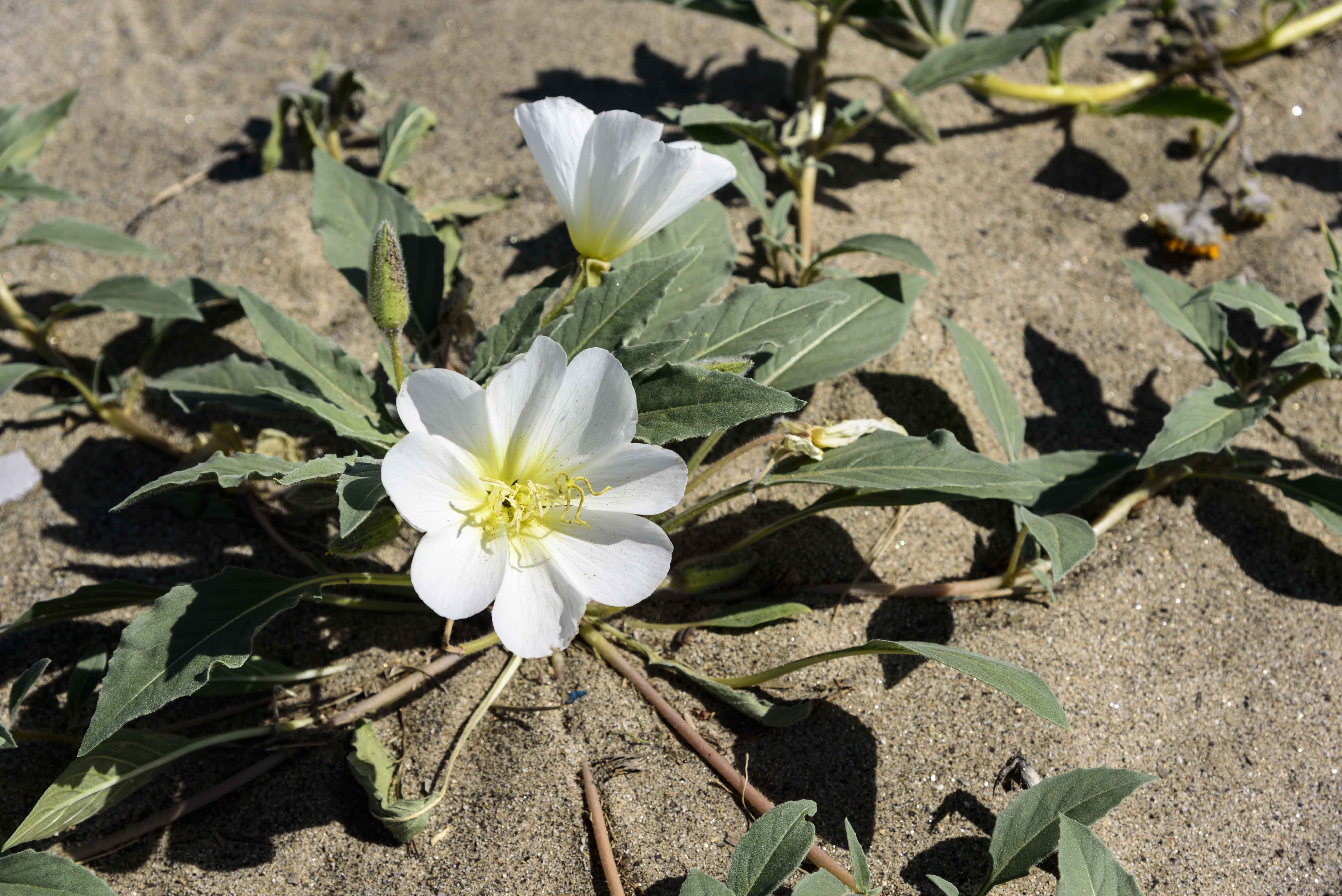
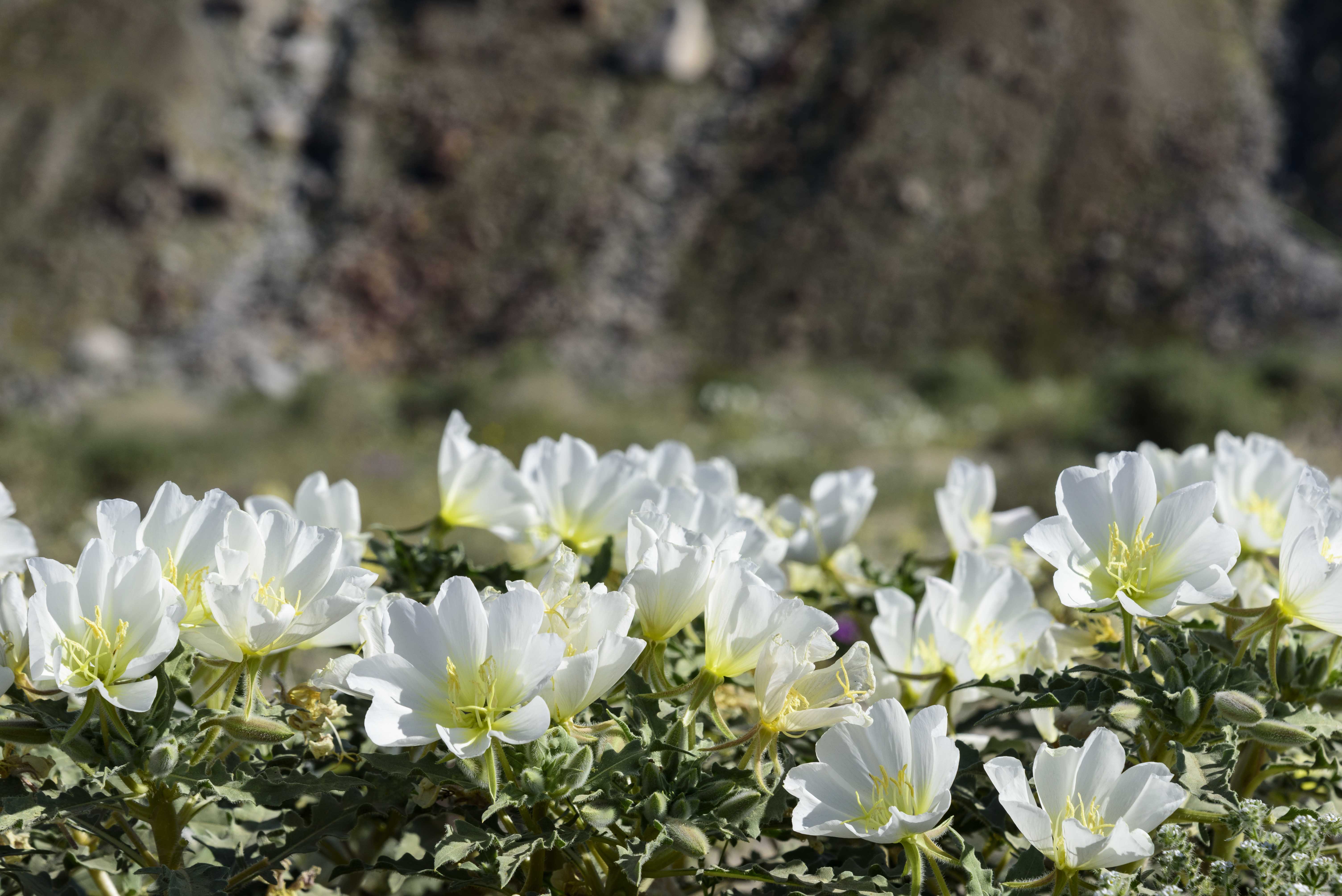
Oenothera deltoides
Onagraceae
dune evening primrose, desert evening primrose, birdcage evening primrose

There’s a native Oenothera species for every state in the Union except Alaska. Dune evening primrose is more widespread than many of them, and more widespread than many of the species I found in Anza-Borrego; it ranges from the Chihuahuan Desert north through the Sonoran and Mojave Deserts to the Great Basin Desert in Oregon, and also somewhat inland and along the California coast.
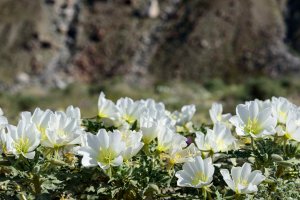
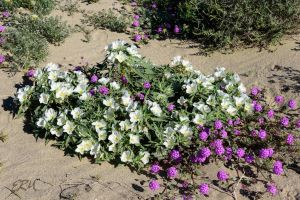
The plants I saw spread out along the sand maybe as much as three feet, and stood up to about a foot tall. I’ve read that in other parts of its range desert evening primrose can stand up to three feet tall. It’s described by various sources as both an annual and a perennial, so I’m not sure what to conclude there. One thing’s for sure, in Anza-Borrego at least it grows in association with this next plant. Almost any time I saw one, the other was there, too. Or close by.

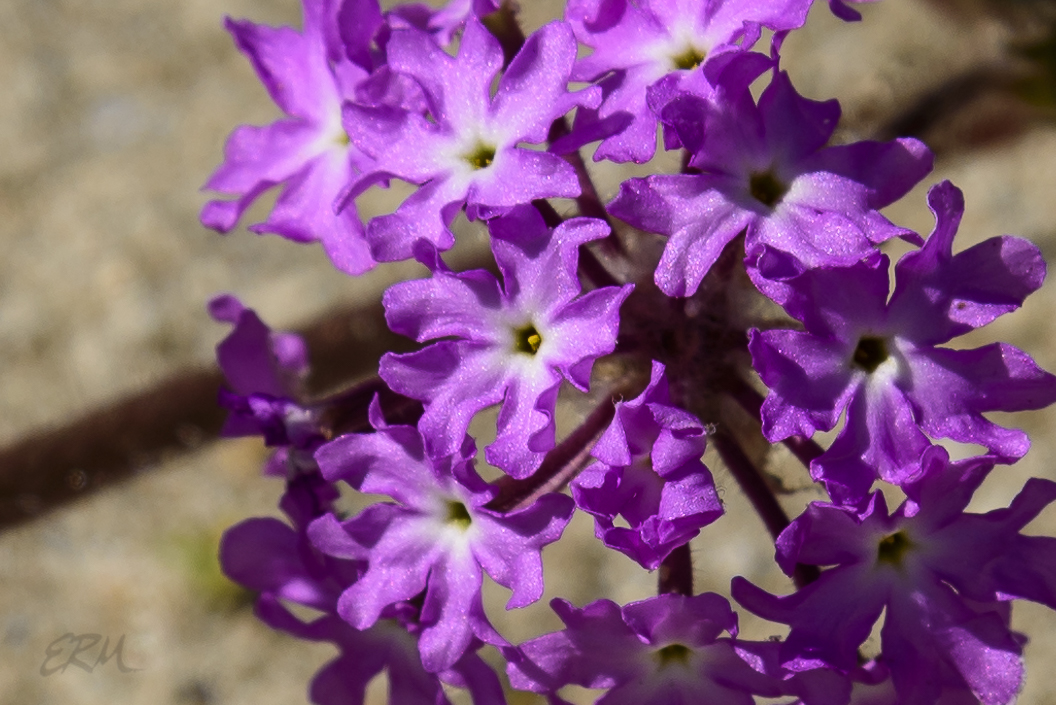
Abronia villosa
desert sand verbena

Desert sand verbenas are not actually verbenas, which are in their own family. It’s in the four o’clock family (Nyctaginaceae). It is similar in size and growth habit to the dune evening primrose, but with a smaller range, being mostly restricted to the Sonoran and Mojave deserts, and some inland and coastal areas in California.

Take a look at the flowers. Looks like each has five petals, right? Not really. Another botanical oddity. More on that and other desert plants in the Nyctaginaceae next time.


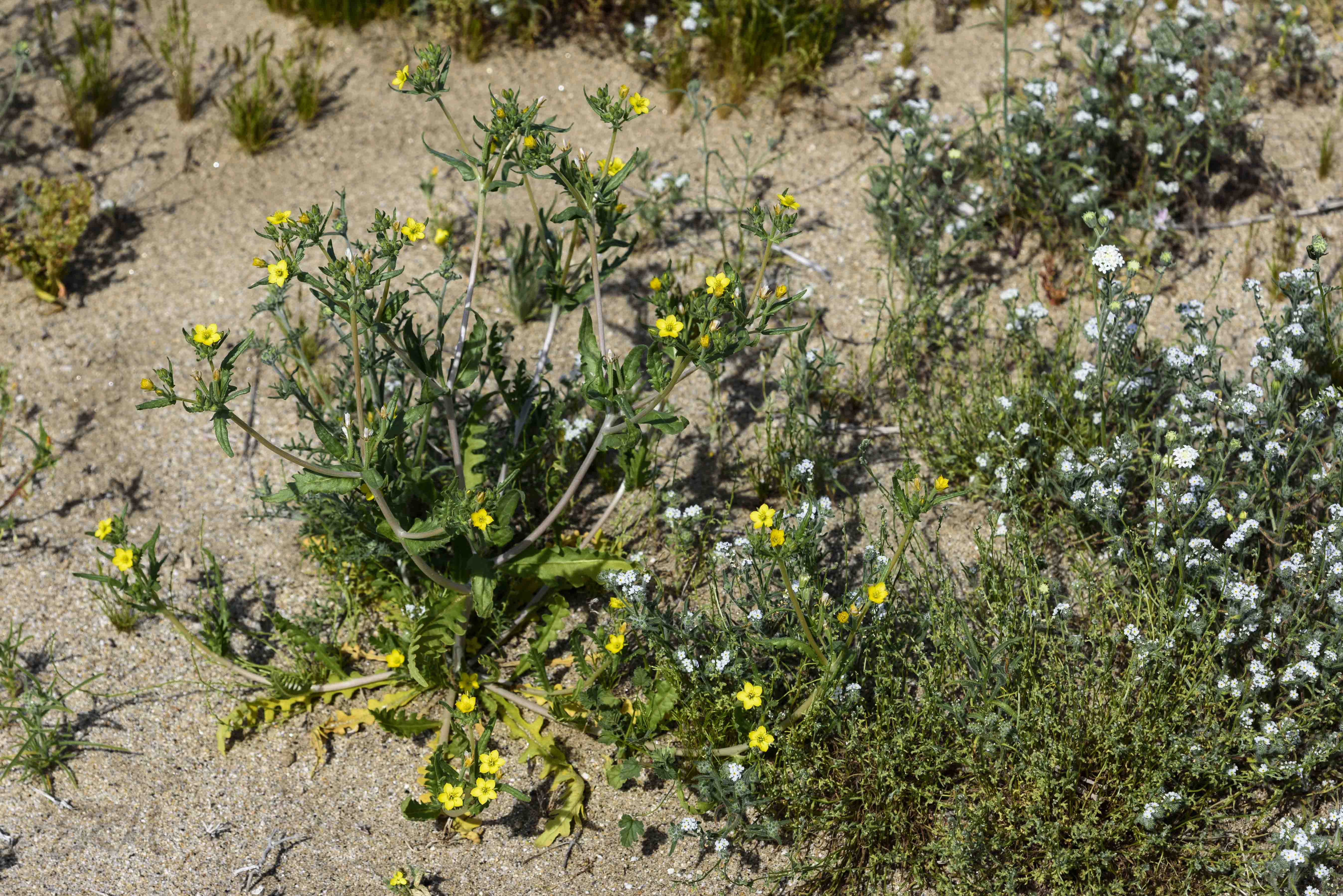
There are at least six different species shown flowering in the first photo, and one plant not flowering but clearly a seventh species (not counting the dead ocotillo). Click on it to see it larger. This was one of the neat things about the super-bloom: so many different species growing together, forming crazy bouquets.
Mentzelias

Blazing stars (Mentzelia species) can be tricky to identify. There are over 70 species, some not well-described in the literature, at least not in the readily-available literature. Mentzelia involucrata is easy enough, though, since it’s rather showy and common.

Even so, I second-guessed myself with some of the pictures. There’s a similar-looking, M. hirsutissima, which I thought I’d seen. But it’s a rare species, and you know what they say about extraordinary claims. I was able to eliminate that possibility once I read that only M. involucrata has floral bracts that are white with green edges.

M. involucrata is an annual plant growing to a little over a foot tall in both the Sonoran and Mojave deserts.

There were a few other small, yellow flowers that weren’t so easy, though. I could place them in the Loasaceae by observing the leaves, the flower shape, and the number of petals and stamens. Plants in this family tend to be low-growing, with thick, sometimes hairy, lobed or dentate leaves; the flowers have five radially symmetrical petals and many stamens.

Once I figured out Loasaceae, getting to Mentzelia was easy, since it’s the only genus represented in the area (according to the comprehensive San Diego County Native Plants). Then it was over to the excellent CalFlora website, which showed 18 Mentzelia species in the Anza-Borrego area. A close look at the location records and habitat information allowed me to eliminate all but four species as possibilities. Detailed descriptions at SEINet led me to eliminate two more, with some uncertainty, leaving two likely candidates: M. affinis (yellowcomet, yellow blazing star) or M. albicaulis (small flowered blazing star, whitestem blazing star). I just don’t have enough of the right details in the pictures to be certain, but after reading various descriptions I’m leaning toward identifying this one as M. affinis.

Mojave, Mohave, Mohavea

Do you know the web comic xkcd? I was reminded of it the other night. While getting ready for bed I glanced over Steve’s shoulder at his iPad. “Hey, you’re reading my blog!” I beamed. “Yep,” says he. “I think you made a mistake.”

So I immediately went back to the computer and corrected every instance where I’d typed “Mohave” instead of “Mojave”. I hate making mistakes like that. I work hard not to make mistakes like that. Why did I make a mistake like that?

I blame this flower: Mohavea confertiflora. Ever since identifying it and adding it to my spreadsheet, I’ve been mixing up the words and typing them wrong.

Ghost flower is an annual that grows to about ten inches tall, bearing single flowers in the leaf axils, and is easily identified by the red spots inside the petals. It can be found on washes and gravelly slopes in both the Sonoran and Mojave desserts. Its cousin Mohavea breviflora is found in the Mojave and Great Basin deserts.

In other news of genera starting with M, I found several species of Mentzelia. More on them next time.

In case you’re wondering, the lead photo shows ghost flower, rock daisy, gold poppy, and two different species of phacelia.

above, xkcd “Duty Calls”

[I proofread this post a coupla dozen times.]

Carderock Area Report

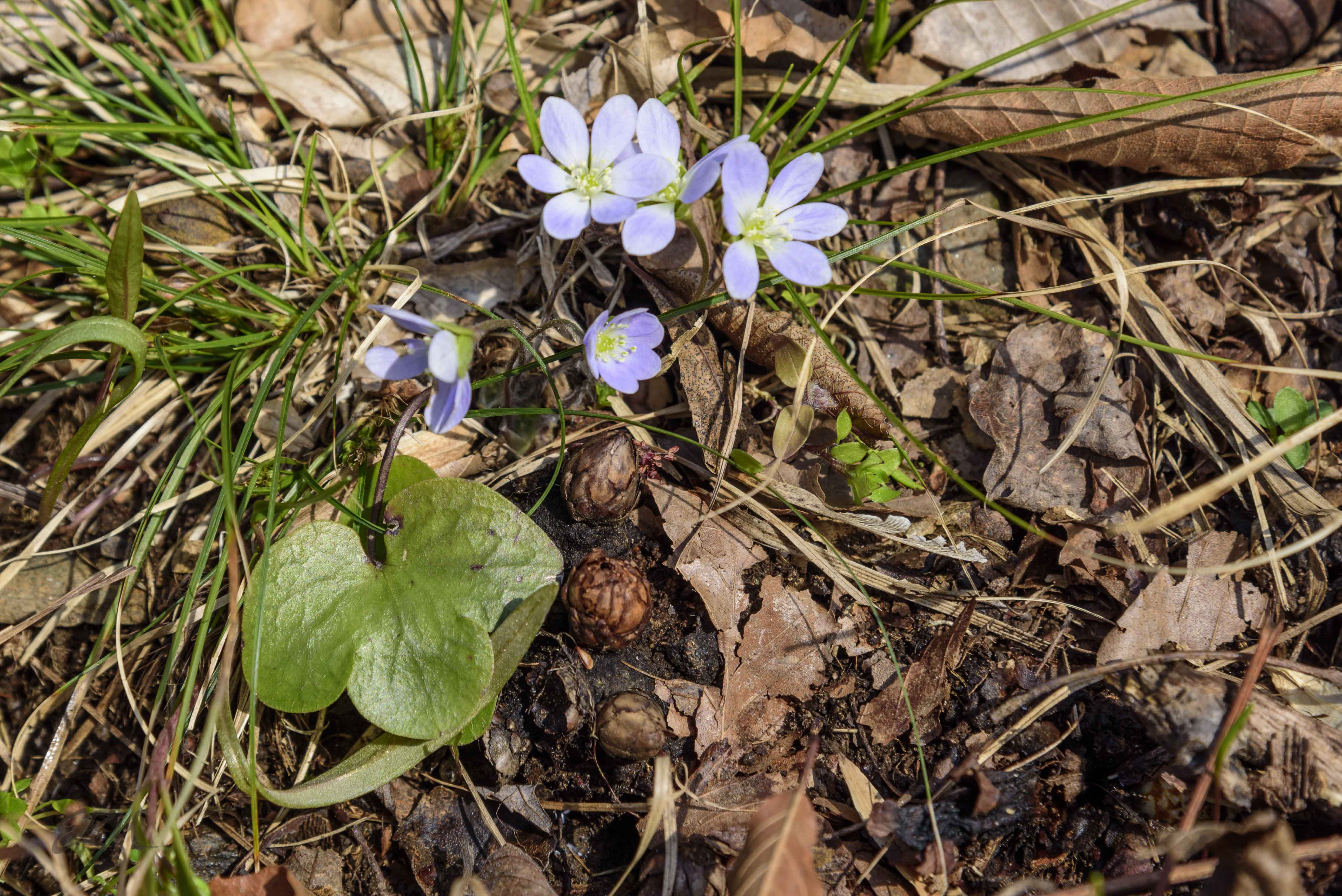
As of March 24, there’s still not much blooming yet. Harbinger of spring is in full bloom, or even slightly past, and round-lobed hepatica (pictured) and lyre-leaved rock cress seem to be at their peaks. Spring beauties are blooming but not en masse. Other native plants seen just starting to open:

  • Virginia bluebells
  • leatherwood
  • cut-leaved toothwort
  • star chickweed
  • wild blue phlox
  • common blue violet
  • spicebush

Golden ragwort is starting, too, well downstream of the Carderock area. Dutchman’s breeches and trout lily foliage is now visible through the leaf litter.

Until the show really gets going I’ll keep posting about Anza-Borrego.