
Houstonia species, Rubiaceae
Nationwide there are 18 species of Houstonia, only five of which are found in Maryland; one of those one is found only in Garret County. In the Piedmont, two of these species (azure bluet and Venus’ pride) are rather widespread, and two (longleaf bluet and small bluet) not so much.
Last June I thought I’d found both Venus’s pride and longleaf bluet along the C&O Canal near the Marsden Tract. This year, when I went in search of them I found only Venus’ pride, but I did find longleaf bluet on Sugarloaf Mountain. Here’s a little primer about the two. Their flowers are almost identical; it’s the leaves that differentiate them.
I took measurements of only a few plants, and each patch of plants contained only a few individuals, so consider this casual observation rather than proper science.
A note about color: these flowers were all vaguely purple… in the right light. In some of these photos they’ll look white, which is pretty much how they appear in strong sunlight. In shade the purple, while faint, is more apparent. Despite the moniker “bluet”, they never seem blue.
There’s a little glossary at the end.

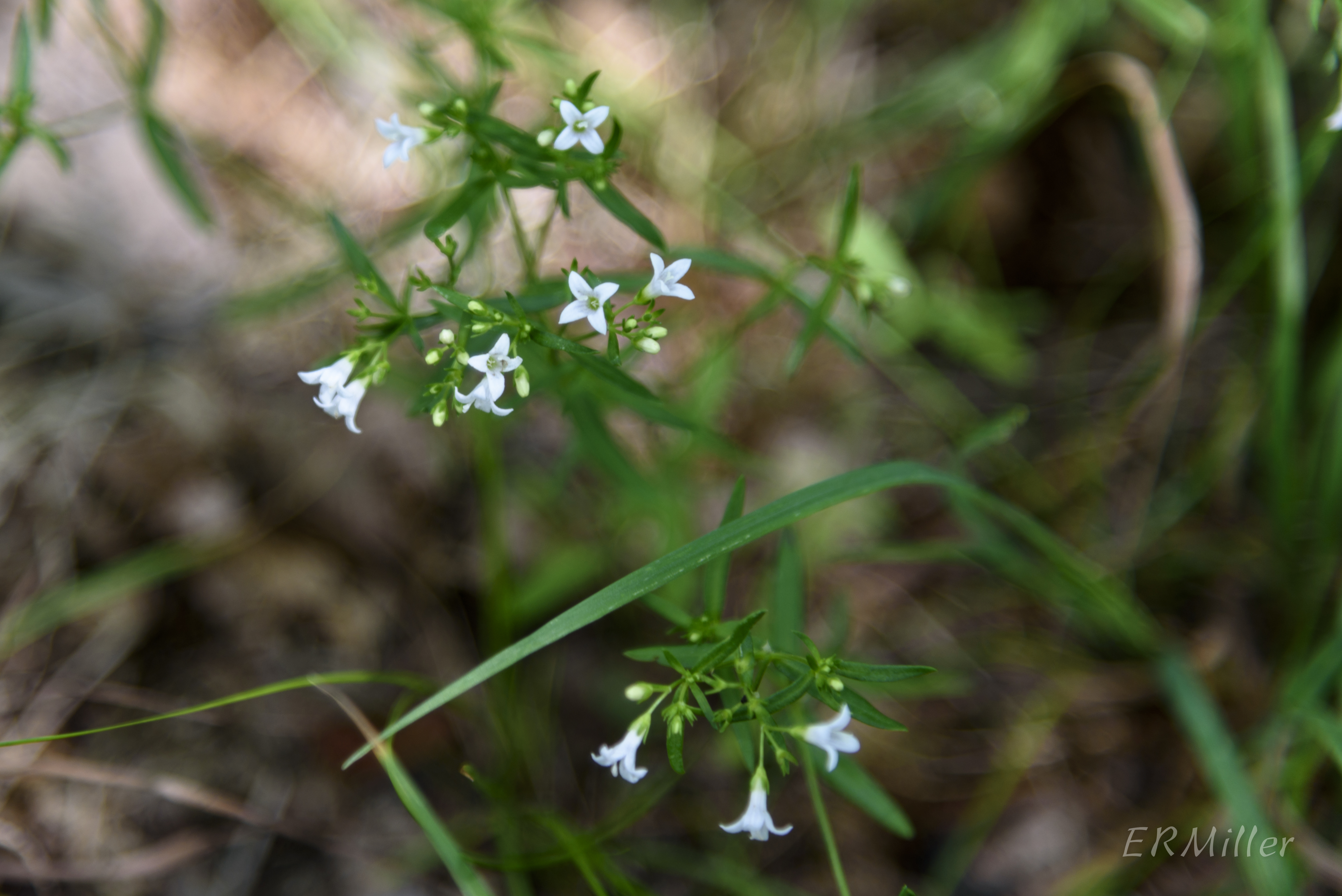
Houstonia longifolia
common names: long-leaved bluet, longleaf summer bluet
- perianth about 1/4″ long
- corolla about 3/16″ wide
- plant height estimated 4-6″
- leaves opposite, 1/2′ to 3/4′ long, linear shape, one-nerved, margins entire, stipules present
H. longifolia is present in Maryland in parts of the Piedmont and one section of the Coastal Plain, but is found mostly in the Blue Ridge and Ridge and Valley physiographic provinces. BONAP shows it as rare where present in Maryland, but it’s not on the state DNR list of rare, threatened, and endangered plants.
Taxonomic note: MD DNR lists another species, H. tenuifolia, as S1/endangered. However that species is not recognized by ITIS, which considers is a synonym for H. longifolia. What that means for conservation efforts I have no idea.
H. longifolia grows mostly in the Appalachians and Ozarks, and in parts of the Upper Midwest. It’s endangered in Connecticut and Massachusetts, special concern in Maine, and historical in Rhode Island.
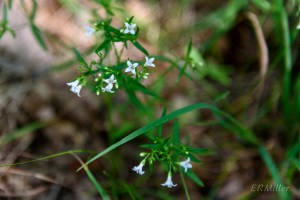

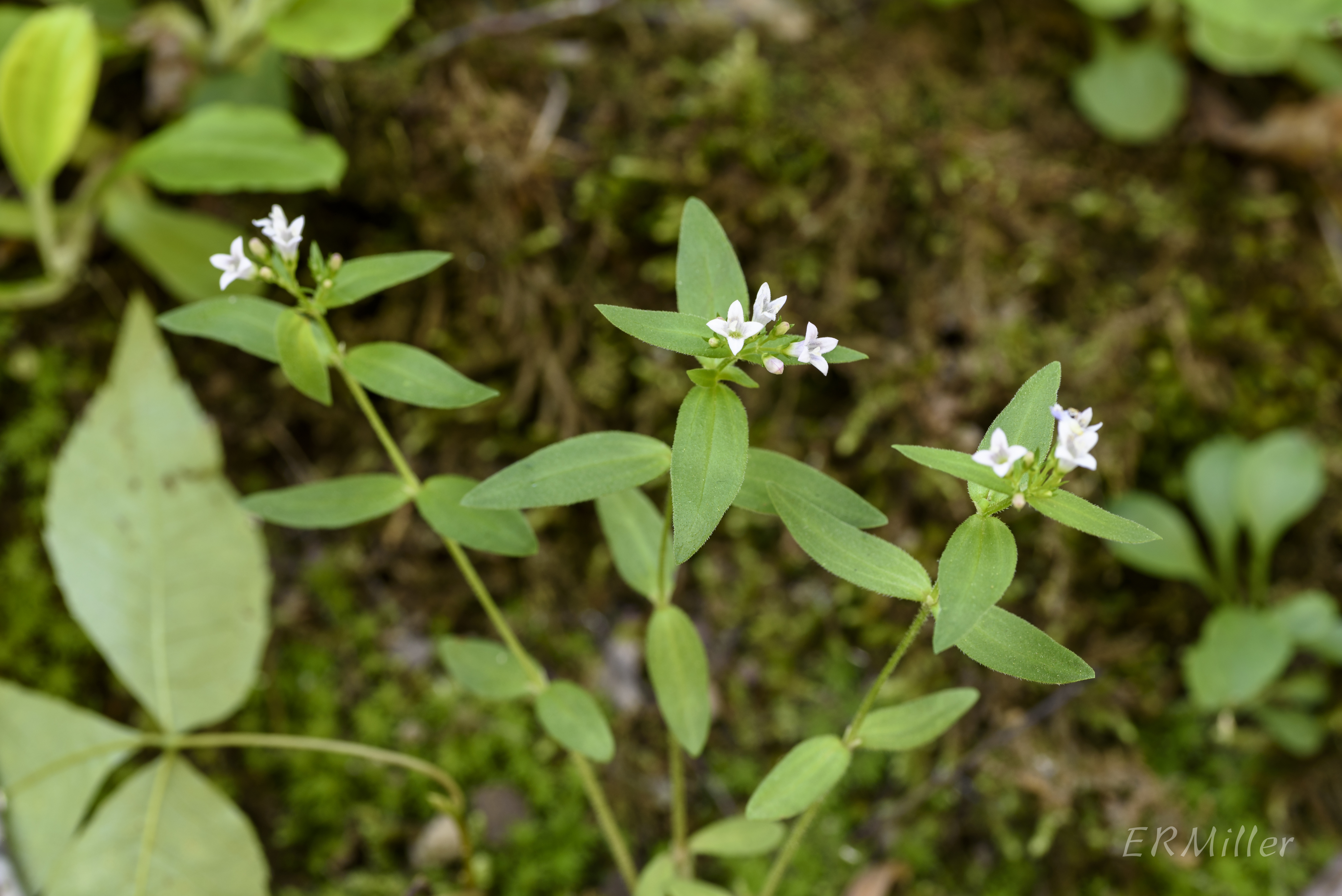
Houstonia purpurea
common names: purple bluet, Venus’ pride, woodland bluet, large bluet
- perianth about 3/8″ long
- corolla about 3/16″ wide
- plant height estimated 4-6″
- leaves opposite, 1″‘ long, oval shape, three-nerved, margins entire but ciliate, stipules present
H. purpurea is present in the Maryland Piedmont and parts of Coastal Plain. Per BONAP, it ranges through the Appalachians, the Ozarks, and much of the South, but not the Upper Midwest.
ITIS lists three varieties, two of which are endangered in New York; the third is endangered in North Carolina and Tennessee and is also on the federal endangered species list.

perianth: the sepals and petals of a flower, collectively
corolla: the petals of a flower
ciliate: fringed with hairs
stipule: small, leaf-like growth where leaf meets stem
sources:
BONAP the Biota of North America Program
ITIS the Integrated Taxonomic Information System
Maryland Biodiversity Project

 A year ago my friend B texted that she’d found another stand of Baptisia australis (wild blue indigo; Fabaceae; S2/threatened) along the Potomac near Great Falls. I tried searching for it but a broken wrist prevented me from doing the necessary rock scrambling. This year, though, I was able to go out and find the plants on a sunny, breezy afternoon. They were a bit past peak bloom but still magnificent.
 Blue false indigo is a prairie species with just a few populations in Maryland. Search for them on the rocky scour bars of the Potomac River.







 Elizabeth's Wildflower Blog