What’s That Scrophy-Looking Thing?

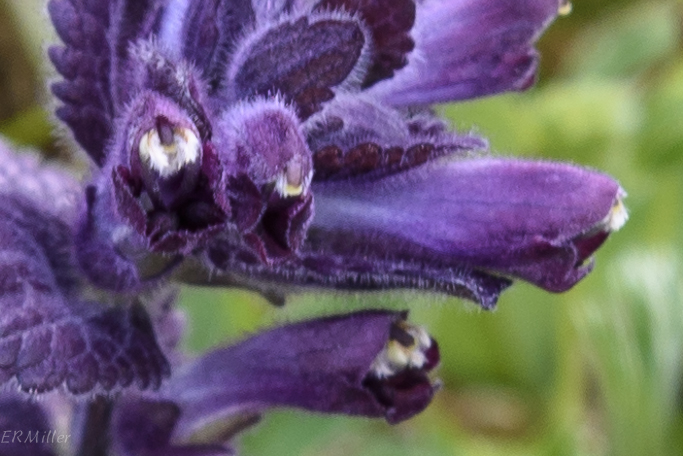
Bartsia alpina
velvetbells
Icelandic: smjörgras
Orobanchaceae


In the second picture of my previous post, you can see some dark purple plant material surrounding the cuckoo flowers. Those are the upper leaves and flowers of this very common plant, but the flowers are hard to make out at first, since the leaves become increasingly purple as they ascend the stem. You might be able to see that if you click on these two pictures to get larger images.


Velvetbells grows in a wide variety of habitats and so is found almost everywhere in Iceland. The plant stands from 6-12″ tall, blooms in June and July, and is incredibly easy to identify, because nothing else looks like it. Indeed, Bartsia is a monotypic genus, so there’s nothing similar in the Maryland Piedmont to compare it to. It’s also found in much of eastern Canada as well as Greenland, but nowhere in the US.
20160620-_DSC0571

Bartsia was formerly classified in the figwort family, Scrophulariaceae (hence the pun in the post title), a large family made much smaller by the work of taxonomists. You have to look in the broomrape family, Orobanchaceae, to find anything similar to velvetbells in the Maryland Piedmont. You can see the family resemblance in the flowers of beechdrops (Epifagus virginiana) and squawroot (Conopholis americana) if you look closely. I think they all look like the gaping maws of miniature monsters.

Because I am fascinated by words and etymology and the whole concept of names, I tried to investigate the Icelandic common name, but didn’t come up with much. “Smjör” means “butter”, and “gras” means “grass”. But are those the roots of the common name or is that coincidental? Google translate offers “amethyst” as a translation of “smjörgras”, but reversing the search tells me that the Icelandic word for “amethyst” is “ametyst”. Amethyst is a nice description (the upper leaves and flowers are a lovely deep purple)  but I have no idea if the plant tastes like butter.
 

Hrafnaklukka: Cuckoo Flower, Indeed!

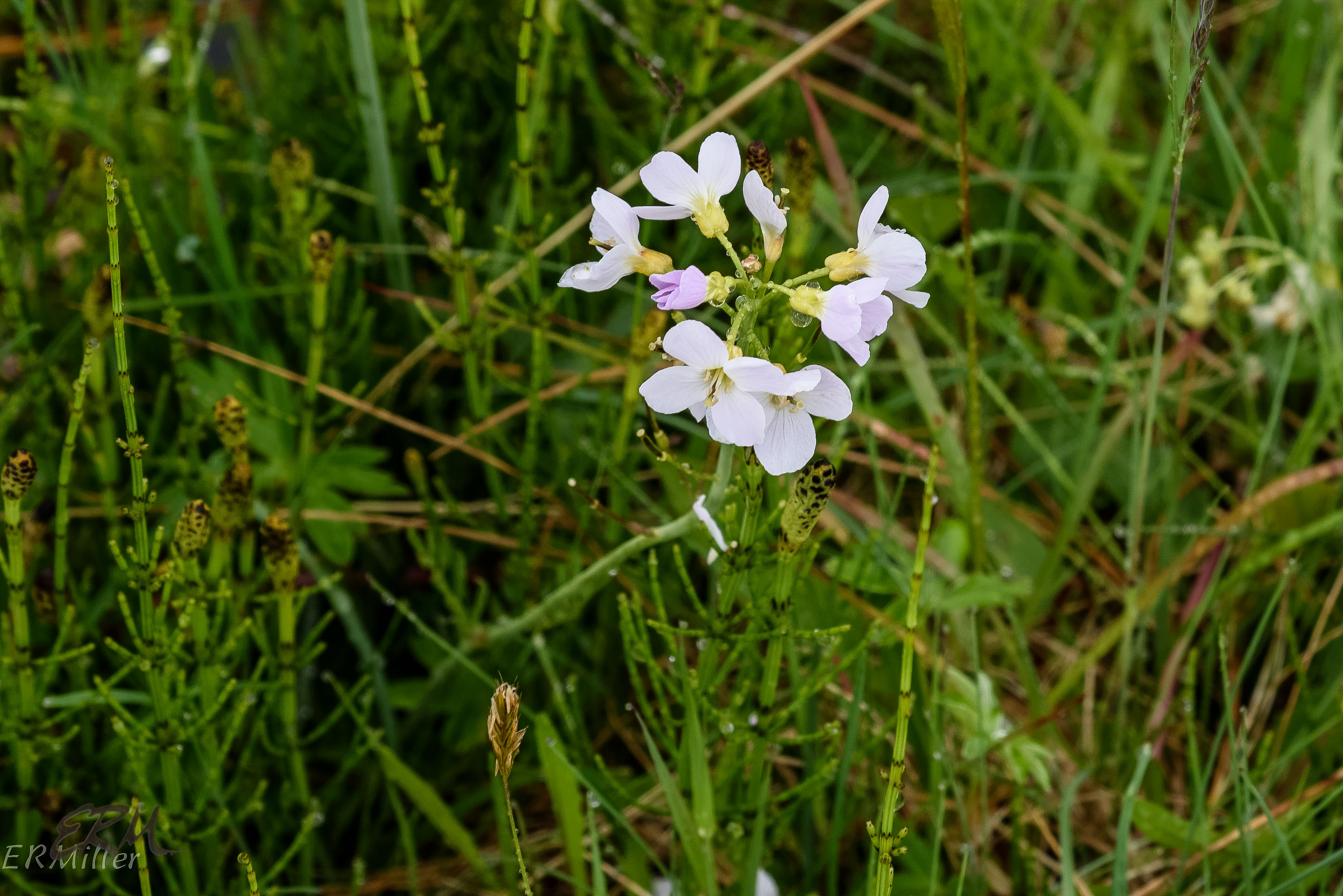
Cardamine species
Icelandic: hrafnaklukka
Brassicaceae


The flowers pictured here are easily identifiable as a Cardamine species. In the Maryland Piedmont, we have about 10 species of Cardamine, a handful of which have flowers very similar to what’s pictured. We call them “toothwort”, and the various species are readily identified by differences in their leaves.

Not so with this one. Almost as soon as I started trying to identify these I ended up in a taxonomic whirlpool.

A Guide to the Flowering Plants and Ferns of Iceland shows one species with flowers like this, and calls it Cardamine pratensis ssp. angustifolia. The listing Cardamine nymanii in the index goes to the same plant. Are the names synonyms? The book doesn’t say.

The Integrated Taxonomic Information Service accepts both C. pratensis and C. nymanii, but does not accept C. pratensis ssp. angustifolia, which it considers a synonym for C. nymanii.

The Botanical Map of Iceland shows a similar-looking plant and labels it C. nymanni.

The Natural History of Iceland website shows only C. nymanii.

In English one of these is called cuckoo flower, and the other is lady’s smock. Both have the same common name in Icelandic: hrafnaklukka.

I had to go to Svalbard to get an answer. Not literally, of course (I wish!), and only an answer, not the answer. The comments section of the listing for C. pratensis ssp. angustifolia on the svalbardflora.no website says “The Cardamine pratensis group is unusually complicated taxonomically.” It goes into a rather interesting discussion (interesting if you’re into that sort of thing) about the taxonomic difficulties and distribution of the similar species.

But hey, useful ID tips from the same site:

Cardamine nymanii is distinguished by, e.g., the glabrous, entire, fleshy leaflets with impressed veins. In the two others, the leaflets are often hairy, dentate, thin, and with protruding veins. Cardamine nymanii is distinguished from C. pratensisalso by the often distinct petiolules of leaflets on stem leaves (in common with C. dentata but absent from C. pratensis).

Well, guess what? I don’t have good enough pictures of the leaves. The ones I do have definitely show glabrous (smooth), entire (not toothed or lobed), fleshy leaflets, but they don’t have distinct petiolules (leaflet stems).

Gah! So what species did I find? I really can’t say.

Maybe I should just dub them “Icelandic toothwort” and add to the confusion.

Whatever species they end up being, they’re fairly common throughout Iceland, found almost everywhere except in parts of the highlands. I saw them blooming on Mt. Esja and in several places around Ísafjörður in the Westfjords.

20160620-_DSC0583

Hey, This Looks Like a Geranium

20160615-_DSC0037

Geranium sylvaticum
wood (or woodland) geranium
(or cranesbill)
Icelandic: blágresi
Geraniaceae


As we hiked up the lower slopes of Mount Esja in western Iceland, the vast sweeps of Nootka lupine and cow parsley started giving way to other plants. I did a double-take when we spotted this one: could it be Geranium maculatum?

20160425-_DSC0192

The North American native G. maculatum, also sometimes called wood geranium, flowering in the Maryland Piedmont

No, but it’s close. It’s Geranium sylvaticum, a species native to northern Europe (including Iceland). It’s been introduced to North America and can be found in Quebec and Greenland, so no overlap with G. maculatum, which can be found through most of the eastern and mid-western US (with scattered occurrences in the Great Plains).


G. sylvaticum stands about 12-20″ tall (about the same size as G. maculatum), and blooms in June. It has a fairly widespread distribution in Iceland, though I never saw much of it in any one place. Look for it at lower elevations in shady or sheltered areas, especially near stands of trees and in birch scrublands. It’s showy and therefore hard to miss.

In addition to Mount Esja, I saw it blooming on the Snæfellsnes penninsula, and in a wooded vale near Ísafjörðer in the Westfjords region.

This wasn’t the only look-alike we spotted in Iceland. More on those in upcoming posts.

A Beautiful, Useful Pest in Iceland

Lupinus nootkatensis
Nootka lupine, Alaskan lupine
Icelandic: Lúpína
Fabaceae


My recent post about yellow flag iris (“A Beautiful, Useful Pest”) was written in the lounge at Dulles International Airport while I waited for my flight to Iceland. It struck me as funny, then, that the next day, when we parked our rental car near a trailhead and started hiking, that the first flowers I noticed were the Nootka lupines. They were everywhere – wide swaths of blue-and-white flowers ascending the slopes of Mount Esja.

There was so much of it, I wondered if it was an alien invasive. In my limited experience, it’s unusual for native plants to form such massive colonies. Was this another beautiful, useful pest?

Short answer: yes. It’s native to the coastal areas of northwestern North American, and is alien to Iceland. But it didn’t sneak in via packing on a cargo ship or by hitchhiking on other agricultural material. It was introduced, possibly as early as the late 1800s (I’ve read conflicting stories), and certainly by the mid-1900s, when it was planted deliberately and extensively by first the Icelandic Forestry Service, and later by the Soil Conservation Service, to help with land reclamation.


You may recall from the previous post that after Icelandic settlement, deforestation and overgrazing led to lifeless soil, which is easily eroded and transported by winds. The Nootka lupine grows fast and roots well, keeping soils in place. It’s perfectly suited to Iceland’s cool, wet growing conditions. And like most members of the Fabaceae (pea family), it takes nitrogen from the air and fixes it in the soil, which together with decaying plant material (from dead lupines) results in soil fertile enough for native plants to colonize. It’s even thought to have helped with the problem of sandstorm-induced road closures in the eastern parts of the country.

But (of course there’s a “but”), it’s too aggressive. It grows tall enough to form a canopy that blocks sunlight to mosses and lichens (which are important pioneer species). It can invade nearby plant communities, outcompete the natives, and form monocultural stands. So yes, it exhibits the usual alien-invasive characteristics.

There’s a little more good news, though: studies have shown that in some sites, lupine colonies will eventually decline to the point where they no longer out-compete other species. It seems that if managed correctly, the Nootka lupine will continue to be a valuable tool for soil reclamation.

lupines on the lower slopes of Mt. Esja


for more information:

Biological Diversity in Iceland (The Icelandic Institute of Natural History; go to page 10 for the case study of Nootka lupine)
Alaskan “Wolf” Invades Iceland (Reykjavik Grapevine, August 25, 2011)
Invasive purple flower Impacts Iceland’s Biodiversity (mongabay.com)
Invasive Alien Species Fact Sheet (nobanis.org)

And the Answer is…

…Iceland!

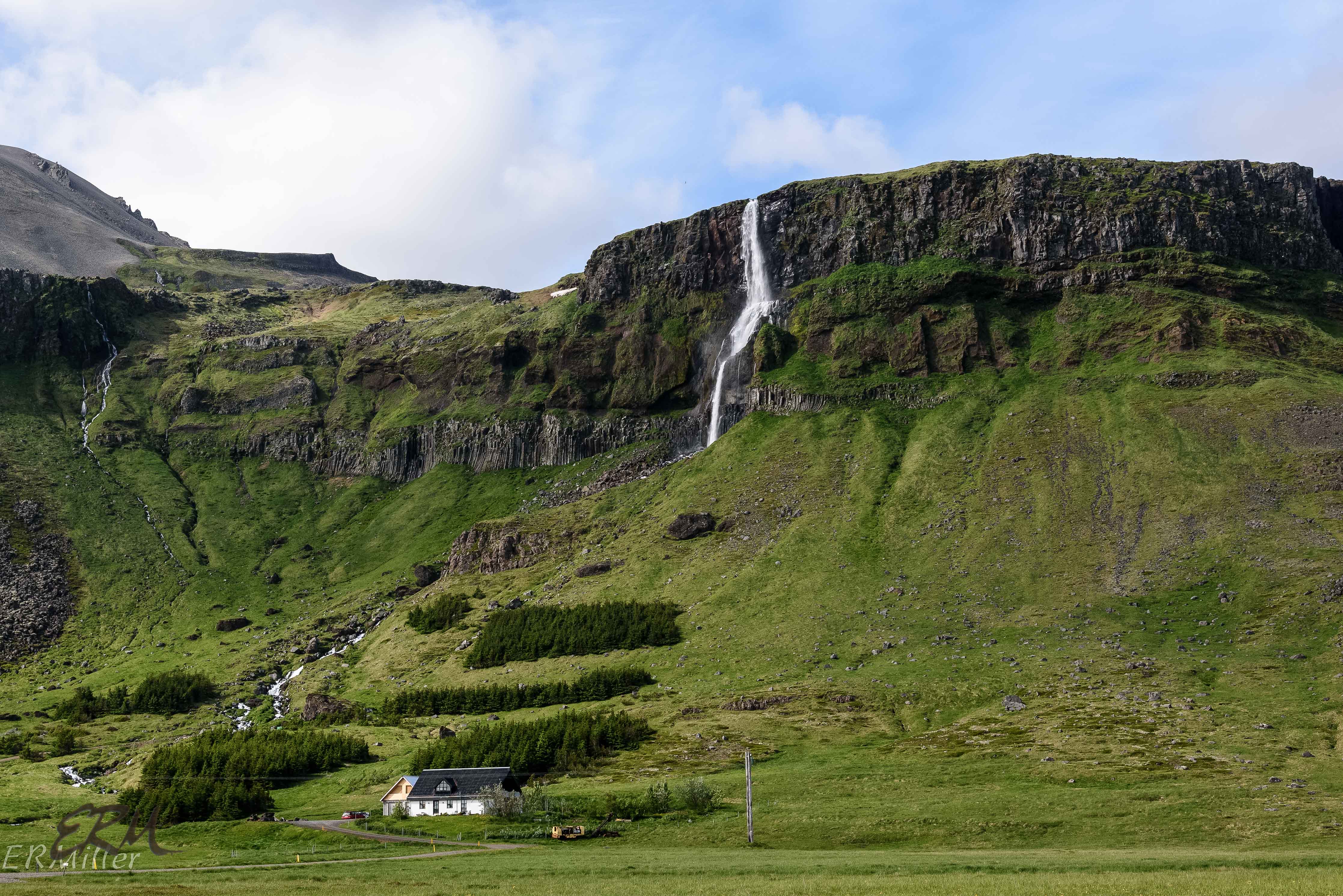
The Nootka lupines pictured in my last post were in a little nature preserve near the town of Ísafjörður, in the Westfjords region of Iceland. We just returned from a ten day trip to the south, west, and north of that wonderful country, the main purpose of which was to see the midnight sun and the gorgeous scenery.

But nothing I’d read prepared me for the variety of wildflowers. I haven’t yet identified everything I photographed, but can estimate that I saw about 60 different species of plants in flower.


the town of Ísafjörður lies along the base of the left mountain and on a little spit in the fjord (zoom in to see the skyline)


Iceland sits just south of the Arctic circle in the Atlantic ocean, but despite the high latitude it has a cool maritime climate, due to the effects of the North Atlantic current from the south and east and the East Greenland current from the north.  A semi-permanent low pressure system brings in both warm and cool air masses. That plus the effects of topography (mountains to almost 7000′ in elevation ring the interior volcanic plateau, and about 12% of the land is covered by glaciers) yield highly active weather within a rather narrow temperature range (on average).

There’s plenty of fresh water – groundwater and runoff from glaciers and snowpacks – running in small, swift streams everywhere, with plenty of larger rivers, too, so that the land is beautifully verdant at lower elevations.


unnamed waterfall on the Snæfellsnes penninsula


There’s a huge variety of grasses, rushes, and sedges, as well as mosses and lichens, and a good variety of boreal and alpine forbs. But there aren’t many trees. When Nordic settlers arrived in the late 800s CE, about one quarter to one half of the land was forested (mostly with birch species), but after a few hundred years of harvesting trees for building houses and ships, fueling iron smelters, and clearing land for sheep to graze, virtually no trees were left. Subsequent overgrazing by sheep led to serious degradation of the soil, so that many areas still have almost no plant life, and without plants to hold the soil in place the windy weather can create massive dust storms. Only about 1.4% of the total landmass is considered arable. Reforestation efforts have been under way since the mid-20th century, so there are small stands of trees dotted about, but there’s not much of anything like a forest.

Back to wildflowers: I was happy to find that in most cases I could tell right away what family plants were in, and in many cases I got the genus correct, too, even before opening the wonderful book my husband found and purchased for me: A Guide to the Flowering Plants and Ferns of Iceland (Hörður Kristinsson, 3rd ed., in English). I also got a lot of use from the poster-sized Botanical Map of Iceland published (in Icelandic, English, and German) by Mál og menning (Reykjavík).


reforested area near Húsafell, looking east toward the glacier Eiríksjökull


Further reading:
topography
weather
climate
flora
forestry