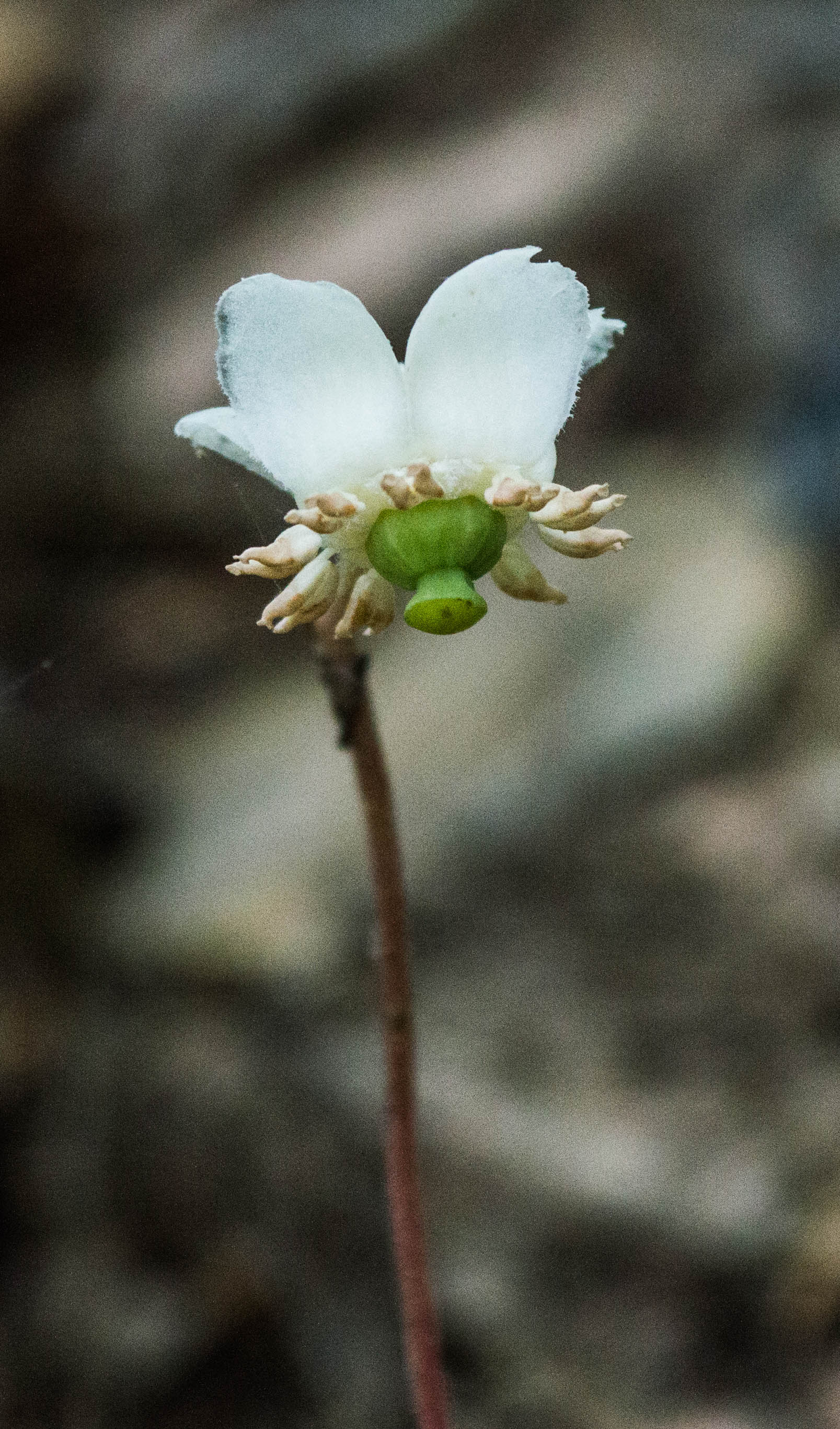
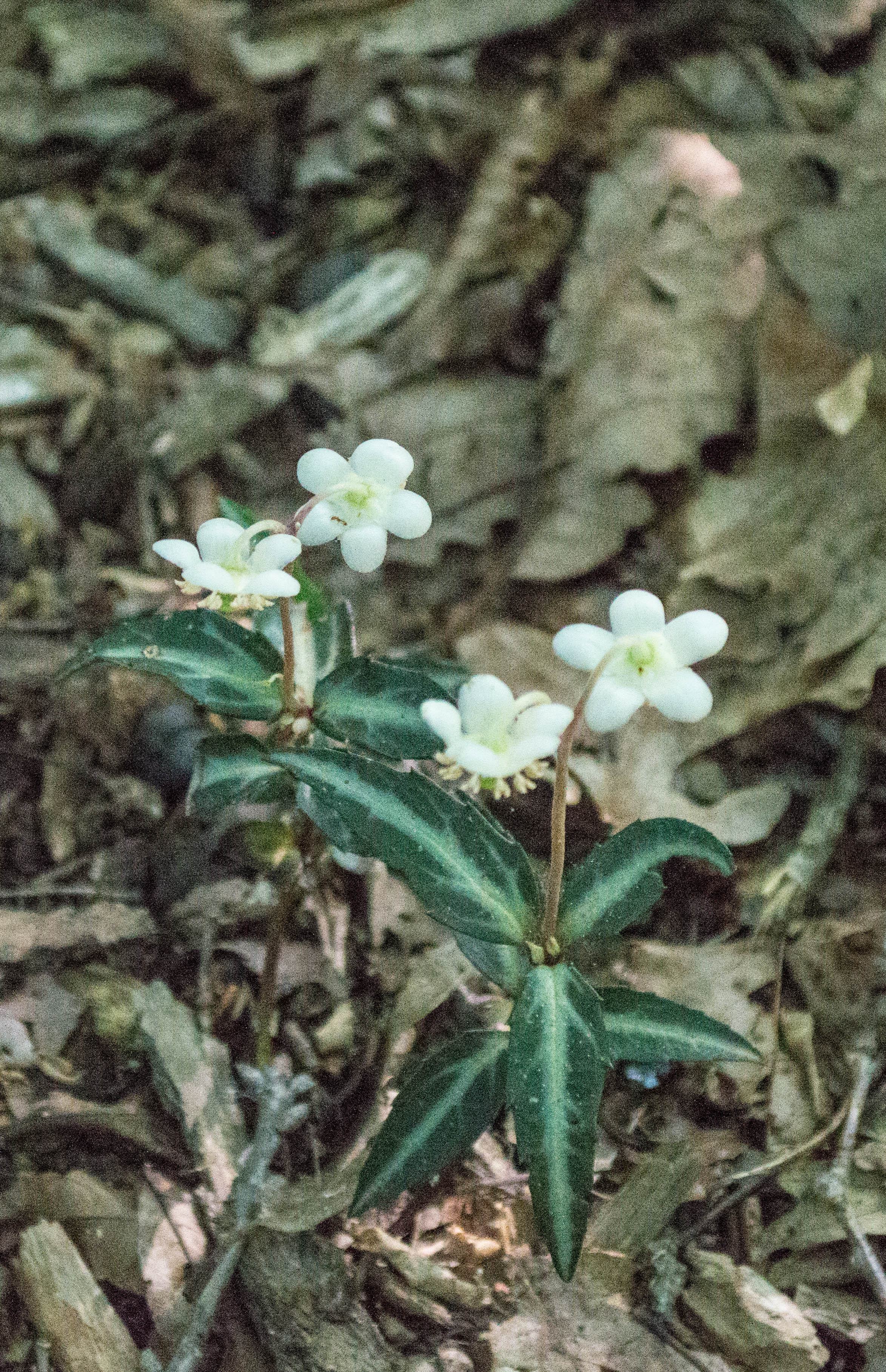
Flower of the Day: Spotted Wintergreen

aka striped prince’s pine; Chimaphila maculata; Pyrolaceae (shinleaf family; some authorities place it in the Ericaceae (heath family))

20140618-DSC_0099

This low-growing (only a few inches tall) evergreen plant likes the shade of deep woods.  The flowers most often appear in pairs, though there can also be one or three flowers together.  It’s found in eastern North America from Florida through Quebec, but is endangered in much of Canada, Maine, and Illinois, and is classed as exploitably vulnerable in New York.

20140618-DSC_0105 20140624-DSC_0040

Flower of the Day: Common Jewelweed

aka spotted touch-me-not, orange touch-me-not, orange jewelweed; Impatiens capensis; Balsaminaceae (touch-me-not family)

20140614-DSC_0144

This easily-found annual plant grows 2-5′ tall, with flowers borne in small clusters in the upper leaf axils.  It likes the wet soils along stream banks, and can be found over most of the US and Canada except the desert southwest, Montana, and Wyoming.  In this area, you can also find the less common pale touch-me-not, I. pallida, along the C&O canal in DC (where I saw it last year).

20140614-DSC_0145

The touch-me-nots are closely related to the very popular bedding plant called impatiens that you find just about any place that sells plants.  This native species attracts ruby-throated hummingbirds, and is an especially important food source for bumblebees.  Supposedly the sap has anti-fungal properties, and can relieve itching from poison ivy as well.

Supposedly the common name “touch-me-not” comes from the fact that the ripe seed pods explode and fling seeds everywhere at the slightest touch.

Flower of the Day: Trumpet Creeper

Campsis radicans; Bignoniaceae (bignonia family)

20140618-DSC_0010-2

There are always small, subtle flowers to be found, but now is the time of year for big, showy flowers.  Trumpet creeper practically shouts for you to come have a look.  It grows along the rock walls of the Clara Barton Parkway, and the flowers are so large (2-3 inches long) and bright you can see them as you’re driving by.

It’s a woody vine that grows vigorously to thirty feet long, so think twice before buying one for the garden, unless you have a very large area that you’re trying to naturalize.  It does attract hummingbirds.

By the way, if you are interested in native plant gardening and attracting wildlife, read this very interesting article before buying plants at the nursery. Many native plant cultivars developed for the garden are far enough removed from their native form that animals don’t recognize them.  They’re useless.

Flower of the Day: Thimbleweed

Anemone virginiana; Ranunculaceae (buttercup family)

20140615-DSC_0067

The same day I found water willow (yesterday’s FOTD), I found another native amongst the aliens.  It was also amongst a terrifying stand of poison ivy, so I couldn’t get terribly close to it.  Out of seven new plants I saw that day, only three were natives.  (Check back tomorrow to see the third one.)

Thimbleweed likes a moist to dry soil and some shade.  It can be found in open woods in rocky areas and slopes, throughout the eastern US (except Florida) and much of the midwest, and Canada.  Here it is growing along a rock wall between the C&O canal and the flooded Potomac River:

20140615-DSC_0066


Flower of the Day: Water Willow

Justicia americana; Acanthaceae (acanthus family)

On a mid-June weekend Steve and I walked along the C&O Canal towpath from Pennyfield Lock to Violette’s Lock.  The wildflower scene was lean.  I have a rule that’s a cynical twist on Murphy’s Law: if it’s found growing along the canal, it’s probably an alien. Sadly on that day the rule mostly held.  But then I saw this:

20140615-DSC_0009

Tricky to photograph, as the plants were growing right in the water.  I couldn’t get any closer without sliding down the embankment into the water myself.  I figured these for aliens, too, but took some pictures, went home, and cracked open Newcomb’s.  And guess what?  They’re natives!

There’s another native with the common name water willow, Decodon verticillatus, aka swamp loosestrife.  They aren’t even closely related. Common names are an annoyance.

Water willow grows in colonies in wet soils or shallow water, from Texas east and north through Quebec.  It stands about three feet tall with narrow leaves; the purple and white flowers are borne on long stems arising from the middle and upper leaf axils.


20140615-DSC_0025