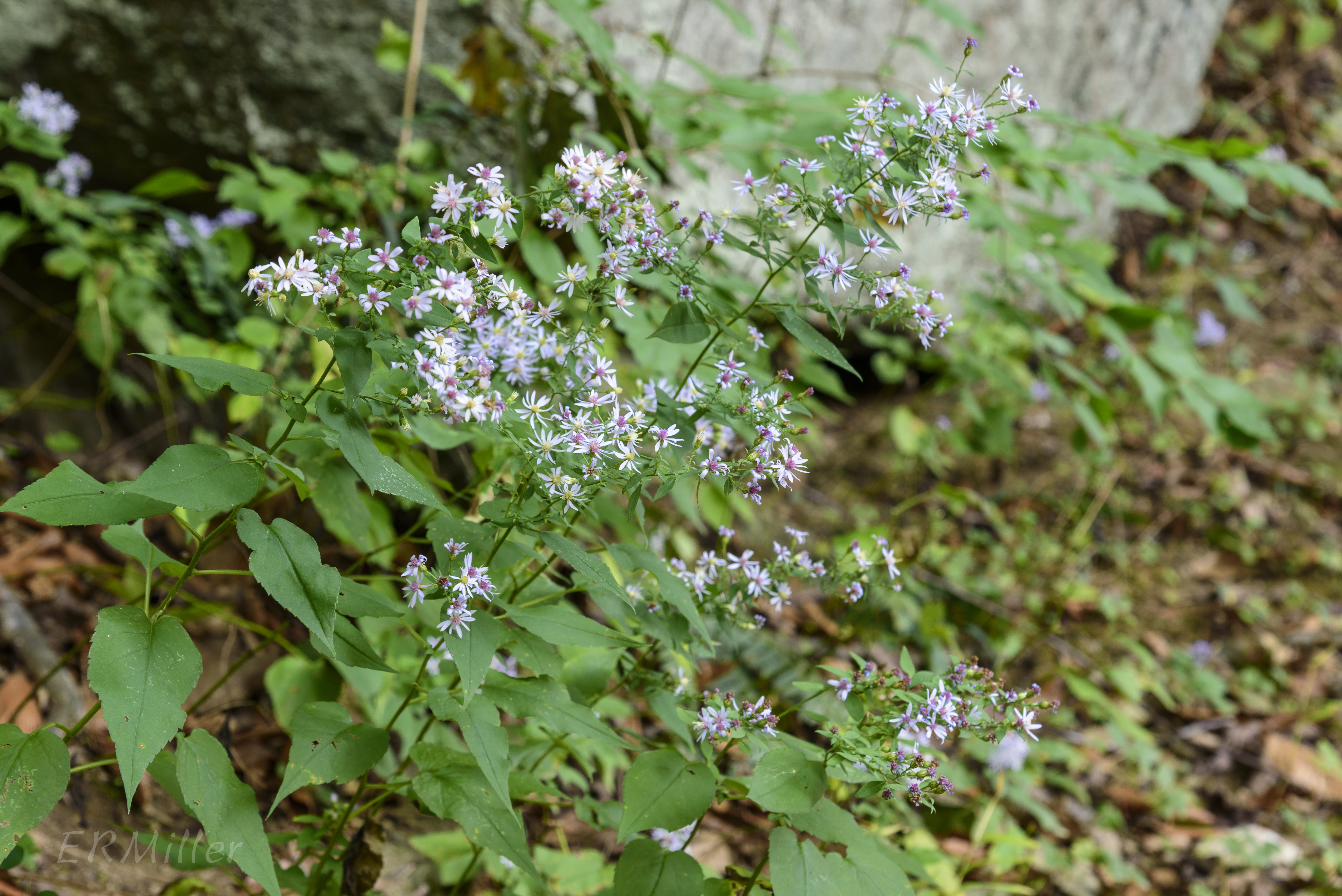
The Aster Family (part one)

From golden ragwort in April to goldentop in October, about one in five flowering plant species that I find in the Maryland Piedmont is in the aster family.

It’s unknown how many plant species there are altogether: discoveries still happen, and of course there’s taxonomic uncertainty. But experts believe that there are about 352,000 flowering plant species (angiosperms), and of the other major plant groups, there are an estimated 1,000 species of conifers and conifer allies (gymnosperms), 13,000 species of ferns and fern allies (pteridophytes), and 20,000 species of mosses and liverworts (bryophytes). [The Plant List]. So it’s probably safe to say that flowering plant species outnumber all other plant species combined by an order of magnitude.

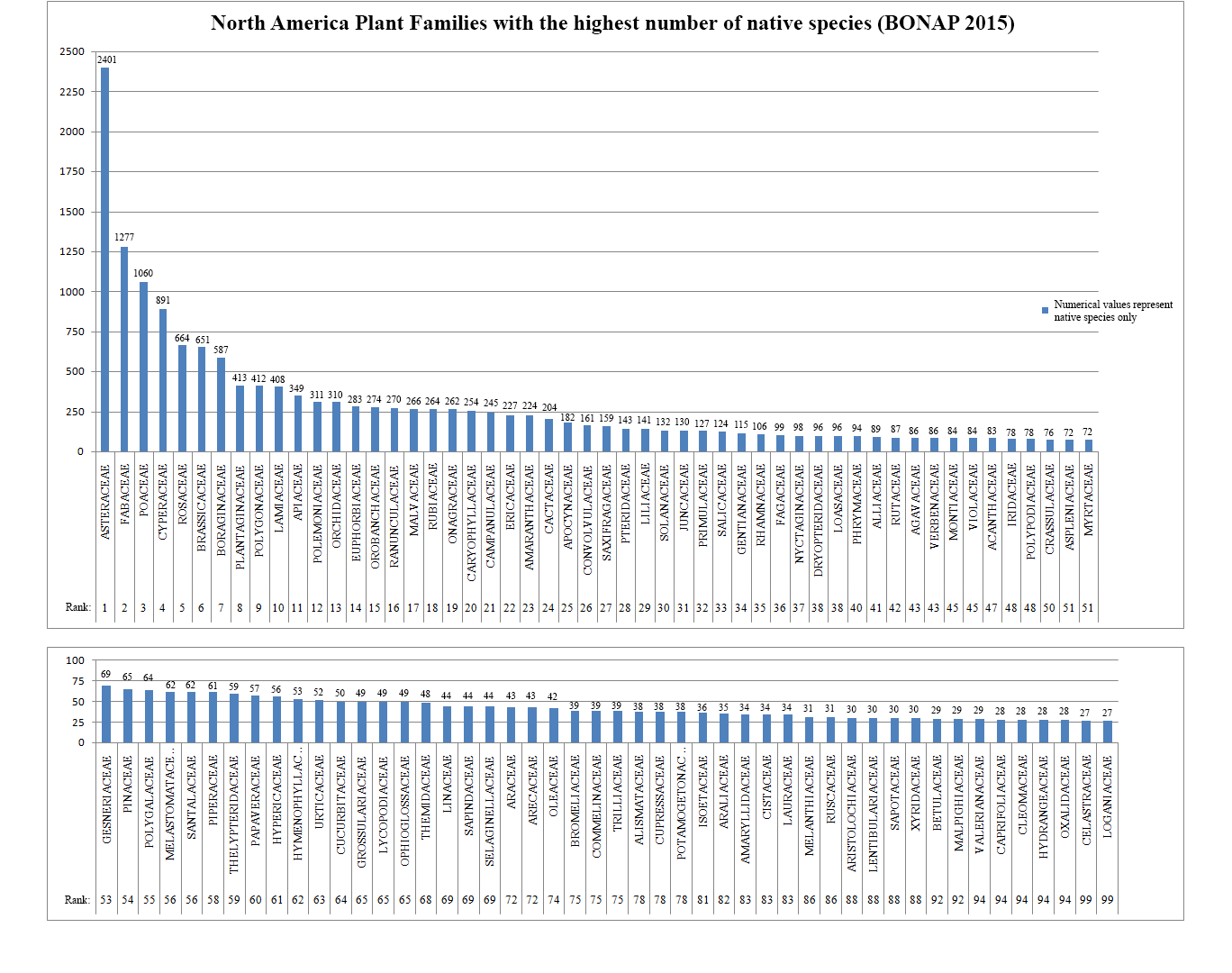
Of the flowering plant families, the Asteraceae is probably the largest with about 23,600 species in 1,620 genera. [Encyclopedia of Life]  Whether or not it actually is the largest depends on the current state of taxonomic science; the other contender is the Orchidaceae.

There are 2,401 native Asteraceae species in North America. [BONAP] The Maryland Biodiversity Project lists 373 Asteraceae species (native and alien) in Maryland, and by my very rough estimate, about half of these can be found in the Piedmont.

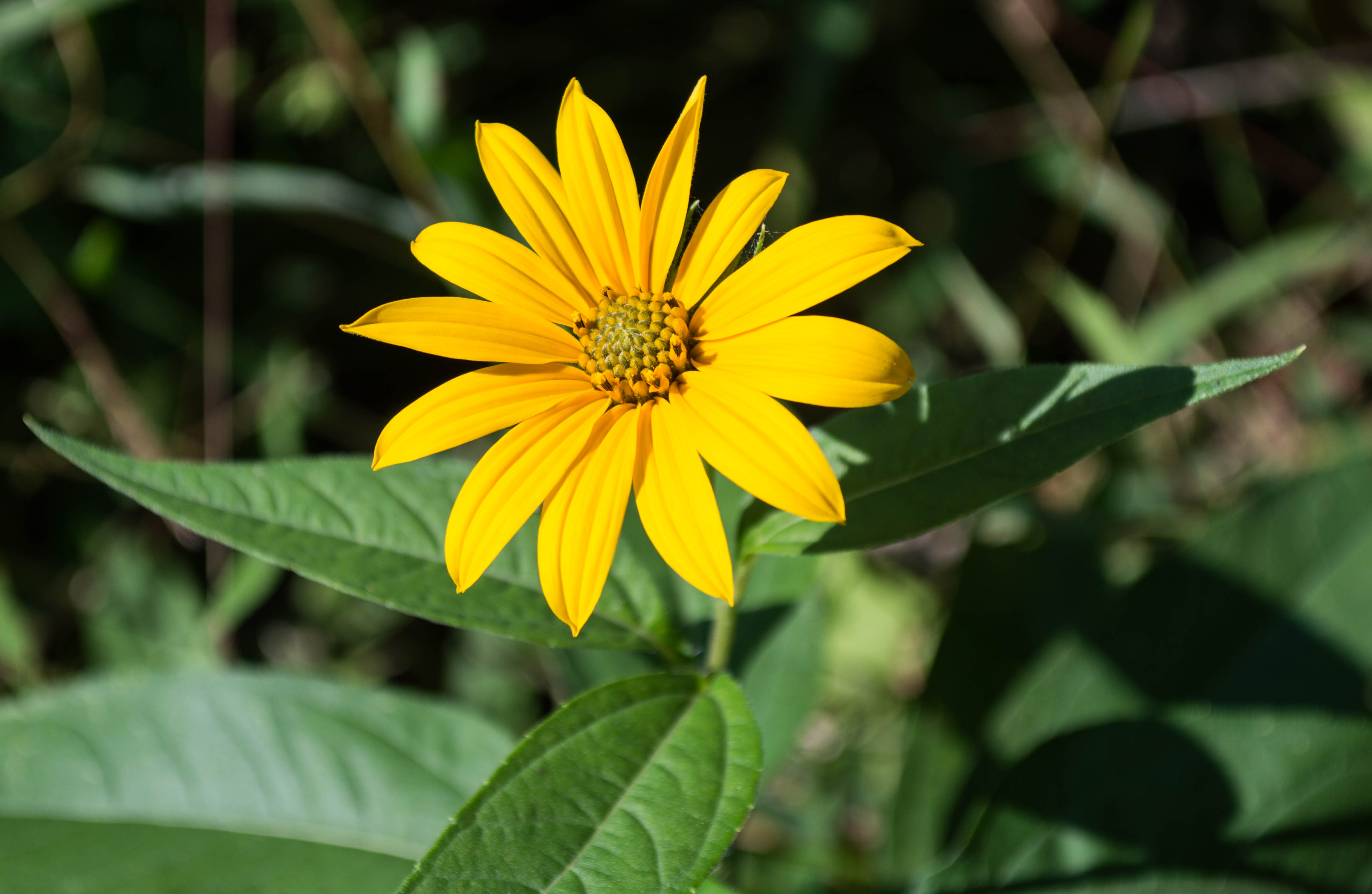
So what are the characteristics of aster family flowers?  Have a look at this Jerusalem artichoke:

20141006-DSC_0080

How many flowers do you see? If I zoom in I can see about 21, not counting the unopened buds.

Wondering how that can be? Here’s a clue: an older but still accepted name for this family is Compositae, or composites. Plants in this family bear heads that appear to be single flowers, but these heads comprise from several dozen to several hundred individual flowers.

next time: aster family floral morphology

This post is dedicated to my friends Cheryl and Barry, who independent of each other gave me the idea to write about plant families during the dormant season. 

The Physiographic Provinces of Maryland

We haven’t had a hard freeze here in the Piedmont yet this season, but what with the drought and cooler weather and shorter days, the wildflowers are just about done for the season. Normally this is when I put my blog to bed for the winter, but this season I’m going to try to keep it going by writing about related subjects. And it occurred to me that I mention the Piedmont a lot, but have never really explained what the Piedmont is. So here’s a little primer.

Maryland is a complicated state, geologically speaking. From west to east, it measures about 250 miles, and includes five physiographic provinces. (A “physiographic province” is an area of similar landforms.) The combination of underlying rock formations, elevation, and climate gives each province its own character.

The westernmost of these is the Appalachian Plateau, in Garret County and the western quarter of Allegany County. It consists of folded strata of sedimentary rocks. Maryland’s highest point is here: 3,360 feet at Backbone Mountain.

To the east of that is the Ridge and Valley province, in Allegany and Washington Counties. It also consists of folded sedimentary rock. Here, though, differing resistance to erosion has allowed the formation of long ridges and valleys, including the very wide Great Valley section, which ends on the east with the next province, the narrow Blue Ridge in the easternmost part of Washington County and the western third of Frederick County. The Blue Ridge is one big anticline (with sub-folds) of metamorphic rock. The mountain tops are largely quartzite, highly resistant to erosion.

Continuing east, the next province is the Piedmont, an area of hills and valleys underlain by complex folds and domes of metamorphic and some igneous rock. The Piedmont is in Frederick, Montgomery, Carroll, Howard, Baltimore, Harford, and Cecil Counties.

The Piedmont is bounded to the east by the Fall Line, where the metamorphic rock gives way to the unconsolidated sediments of the Coastal Plain. That’s right, the Coastal Plain isn’t really rock, it’s just sand and gravel that’s been carried downstream and deposited. In Ocean City the sediment layer is 8,000 feet thick!

Fall lines define geological boundaries between uplands and lowlands, and are characterized by waterfalls. Sometimes the areas will be referred to as fall zones, when the transition is not as dramatic and more likely to be characterized by rapids than waterfalls. Think of Great Falls, which is not a single plunge over a cliff, but rather a series of falls (none more than 20 feet tall) totaling a 76 foot drop in elevation over two thirds of a mile.

Historically, seagoing vessels could travel no farther west than the fall zone, and that’s why cities were established there: Philadelphia, Wilmington, Baltimore, Washington DC, Richmond, Raleigh, and so on. Interstate 95 runs mostly just to the east of the fall zone.

Botanically, the Piedmont (“foot of the mountain”) is a really neat place. Plants don’t always recognize physiographic province boundaries. Some species are very particular in their growing conditions and will only be found in specific places, while others are generalists and can be found everywhere. In the eastern Piedmont you’ll sometimes find plants that are mostly limited to the Coastal Plain, and in the western Piedmont you’ll sometimes find plants from the Blue Ridge. There’s a lot of floral diversity in the Piedmont.

Weakley Flora to the Rescue! (With a Primer on Using Botanical Keys)

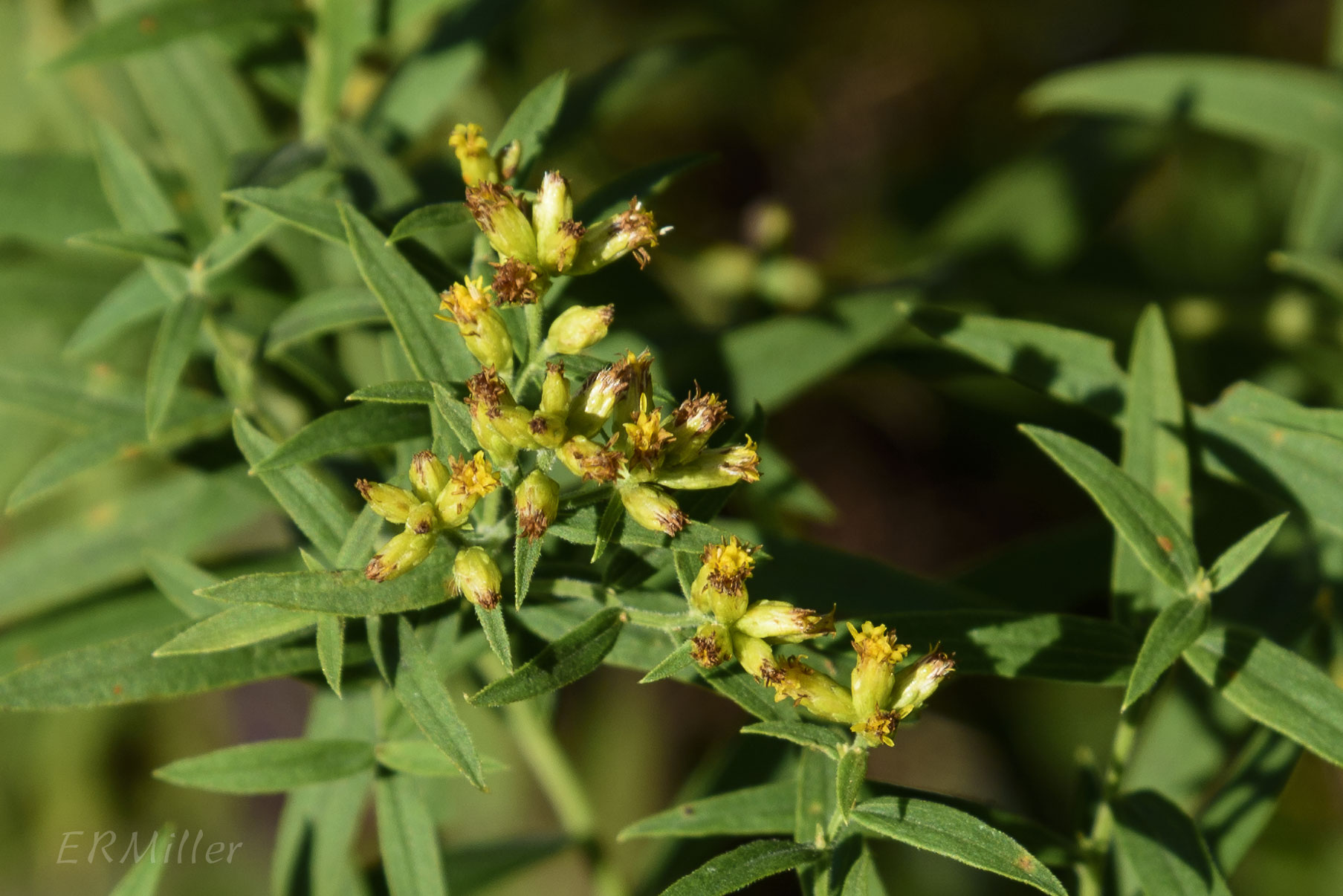
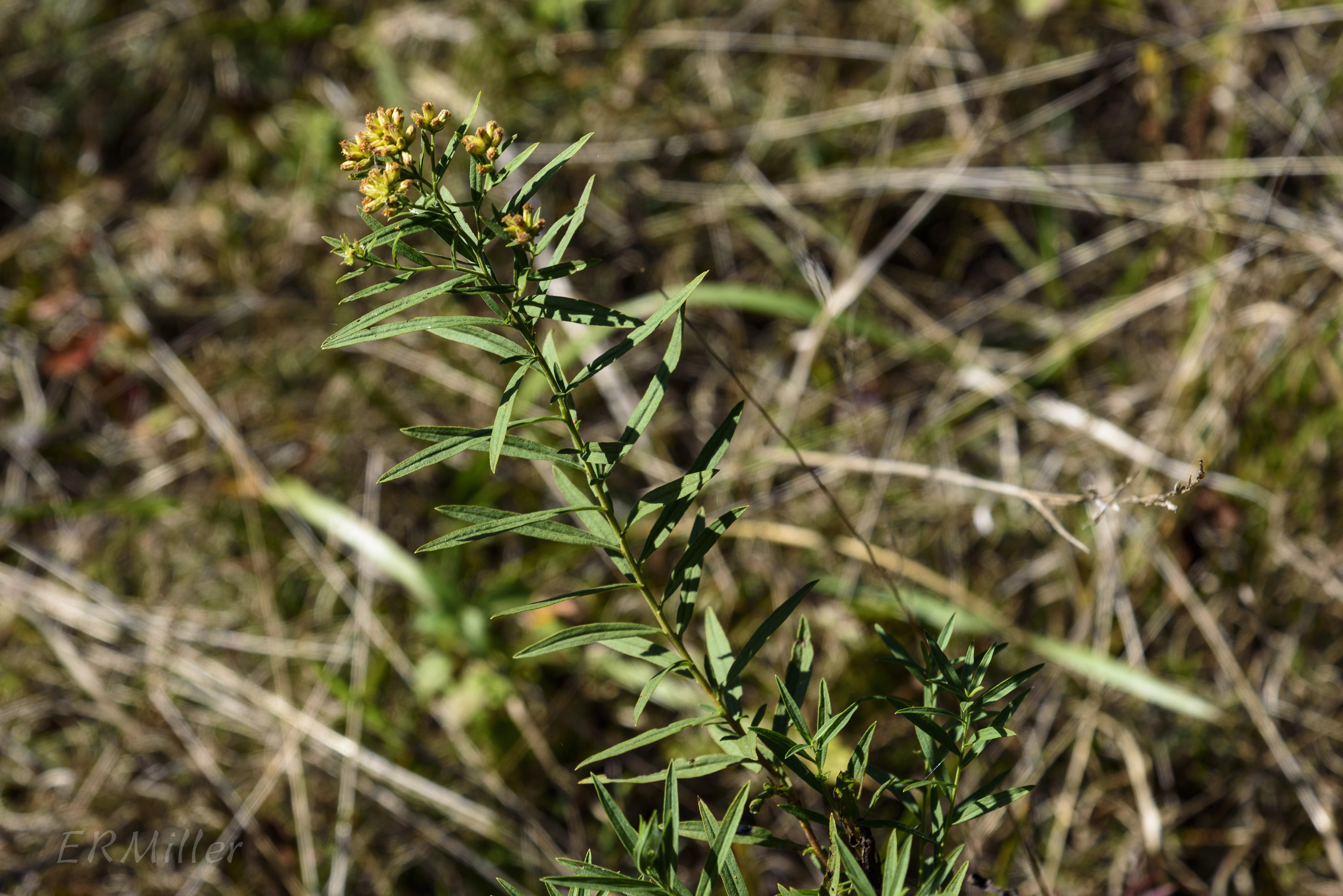
upper stpem, leaves, and inflorescence

upper stem, leaves, and inflorescence

The day after writing the previous post, I returned to Serpentine Barrens Conservation Park armed with a 10X lens, a small knife, a ruler, a notebook, and most important, a printout of page 1126 of the Flora of the Southern and Mid-Atlantic States by Alan S. Weakley, determined to key out my unknown goldenrod species.

Success! I keyed it out in the field, but collected a sample to photograph at home with the macro lens.

If you’re interested in how botanical keys work, keep reading. If you just want to know which species it is, skip to the end.

The first couplet in Weakley’s key reads:

1  Leaves with numerous slightly raised, pale, translucent, blister-like pustules; leaves transmit light when held up; plant glabrous………E. leptocephala
1  Leaves without pale pustules, or if present then leaves opaque and do not transmit light; plants glabrate to pubescent.

Glabrous is smooth, glabrate means “almost smooth”, and a pubescent area is covered in short hairs.

closeup of stem and leaf base showing hairs

closeup of stem and leaf base showing hairs


Have a look at this photo. Clearly the plant is hairy, so I chose the second line, which leads to this couplet:


2  Major veins on leaf underside 3-5 (if 3 then all 3 veins bold), leaves 5-12 mm wide; heads with 20-50 flowers.
2  Major veins on leaf underside 1-3 (-5) (if 3 or 5 then only the midvein bold), leaves <6 mm wide (-8 mm wide in E. gymnospermoides); heads with 10-20 flowers.

leaf base, underside

underside of leaf at base

In the field I measured the largest leaves that were still intact on the plant. (All the lower, presumably largest, leaves had turned brown and curled up and many had fallen off.) Most of them were in the 7-8 mm range. Every leaf I examined had five veins, though some were pretty hard to see. Given these facts, I chose the first line of couplet 2 (more about the flower heads later), which leads to

3  Leaves 3-6 (-8) mm wide, punctae on leaf upperside bold, flower heads 10-20 flowered………..E. gymnospermoides
3  Leaves 5-12 mm wide, punctae on leaf upperside obscure or not bold, flower heads 20-50 flowered.

Again based on leaf width, and the fact that the punctae (dots) were not bold, I chose the second line, which leads to

4  Leaf undersides, upper stems, and branches glabrate, often with villous hairs on midrib of leaf underside …………………E. graminifolia var. graminifolia 
4 Leaf undersides, upper stems, and branches copiously to moderately short villous
…. E. graminifolia var. nuttallii

Look at the first picture again; I’d call that copiously villous. (“Villous” means covered in soft hairs.)

flower heads (7/32" long)

flower heads (7/32″ long)

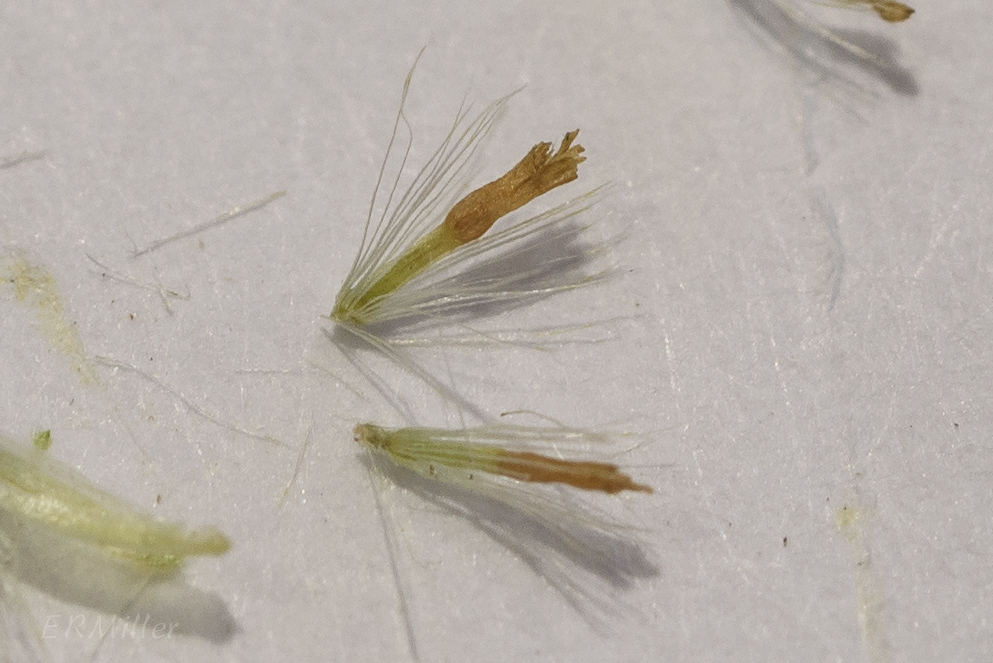
About the flowers… Remember that plants in the Asteraceae have composite flowers. That little thing next to the ruler in this picture, measuring only about five and a half millimeters long, is a flower head – a collection of flowers. At least, it was, as these had all turned to seed. I was able to cut some open and tease out the seeds. I didn’t count more than 20 in any single head, which suggests about 20 flowers (each flower produces one seed). But, they were minute, and I was working with a small knife and a 10X hand lens, so it’s quite likely my count was inaccurate. Since I couldn’t get a true count of flowers per head, I ignored that part of the key.

seeds

seeds

So there it is. My mystery grass-leaved goldenrod/goldentop is Euthamia graminifolia var. nuttallii.

The More I Learn, the Less I Know

Readers of this blog will have noticed that I am fascinated by names. It isn’t enough for me to spot a plant and say “that’s a goldenrod”; I need to know which goldenrod, the actual species name, what other common names there might be for it and what the Latin words translate to and how it relates to other species… and pretty much anything else related to its taxonomy.

20161017-_dsc0007-2

No plant has led me into taxonomic Wonderland like this one —>.
I first saw it at Serpentine Barrens Conservation Park, in late August in bud, then in October in flower (kind of).

Right away I recognized it for a goldenrod, yet it looked a little different from other goldenrods. The flower heads weren’t in plumes or in the leaf axils like other goldenrods I know. So I took a few pictures, went home, and opened the books. It was easily categorized into “flat-topped goldenrods”, sometimes known as goldentops, for which Newcomb lists two Solidago species and Peterson lists four; Clemants and Gracie list two Euthamia species and two Oligoneuron species.

Hmm. Time to open more books.

Melanie Choukas-Bradley, in An Illustrated Guide to Eastern Woodland Wildflowers and Trees (2004), describes a lance-leaved goldenrod, Solidago graminifolia, noting that it’s also called Euthamia graminifolia, and also noting that “some botanists…consign the flat-topped goldenrods to a separate genus (Euthamia).”

Fleming, Lobstein, and Tufty, in Finding Wildflowers in the Washington-Baltimore Area (1995), report seeing “lance-leaved goldenrod (Solidago graminifolia)” in the area where I found this plant (they call the area the Potomac Power Line).

At this point I had tentatively decided that what I found and photographed would currently be called Euthamia graminifolia. I decided to run it by a few experts for confirmation. That’s when I learned that Euthamia is a “problem genus”.

Now I was really interested in learning what was going on, so I consulted a bunch of internet sources, and that’s when things got a little crazy.

In short, the USDA PLANTS Database lists six Euthamia species, not all of which are found in the Maryland Piedmont. BONAP lists five, only one of which is in the Piedmont. MBP lists four, only one of which is in the Piedmont. ITIS recognizes four species, and lists thirty-six Latin synonyms for E. graminifolia. Thirty-six!

Now totally confused, I consulted even more authorities, and found the following:

from EOL

 Euthamia is a genus of flowering plants in the aster family, Asteraceae.[2][3] They are known commonly as goldentops[4] and grass-leaved goldenrods.[5][6]

The species were formerly classed in genus Solidago, the goldenrods. They were separated on the basis of morphological differences, such as the arrangement of the flower heads in the inflorescence and the glands on the leaves, and of DNA data.[7] Authors have recognized 5 to 10 species.[5]

from the Astereae Lab:

Euthamia… is a small genus of erect, herbaceous perennials native to North America. Sierren (1981) revised the genus and recognized nine eastern species and one western species. Haines (2006 Flora North America) recognized only five species. Euthamia was incorrectly included in Solidago by many authors for a more than a century. Cronquist (1981) accepted the distinct generic status for this group of species on the basis of morphology and leaf anatomy (Anderson and Creech 1975).

Lane et al. (1996) showed that the on the bases of cpDNA, Euthamia was phylogenetically not close to the true goldenrods with a number of other genera more closely related…

Unfortunately, the practice of placing the grass-leaved goldenrods in Solidago continues and leads to errors in interpreting the results of ecological studies.


And finally, Flora of the Southern and Mid-Atlantic States (Alan S. Weakley, 2015) lists six species, with the note that Euthamia is

A genus of about 8-10 species, herbs, of North America. There are a number of serious problems remaining in our knowledge of Euthamia.

Apparently so.

Weakley’s key is excellent, and if I can get back to the park before the plant is done blooming, I might be able to key it out. Stay tuned…

20161017-_dsc0010


on-line sources

USDA PLANTS Database
BONAP (The Biota of North America Program)
MBP (Maryland Biodiversity Project)
ITIS (Integrated Taxonomic Information System)
EOL (Encyclopedia of Life)
Astereae Lab (University of Waterloo)
Weakley Flora (The University of North Carolina Herbarium)

October Report

I can hardly believe it’s been more than a month since my last post. Sadly, I’ve only been out hiking three times since then. In mid-October, there isn’t a whole lot of variety to see.

Serpentine Barrens Conservation Park, October 17:

  • asters, blue and white, unknown species
  • silver rod (Solidago bicolor)
  • tickseed sunflower (Bidens polylepis)
  • hyssop-leaved thoroughwort (Eupatorium hyssopifolium)
  • goldenrod (unknown species)

Carderock, October 17:

  • white snakeroot (Ageratina altissima)
  • flax-leaved aster (Ionactis linariifolia)
  • calico aster (Symphyotrichum lateriflorum)
  • blue stem goldenrod (Solidago caesia)
  • zigzag goldenrod (Solidago flexicaulis)
  • silver rod (Solidago bicolor)

Cabin John Trail, October 14:

  • beech drops (Epifagus virginiana)
  • seedpods on downy rattlesnake plantain (Goodyera pubescens)
  • common blue wood aster (Symphyotrichum cordifolium)
  • white wood aster (Eurybia divaricata)
  • other white aster (unknown species)

20161014-_dsc0025

common blue wood aster
Symphyotrichum cordifolium

Common blue wood aster, aka heart-leaved aster, is found all over the eastern US and Canada, with some occurences in the midwest, mostly between the Missouri and Mississippi Rivers, and also in British Columbia. The taxonomy of several species closely related to this one is in flux*, so beware if you’re using an older guidebook to try to identify asters that you find. You might not be able to say for certain which species is is, only which genus. For that matter, the older guidebooks will still give the genus as Aster rather than Symphyotrichum.

20161014-_dsc0012


20161014-_dsc0032

white wood aster
Eurybia divaricata

White wood aster has similar leaves to common blue aster, but obviously different flowers. This species is not as widespread, occurring mostly in the greater Appalachian region, from New Hampshire to Alabama (and possibly in Quebec and Ontario).

BONAP and the Maryland Biodiversity Project agree that common blue wood aster can be found in Montgomery and Frederick Counties in Maryland, but disagree where else in the state it grows. Both sources show white wood aster growing in more counties in Maryland. Each of these species grows one to three feet tall, common blue in moist to dry woodlands, white wood in drier areas.  The patch of common blue pictured below is along the Cabin John Trail, near the southern end. It really just lights up the whole area.

20161014-_dsc0007

*see my post last year on the subject: Are Asters Really Asters?