Bad News, Good News

The first week of March there were news reports about a “superbloom” of wildflowers in Death Valley. Since I had an airline credit to use, it was an easy decision to fly out and spend a few days there, just me and the camera.

I arrived late on Monday, March 7 to find the show not as spectacular as the news articles suggested. On March 9, an update was posted at the Furnace Creek Visitor Center. The bad news: hot weather and a windstorm had damaged the flowers before my arrival. The good news: there were still plenty of flowers to see. And since I had never visited that part of the country, it was all new to me.

I believe I found about 30 different species of plants flowering, but I’m only just starting to go through the photos to identify them.  It’s a good way to pass time while sitting in an airport lounge awaiting the flight home.

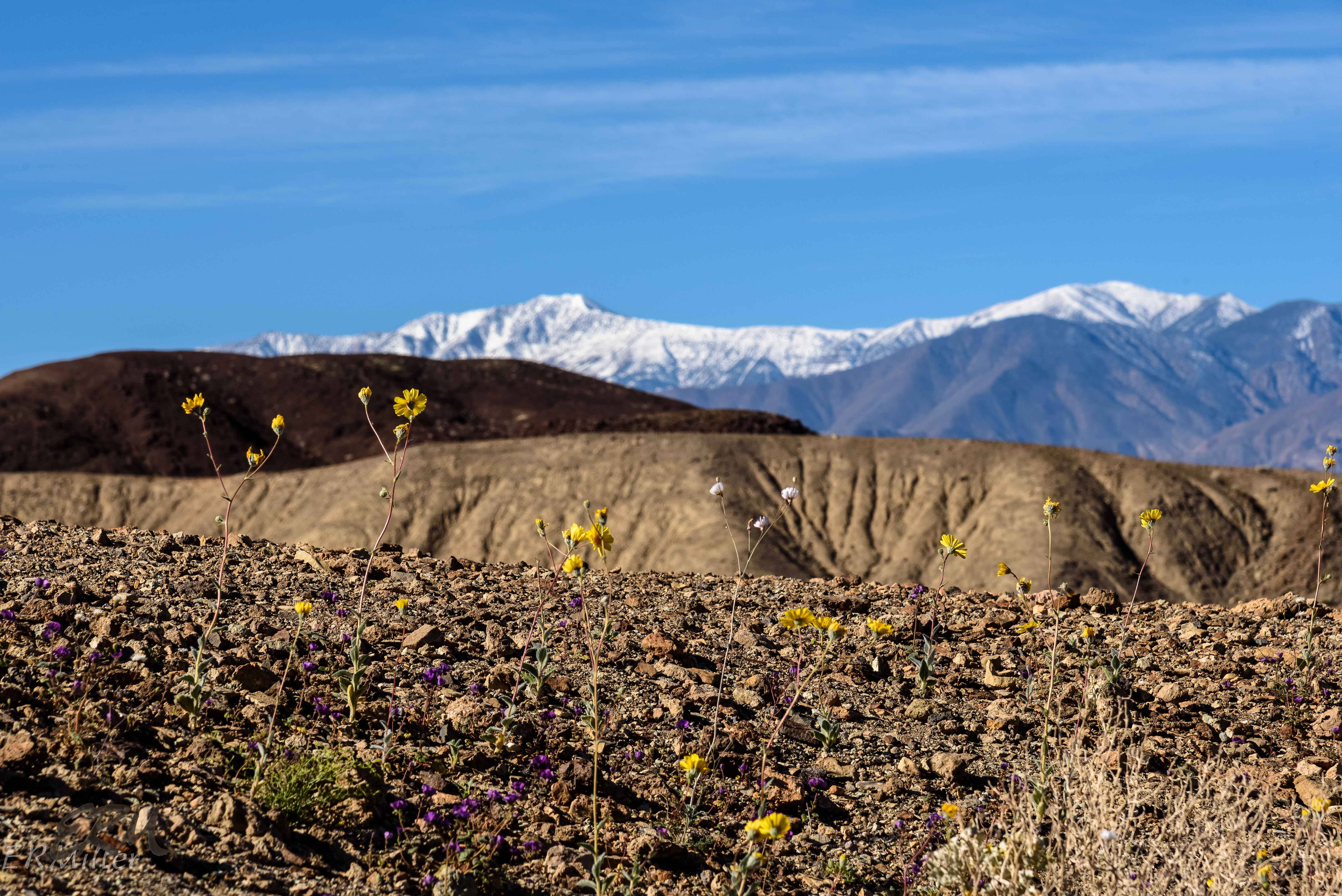
Here’s a teaser: flowers in the badlands area of the Black Mountains near Artist’s Palette.  This view is looking southwest toward the Panamint range, with snow-covered Telescope Peak in the distance.  The yellow blossoms are desert sunflowers, aka desert gold (Geraea canescens, Asteraceae).  Also visible are the white-flowering gravel ghost (Atrichoseris platyphylla, Asteraceae) and purple caltha-leaved phacelia (Phacelia calthifolia, Hydrophyllaceae).

Mystery Aster

20151020-_DSC0014

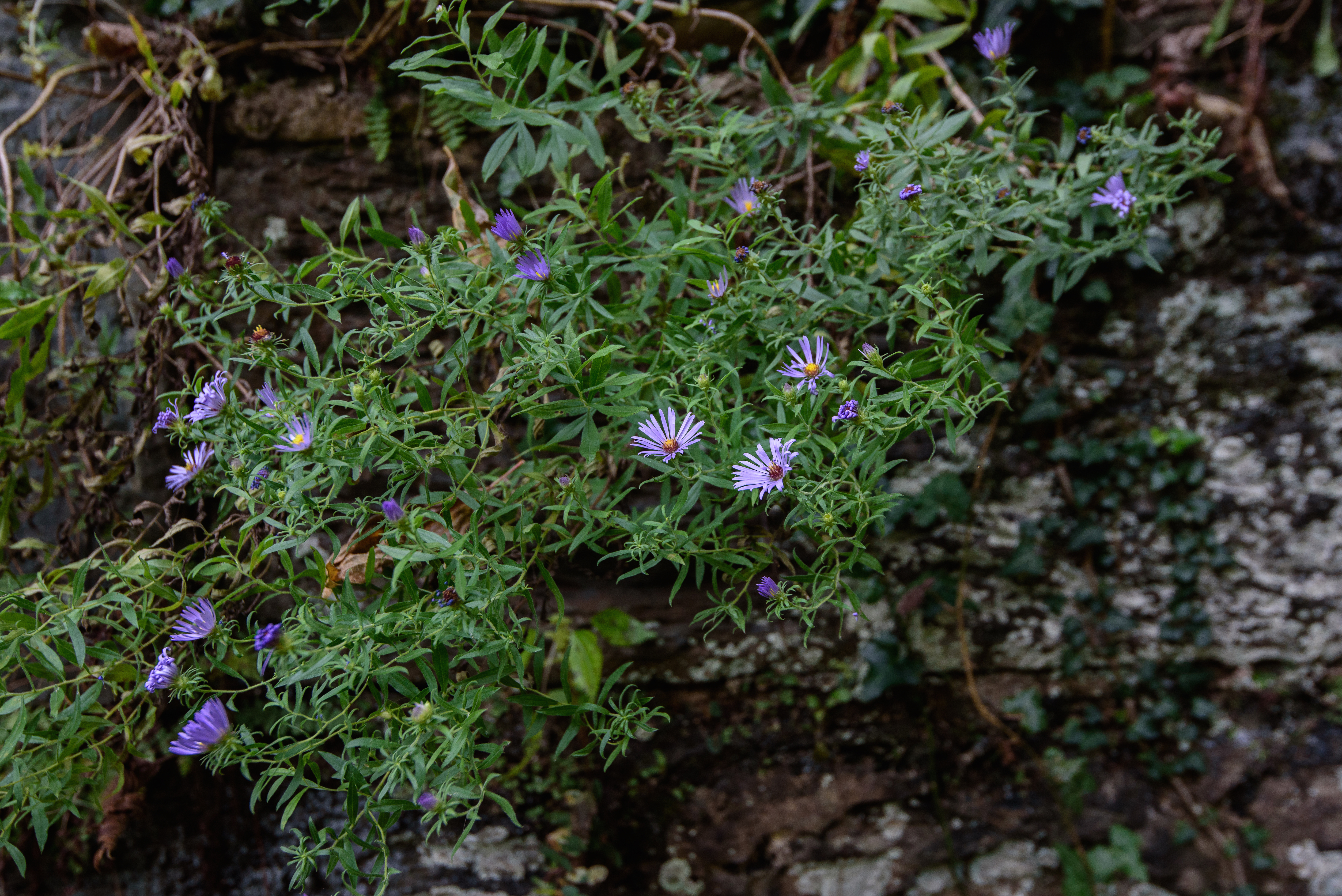
As I wrote earlier this month, identifying asters can be somewhat tricky. I still haven’t tried getting on the internet and finding a dichotomous key while in the field. But one day last week, while testing a rented wide angle lens, I stumbled on these late-bloomers near Harper’s Ferry, WV. I tried to key them out using my pictures, but couldn’t quite manage – there was always one detail that was not quite right.

So I cheated and asked on an internet forum. The experts there weren’t sure, either, but the best fit to the available information seems to be that this is aromatic aster, Symphyotrichum oblongifolium. Other people keyed it out and got S. pratense (barrens silky aster), which doesn’t grow in that area, and S. novae-angliae (New England aster), which is still a possibility.

Aromatic aster grows in Frederick, Montgomery, and Prince George’s county in Maryland (per the Maryland Biodiversity Project). Otherwise in the mid-Atlantic it looks to be western, occurring in the Blue Ridge, Ridge and Valley, and Appalachian Plateau physiographic regions more than the Piedmont. It ranges west to the Rocky Mountain states, north to New York, and south to Alabama. It’s listed as rare in Indiana and is threatened in Ohio.

20151020-_DSC0011

The asters are the latest blooming plants in this area, except for witch hazel, so it might be time to put this blog to bed for the winter soon.

By the way, the lens I rented was a Nikon 16-35mm f/4, not exactly a great choice for the close-up work that I like to do with plants, but just look at the clarity in the top photo! And at ISO 640! And that’s zoomed way in with Lightroom. Now I really want to buy this lens.


Silverrod

20151010-_DSC0026

aka white goldenrod
Solidago bicolor
Asteraceae

This is one of only two species of Solidago that isn’t golden, though if you look closely you’ll see that the disk flowers are often pale yellow while the rays are white.

Confusingly, the other white flowering species is called upland white aster, but despite the common name is actually a goldenrod, Solidago ptarmicoides.

Silverrod is a plant of the eastern US and Canada that ranges as far west as Missouri, Quebec in the north, and south to the Gulf Coast (but not Florida).  It’s a low-grower, seldom exceeding two feet, and prefers drier soils in open woodlands.

I never have managed to get a really good picture of it, for some reason.

20151010-_DSC0041

Linear Leaf

20151010-_DSC0037

stiff aster, aka flax-leaf aster
Ionactis linariifolia
formerly Aster linariifolius
Asteraceae


After all the mucking about trying to identify various Symphyotrichums [see previous post], it was a relief to find this small stand of plants.  The very long, narrow, one-veined leaves on often-unbranched plants and the terminal inflorescence made for easy identification.

20151010-_DSC0036

This eastern species ranges from Texas northeasterward to Minnesota, and further north and east into Quebec and New Brunswick.  It’s threatened in Iowa.

Four other species of Ionactis occur in North America, but they’re all found west of the Rocky Mountains.

20151010-_DSC0035

Are Asters Really Asters?

20151014-_DSC0102

The plants we commonly think of as asters are all over the Potomac Gorge and the mid-Atlantic Piedmont at this time of year. But, botanically speaking, they aren’t actually asters. Or perhaps it would be more correct to say that they aren’t actually Asters.
20151014-_DSC0088 20151014-_DSC0089

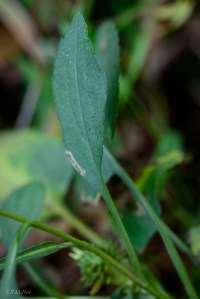
the two photos above show adjacent leaves on the same plant

At one time the genus Aster comprised about six hundred different species in Asia, Europe, and North America, but molecular phylogeny research led to a major reclassification. As a result, only one species native to North America is left in the genus Aster. Other than that one (A. alpinus), Aster is reserved for Eurasian species. The North American aster species were placed into ten new genera.

Species in five of those genera, Doellingeria, Eurybia, Ionactis, Sericocarpus, and Symphyotrichum, are found in my geographic area of interest.

20151014-_DSC0076

Newer guidebooks, like Clemants and Gracie’s Wildflowers in the Field and Forest, reflect these changes.

In many cases, the name change is straightforward: Aster ericoides is now known as Symphyotrichum ericoides, for example.  But in some cases – like with the flowers pictured in this post – it’s anything but straightforward.

20151014-_DSC0092

I was studying these pictures and using the venerable Newcomb’s and Peterson’s guides to try to figure out whether they’re Aster sagittifolius, Aster lowrieanus, or Aster cordifolius (and expecting that they would likely be the Symphyotrichum equivalent). Not making much progress, I turned to the internet, and found the following:

According to USDA Plants, Aster cordifolius is now Symphyotrichum cordifolium, a name accepted by ITIS.

According to USDA Plants, Aster lowrieanus is Symphyotrichum lowrieanum, a name not accepted by ITIS, which considers S. lowrieanum to be a synonym for S. cordifolium.

And Aster sagittifolius seems not to have made the cut. Searching for it in USDA Plants leads to S. cordifolium. Searching for it in ITIS leads to both S. cordifolium and S. urophyllum.

Confused yet? So am I. And without a sample at hand I can’t really narrow them down. In order to correctly identify them, I’m going to have to either collect samples (which I won’t do, for both ethical and legal reasons), or try to use my iPhone to access a good dichotomous key on the internet while in the field. It doesn’t help that by the time I found these plants, they had lost their lowest stem leaves.  By now they might be pretty ragged.

In the meantime, I’ve decided that both common blue wood aster (Symphyotrichum cordifolium) and arrow-leaf aster (Symphyotrichum urophyllum) are pictured here. As always, I welcome correction. Including corrections of typos.  I’ve proofread this so many times I can no longer see straight.
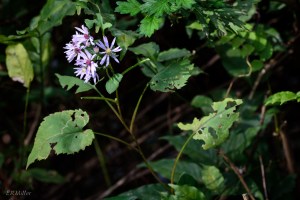
20151014-_DSC0117

Postscript: Just for fun, here’s an excerpt from the Astereae Lab overview of asters:
“…However, during the last decade analyses of morphology, chloroplast DNA restriction fragment length polymorphisms and ITS sequence data, and on going karyotype studies have all demonstrated that asters are polyphyletic and members of a number of very distinct phylads within the tribe…”
————
I researched the hell out of this subject, and used the following sources extensively:
USDA Plants database
ITIS
Maryland Biodiversity Project
University of Waterloo Astereae Lab
Wikipedia
Illinois Wildflowers